
2025
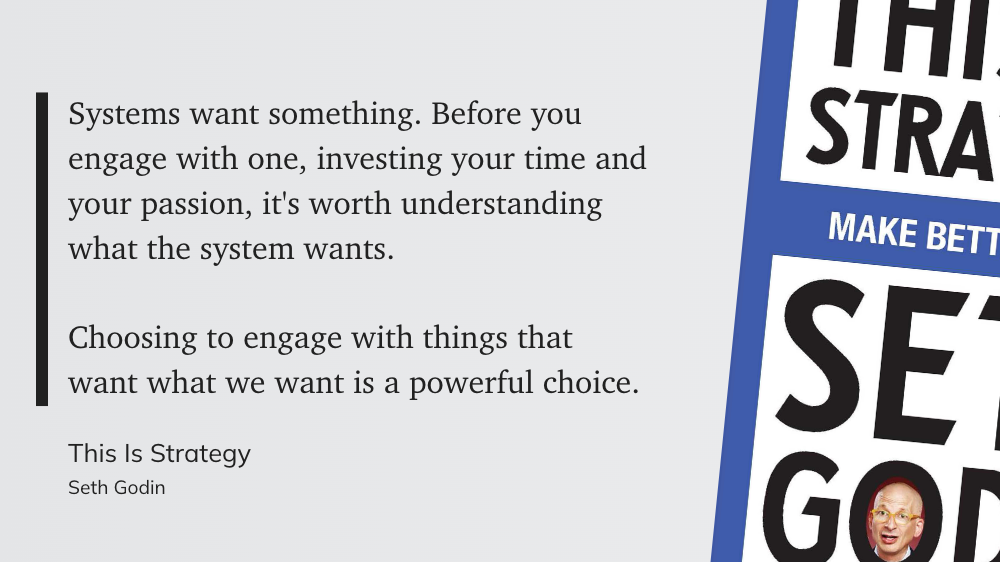
On Seth Godin's Reminder About Systems
Seth Godin is one of the world’s great bloggers because he publishes a thoughtful take every single day, and has done so for nearly 17 years. His posts are usually short, which I appreciate since I already have more than a handful of daily blogs and newsletters to get through. Godin is also a prolific author, educator, and well-known marketing thinker. Not everything he writes applies to my life, but often his ideas are both interesting and relevant. As a new blogger, I find him inspiring.
Earlier this year I finished his latest book, This is Strategy. I wouldn’t necessarily recommend it unless you work in marketing, but as usual, I found a few quotes worth saving and reflecting on. The one below resonates with me as a new blogger with no social media presence.
On one level, I think about the systems that exist for bloggers—Medium, Substack, LinkedIn. The main reason I have decided to blog is simply to practice writing and thinking in public on a regular basis (something Godin highly recommends). I’m not trying to become famous or turn it into a major source of income. Still, I want my ideas to reach others and to invite feedback and conversation. To grow an audience, though, I have to consider engaging with the systems that make that more likely.
Godin’s point helps me reframe the decision. Instead of focusing only on what these platforms can do for me, I need to ask what they will demand of me. For instance, posting through them means exposing myself to their algorithms, and I know from experience that’s a mixed bargain. Leaving Instagram, Facebook, and later Substack has been a real boost to my mental health, so I’m cautious about opening those doors again.
Even if I eventually choose to cross-post, Godin’s reminder will help me pause, reflect, and step in with eyes wide open. It also makes me wonder: what other systems in our lives deserve a closer look at how they shape our habits and our thinking?
Introducing Exist: The Newest Tool in My Quantified Self Routine
I use several tools to keep track of things. Like many people with smartwatches and phones, I rely on Apple’s built-in apps for steps and exercise. I also wear an Oura ring, which gives me reliable sleep stats and now helps me log meals. Lately I’ve been keeping a text-based food log in Google Docs, uploading it each morning for ChatGPT to review and suggest improvements (which I mostly ignore). I also record daily meditation time and fasting windows.
All of this data ends up in a spreadsheet. Each month I average the numbers and copy them into another sheet so I can see longer-term trends. I’ve been doing this since January 2019, and it’s fascinating to look back for patterns. Truthfully, I also just enjoy collecting and organizing numbers.
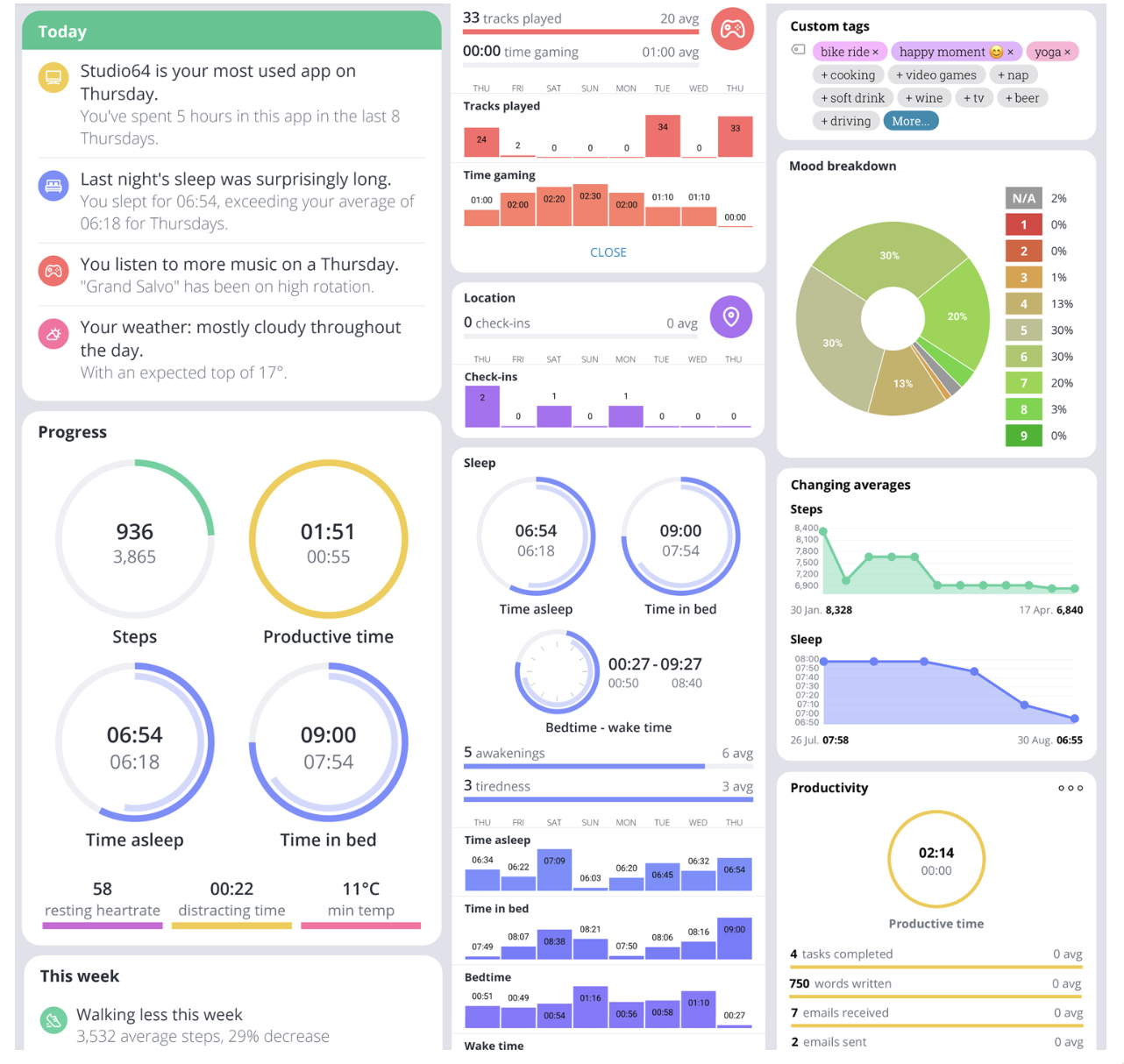
The reason for this post is a newer app I’ve added to the mix: Exist. It recently had a thoughtful refresh and has become a solid addition to my tracking system. With Exist, I can score my days from 1 to 9, add tags, and review insights it generates from my inputs. I’ve found it useful for giving each day an overall grade and spotting the factors that shape whether it feels good or bad.
I know this kind of practice might seem unnecessary to most people, and that’s cool and very understandable. Even my wife pokes fun at me from time to time when she catches me tapping away in my spreadsheets. But I don’t spend time in bars or watch much TV (apart from a good college football game), so I have space for this in my life. If you already have the tracking habit and enjoy reflecting on your data, Exist is worth a try. Screenshot of my dashboard below.
Rush is My Jam Show #3
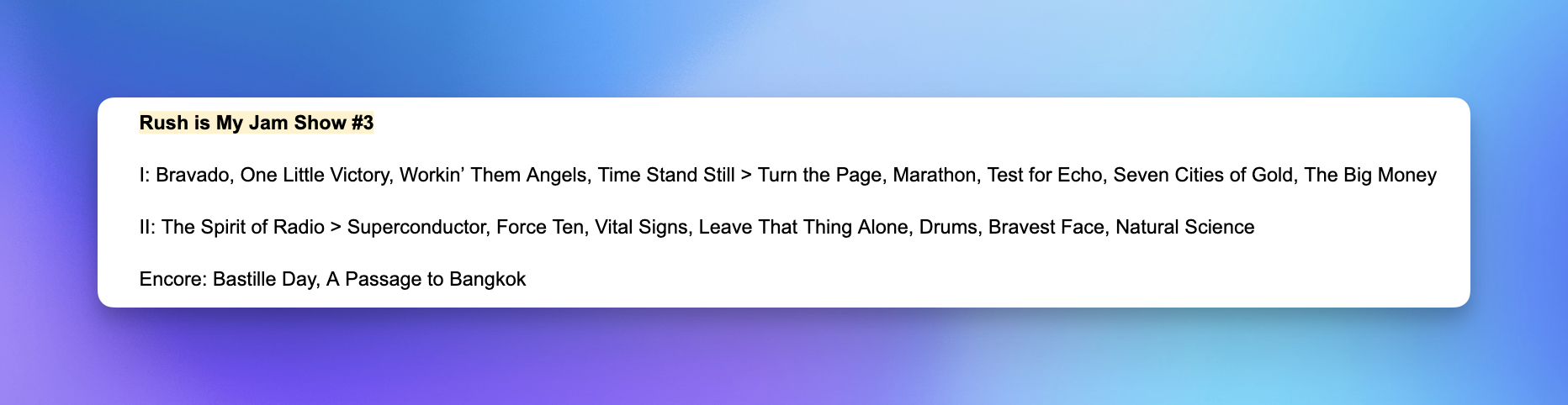
Show #3 of the infinite fantasy Rush tour that never happened. Lots of relative deep cuts tonight, no repeats from the first two nights (of course), and a show hard core Rush fans would dig. Both of these set closers would blow the roof off. Here’s Vital Signs from Cleveland, a huge Rush town. Elevate from the norm.
Six Dharma Tunes
It is not a revelation to say that we filter the lyrics of our favorite songs through the lens of our own experience and worldview. Indeed, we are biased to bend the meaning of poems, stories, and songs to fit our preconceived views of the world. That means that for me, the Dharma filter has been on for close to 30 years now. Of course, I have no idea most of the time what a songwriter meant by a particular turn of a phrase, let alone the author’s beliefs and worldview. Perhaps the line that holds so much significance was just a word or phrase that “fit” that nook of the tune. Who knows? However, I enjoy looking for Buddhist wisdom in songs as I find it is an enjoyable part of my practice, looking for wisdom in the world, and my mind. Here are several tunes that, at least to me, can be interpreted as Dharma in song.
Pearl Jam is hit or miss for me, but this song I love. I suppose the traditional viewpoint on this tune is that Eddie Vedder is singing about a junkie trying to get his fix. The way I hear it, Vedder’s friend is the Dharma. For instance, the lyrics' opening salvo is “Do you want to hear something sad? We are but victims of desire.” Later, “it won’t be long before we all walk off the wire.” Indeed, the song itself is a short burst of energy and is over before you know it. Just like life.
There is likely no song that is as blunt as this by Zevon about sickness and death.The title says it all and the lyrics drive the salient point home repeatedly: We are all going to die…and it may not be pretty (or timely, or convenient). It is a coarse reminder that our time is limited and that no matter your station in life, death is coming for you.
Snow Patrol is not a band I know well or listen to all that much. However, I love this 2018 track and it captures the raw immediacy of being alive. For me, the refrain, “This is life on earth, it’s just life on earth,” lands like a mantra of acceptance. The song doesn’t deny the difficulty—“it shouldn’t need to be so fucking hard”—but it also resists turning life’s struggles into final defeat. That balance between acknowledging suffering and refusing to be defined by it is central to the Dharma (which is why Buddhism is sometimes called The Middle Way). For me, the song becomes a reminder that life, in all its beauty and brokenness, is exactly what we have to work with on the path.
Christianity has redemption, and Buddhism has impermanence. This song can be interpreted either way. I was introduced to this tune by Widespread Panic (I caught their first performance of it at the Warfield in SF in 1995) and see it as a hopeful reminder about how everything changes. An acorn becomes an oak tree, and a dusty clump of coal can become an exquisite diamond. In the midst of our struggles, this is a reminder that comes in handy.
Jethro Tull was the segue from my heavy metal fandom to becoming a Deadhead. Ian Anderson’s lyrics here read like a meditation on impermanence. We are all “skating away on the thin ice of the new day,” moving forward on uncertain terrain, never sure when the ice might crack beneath us. The song also points to compassion and release. Anderson sings “make your peace with everyone;” as if to say, don’t waste the fragile, ephemeral moment with petty grudges. And in lines about “spinning in your emptiness” and the world-as-stage, the lyrics edge into Buddhist territory: life as performance, self as illusion, all of it temporary. To me, it’s Tull’s most Dharma-soaked tune, whether Ian Anderson meant it that way or not.
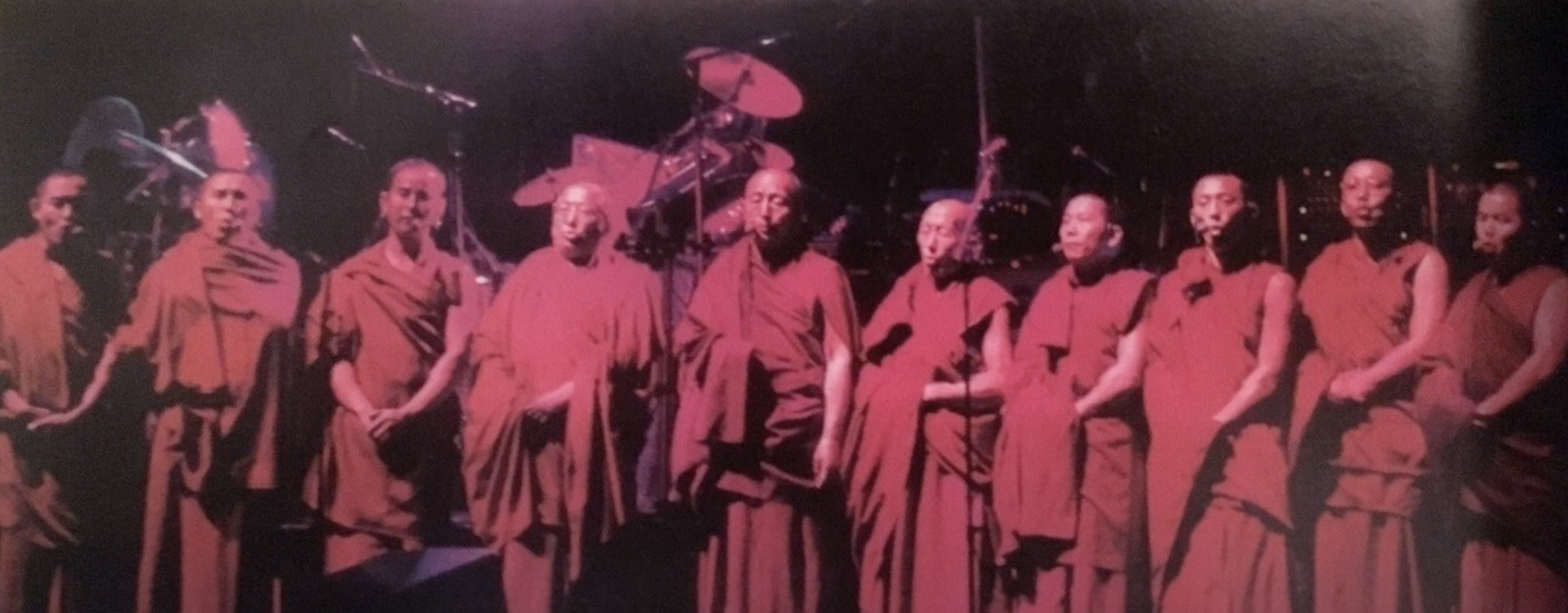
If there’s a song that feels like it could slip into the Pali Canon without anyone blinking, it’s this one. On the surface, it’s a gentle Jerry ballad, but beneath the melody runs a deep current of Dharma. The lines “There is a road, no simple highway / between the dawn and the dark of night” echo the Buddha’s teaching that the path is real, but not easy. And when Garcia sings, “If I knew the way, I would take you home,” it lands right at the heart of Buddhist practice: no one can walk the path for you. You’ve got to do the heavy lifting, not some savior figure. The teacher can point, the song can hint, but the steps must be your own. NOTE: The photo below is of the (Tibetan) Gyuto Monks performing with the Grateful Dead on June 2, 1995 at Shoreline, which happened to be my second to last Grateful Dead show.
Some Great Grateful Dead Covers
I have my younger brother to thank for being a Deadhead. He discovered the band when a lot of folks did, during the mid-to-late 1980s after Touch of Grey became a commercial hit. I attended my first show with him at the Oakland Coliseum Arena (now Oracle Arena) on February 20, 1991. I remember the “Dose Saddam” stickers and the fact that the audience stood for the entire show. I had been to fantastic shows in that arena (like Rush on the Presto Tour), but most of the folks in the seats sat at those concerts. They don’t do that, I learned, at Grateful Dead shows.
Since then I have seen many Dead related shows and spent thousands of hours listening to their music. While I still love listening to live Dead from time to time, the music continues to evolve. One way is through the unique interpretations of the Dead’s oeuvre by other artists. Indeed, several albums have been released over the years offering collections of interesting Dead covers. Two that stand out are the original Dead cover album Deadicated and the more recent Day of the Dead, produced by The National’s Bryce and Aaron Dresser.
Below are 9 favorite Dead covers.
Sultry and confident. Sung at times the way Garcia sang it and at times in her own way. The result is a unique, beautiful rendition of one of my all-time favorite Garcia ballads.
Straight, respectful cover (Goose has been playing this song for many years), then a beautiful high energy jam.
Straight cover, but beautiful vocals and tasty guitar work. My favorite song on the amazing Day of the Dead compilation, which contains a ton of great Dead covers.
A lot of artists have covered this tune, including Bob Dylan, Mumford and Sons, Tom Petty, and Counting Crows, but this was the first one I heard that wasn’t a Dead version. I dig the short guitar solo and Lovett’s voice. A great storyteller’s voice for a good story.
This is likely the most obscure pick. This was submitted to Youtube during the 2012 Dead Covers Project. I love the video, but I love the guitar work even more. My guess is many Deadheads will fault the vocals, but the creative take on the song has led me to listen to this one many times.
- Cassidy by Damià Timoner
Timoner is a classical guitarist from Manacor, Malloca and his rendition of Cassidy is sublime. He is clearly a Head as his playing is reverential. Indeed, he’s got a whole album of sublime Dead covers actually. What a treat!
- Althea by Polish Ambassador and Dead Polish
This one is the newest of the studio releases on the list. These artists have put out a handful of Dead covers in this style, though they are hit or miss (mostly hit, imho).
This is an oldie, but a goodie. From Deadicated, this is Jane’s Addiction doing Ripple the Jane’s Addiction way. Utterly different from the original version. Love the Bird Song and Other One teases at the end.
A bluegrassy Dead tune done by a proper bluegrass outfit. So good!
- Oteil Burbridge’s covers of So Many Roads and High Time
Oteil is the bass player for Dead and Company, among other things (also formerly of the Allman Brothers Band). These are from a recent album honoring the Garcia/Hunter songwriting tandem. This whole album is such a beautiful tribute.
Honorable Mentions
- Cream Puff War by Widespread Panic
- It Must Have Been the Roses by Norah Jones (Sorry, Tim.)
- This mash up
Avoiding the Ego Default
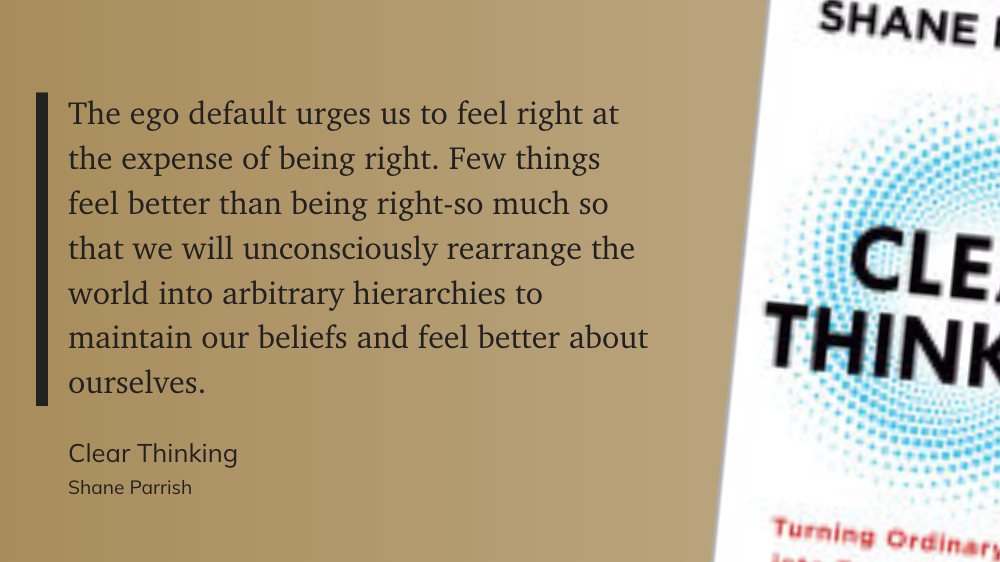
We all know the pull of wanting to be right, especially in the always online world many of us inhabit. It can be intoxicating. In a heated conversation, whether in person or online, the moment we sense our position getting battered, something inside resists; not because truth is at stake, but because our ego is. Shane Parrish–author, podcaster, and clear thinker extraordinaire–calls this the “ego default,” the drive to feel right at the expense of actually being right. I’ve felt it in staff meetings, political arguments with friends, and even small family squabbles. Hell, I even argue with myself while I am reading. Self-righteousness is deeply alluring.
The irony is that this insistence on being right usually blocks one’s growth. When I look back on moments when I dug in the hardest, I wasn’t always defending the truth; I was largely defending myself (even if I was correct on the facts). The hierarchy I built in my mind was designed not to clarify reality, but to protect my pride. Jonathan Haidt also writes about how reason takes a back seat to our feelings and views of the world in his book The Righteous Mind.
The alternative to this ever present issue is harder but richer: to pause, and to ask whether I’d rather feel right or learn something new. The question lingers for me: what parts of my life might shift if I chose truth over comfort more often? This is easier said than done and I am certainly no Jedi in this regard. However, Shane Parrish is correct. It pays to step back from our defensiveness and try to understand the other side. If done well, I think it actually strengthens one’s own position ultimately. Indeed, it not only strengthens our own position, but it also opens the door to genuine discussion instead of polarization and anger. What might shift in our communities, even our politics, if more of us chose truth over comfort?
5 Recommendations
- Hulry email newsletter. I discovered this email newsletter last year and it rarely fails to share something I find interesting. It is also relatively short and doesn’t feel like a chore to read. Good stuff.
- Timestripe software This was an experiment that has stuck. Like many, I’m always trying to utilize the task manager that best fits my quirks and needs. While I still use Notion for every day tasks (like taking vitamins and meditating), this is great for one off tasks or work tasks. I keep it a link pinned in my browser and am in and out of the app daily. The mobile app is great, too.
- 12.30.24 Austin Goose show (via Bandcamp) This was my third Goose show and still my favorite of the four I’ve now seen. I attended with my wife and we both loved it. Top shelf jams (I know, that’s very subjective) in Draconian Meter Maid, Arrow, Arcadia, and Red Bird. My wife’s favorite tune of the night was Nina Simone’s Sinnerman. The encore was a beautiful, mellow, cherry on top.
- Greenlight app We have started using this app to deliver our daughter’s allowance onto a debit card that she can use and that we have ultimate control of. It also allows us to set up and track chore completion. Very smooth so far. Bonus points for letting kids pick their own images to go on their cards. Highly recommend for the purpose it serves.
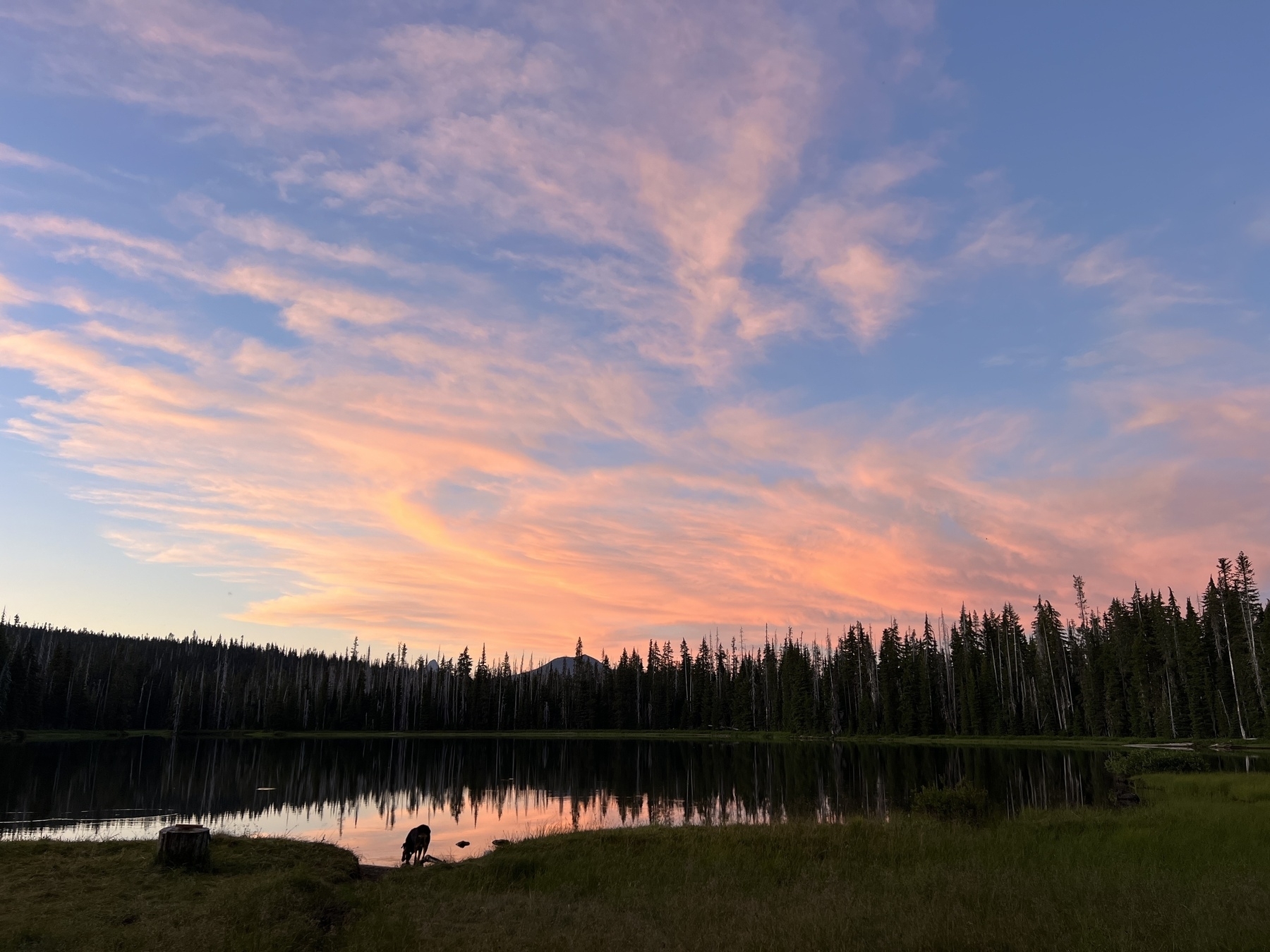
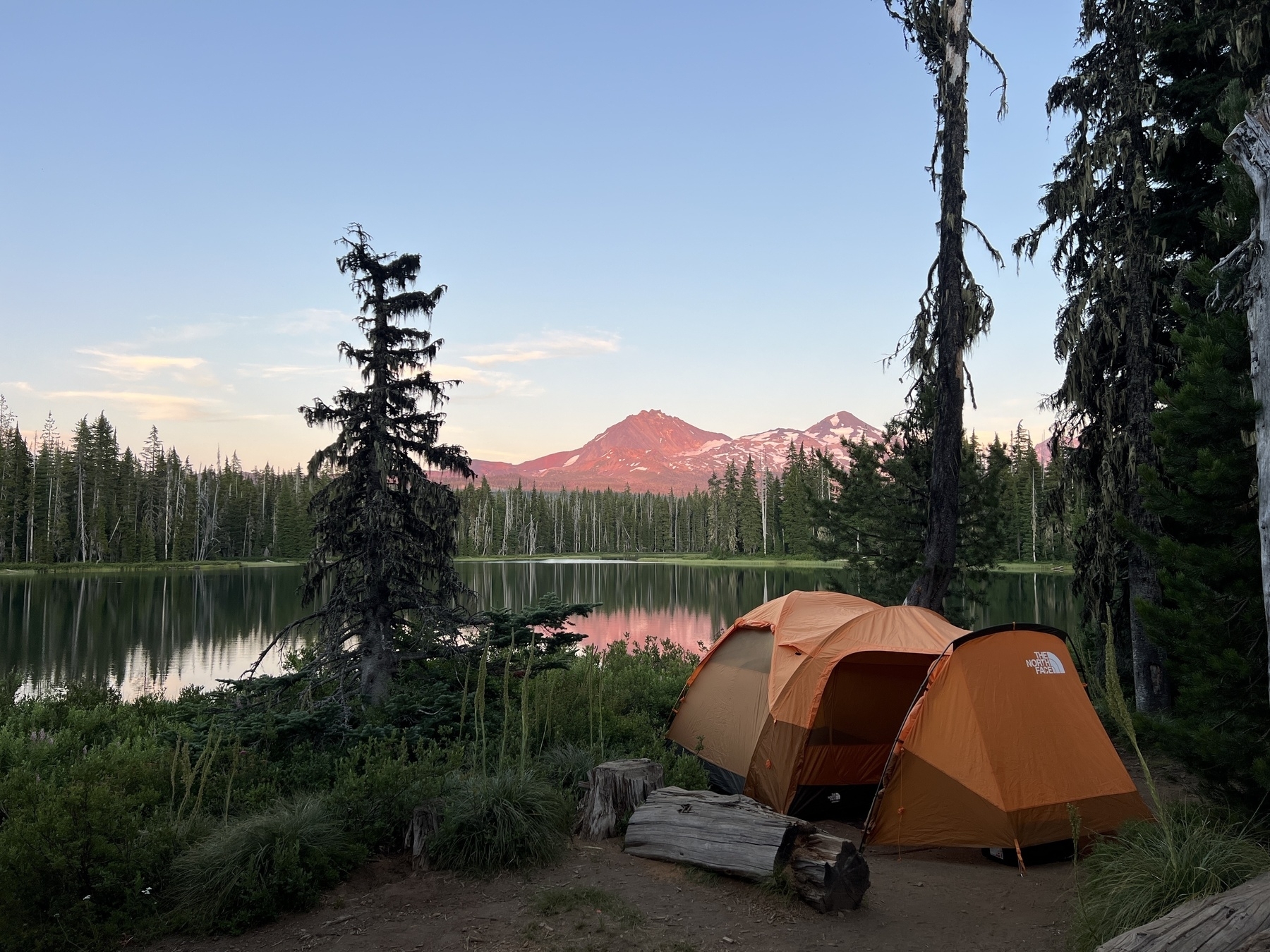
- Scott Lake camping in Central Oregon: I go backpacking every summer with old friends. This year, due to some injuries, we car camped. We wound up at a beautiful campground in Central Oregon at Scott Lake, which is north of the Three Sisters and west of the town of Sisters. The walk ins to the camp spots were long, but worth it. Our camp was very large, and right near the lake. I imagine at the wrong time of year, the mosquitoes would be bad, though we lucked out. Definitely great for larger groups. Here are a few pics.
Getting Through the Gate
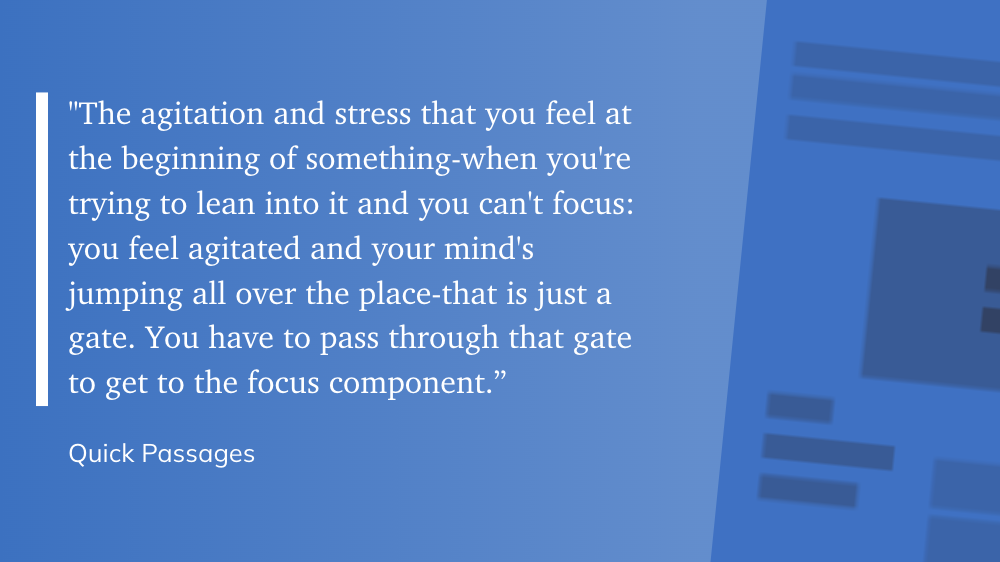
The quote below struck me because I see this dynamic with my students all the time. Getting young people to quiet down and focus on a primary source from the 18th or 19th century, after lunch let’s say, is not easy. There are strategies to help with this and good teachers utilize them. However, high school students often get lost in the initial attempt to get focused and never get ‘through the gate’ to where their minds are calmer and they are applying their background knowledge and general wisdom to the text, to build meaning. I think many people give up on activities that require sustained focus—like reading—because they don’t often make it ‘through the gate.’ A few years ago the Pew Research Center reported that 23% of American adults hadn’t read a single book in the past year. Americans with ‘a high school degree or less’ were at 39%. Slightly more recent data from the federal government indicates that 51.5% of Americans hadn’t read a book in the previous year.
This inability to continue leaning into something challenging to get through to ‘the focus component’ might also help explain the decline in American’s willingness to prepare food themselves at home. This lands close for me, as I do not enjoy cooking because I find it boring. When I am attempting to cook, I often set up the laptop and listen to YouTube videos. I’d be better served in the long run, if I really wanted to get better at cooking, by focusing on what I am trying to achieve and trying to get into the zone.
I think we all have areas in life where the resistance is hardest and we struggle to get into a focused flow. Maybe it’s reading, or writing, or exercising. Maybe the real challenge is not that we lack focus, but that we don’t give ourselves long enough to reach it. What would change in our lives if we treated that initial restlessness not as a stop sign, but as a doorway?
On the Quiet Life
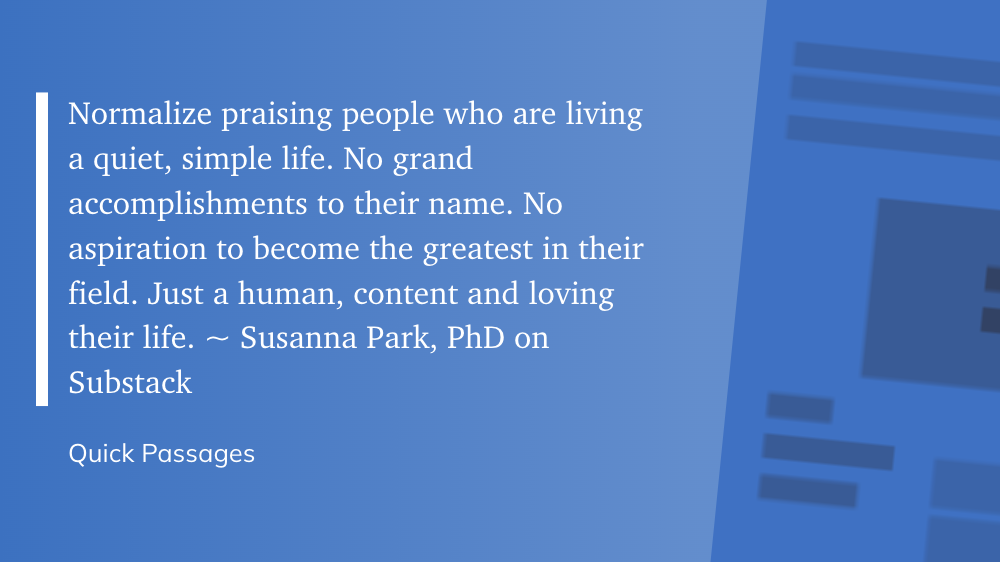
The quote below, which I read on Substack, resonated for a few reasons. For me, it gets at the idea of contentment. I am an admitted productivity nerd. I read all the books, I listen to all the podcasts. My interest, in part, comes from a drive to be better, and better…and better. All the time. However, like the futile goal of always trying to be ‘happy,’ such a goal is a mirage. Instead, I try to remind myself to put forth my best effort and be content with the results. If I do a solid job at work as a teacher, I’ve earned the right to contentment. This is true because my job is hard and the work I do contributes to the common good. Indeed, I’ve earned the right to create a boundary when I am home and to indulge in other pursuits, like reading, trying to stay fit, watching some college football, or hanging out with my family. Our media clearly focuses its attention on the stars, the incredible outliers in their various fields, which is understandable. I get it. Extraordinary achievements are laudable. However, it means most of us need to be vigilant and not get sidetracked into thinking we are not okay because we don’t measure up to the superstar outliers we are constantly seeing online and in the news. Especially if we are working hard and contributing.
Indeed, it often feels a bit radical to reject the idolization of ‘achievement.’ A quirk of my personality is that often when I have down time and I am thinking about what to do, I usually land on the same fork in the road: Sit down with a book or do some ‘work.’ Nowadays, I usually decide to read, but the nagging feeling that I am missing an opportunity to be ‘more productive’ lingers. It is my own toxic productivity hangover. When I really stop to think about it, I actually think I am more impressed with the good, helpful person who is truly content, than with the accomplished striver. Of course, the best in their fields have admirable qualities. Indeed, studying these folks is both interesting and helpful in many ways (it’s one of the reasons I love to read biographies). However, in my mind, true contentment, in a life that is still contributing to society, is more impressive, largely because it is so rare amidst the deluge of influences we all see that fuel our discontent.
I’m with Dr. Park: in a world obsessed with achievement, I want to celebrate contentment.
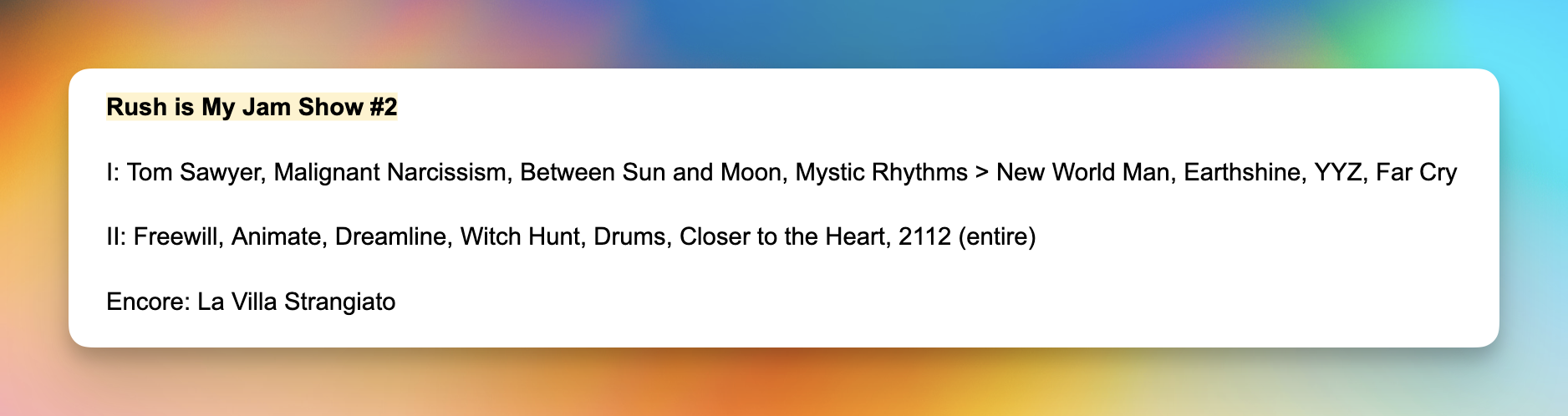
Rush is my Jam Show #2
A lot of heavy weights in show #2 that folks would have been hoping for on night #1. Also, two instrumentals in the first set. Here’s Malignant Narcissim live.
Run a Personal Experiment
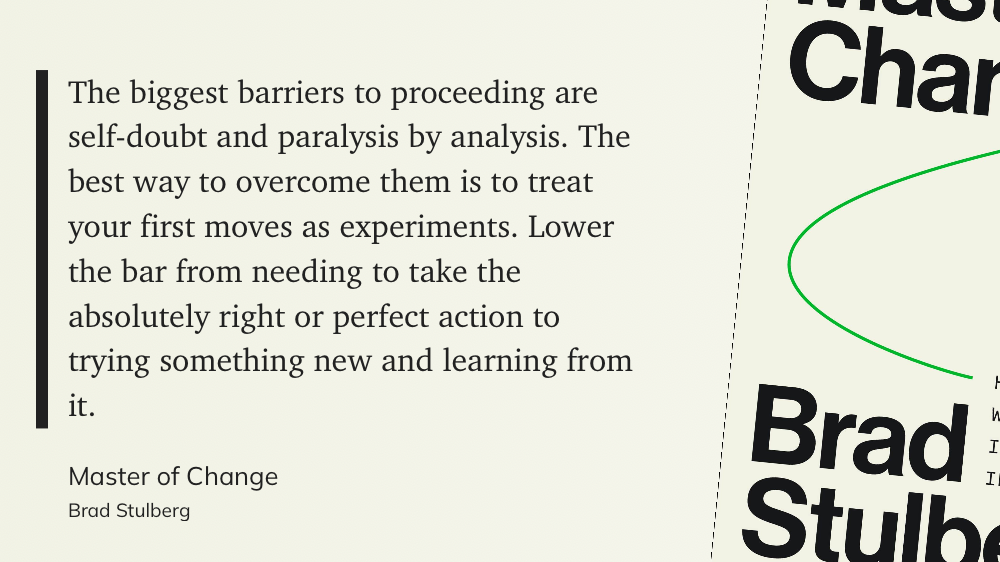
An idea that I have come across several times of late is the one shared by Brad Stulberg in his book Master of Change. Indeed, Ness Labs founder Anne-Laure Le Cunff wrote a whole book on the topic called Tiny Experiments, which I recommend.
The idea is to see yourself as a scientist of your own life. That means applying the scientific method to yourself. Instead of avoiding a change or committing fully to a change, run an experiment. That means starting, taking notes, and being okay with a hard stop in the not-too-distant future. If the change is a net positive, you can continue. If it isn’t working out; abandon it and take solace that now you know.
Examples can include subscribing (or unsubscribing) to a service or subscription, or adding a particular food to your diet. Or maybe changing up your workouts. Or changing when you have your smoothie and what goes in it. You get the idea. The possibilities for experimentation are vast.
Importantly, running these experiments can lead to impactful changes to one’s life. Another major benefit of this approach is noted by Stulberg in the quote below: It allows you to start taking action and avoiding the pitfall of paralysis, which we have all experienced too many times. Running ‘tiny experiments’ helps us take action. In my case, I find that taking action leads to a willingness to run more experiments. Thus, my willingness to experiment with my media consumption helped lead me get started on some diet experiments. Such momentum is always welcome.
A recent experiment that I have learned something from has to do with my online reading habits. I love to read and wanted to read more newsletters instead of just books. I went on to Substack and started following several great writers. Unfortunately, their Notes feature lured me in and after a week of liking comments, I had trained the algorithm to feed more political hot takes, which was a big mistake. Visits to Substack got me worked up and definitely harshed my mellow. I decided to delete the app in all the places and make it more difficult to visit in my favorite web browser. I’m bummed that there are some voices I am not hearing anymore (though in some cases I can find their writing or thinking elsewhere), but I am exceedingly pleased that the political noise is tuned way down in my head.
Surely there are a few experiments you can run for yourself.
Power and Friendship
This quote from Edward Luce’s recent biography Zbig (about foreign policy guru Zbigniew Brzezinkski) strikes me because it humanizes the pope, a figure revered worldwide and often seen as uniquely above everyday concerns. Zbig, as he was known, was a Polish American foreign policy expert and academic. He had befriended Karol Jozef Wojtyla in the 1970s, the man who would become Pope John Paul II, as a result of their both being prominent Poles. Once he was the pope, he and Zbig communicated regularly, as friends do. To me, this anecdote illustrates that John Paul II was a friend before he became pope–and remained a friend afterward. I think many of us have had daydreams in which we are all powerful and are able to use our unique influence to help our friends and family. I certainly wonder what the church employee who took the call from the Vatican must have thought!
As I write this, we have an American pope, who followed the first pontiff from Latin America. However, when John Paul II became pope in 1978 he was the first non-Italian pope in 455 years, and of course, the first Polish pope. At the time Zbig was serving as president Jimmy Carter’s National Security Advisor. The odds that Zbig, having risen to his high station, had also befriended a Polish priest that would become the leader of the Catholic church is also quite stunning and serendipitous.
Interestingly, the biography also reveals that Zbig was never a devout Catholic. Indeed, he was cremated and his ashes returned by his family to the earth. No cross, tombstone, or memorial marks his grave–a humble end for a man who once shaped global history (and was often not very humble) and who had a powerful friend who could do his wife a kind favor; one that we’d all love to do for our friends had we the power to do it.

5 Recommendations
I always enjoy seeing what other folks find interesting. In the spirit of sharing, this is the first of many short posts sharing 5 things I enjoyed or am continuing to enjoy.
- Email newsletter Dense Discovery Lots of gold every week in your inbox.
- Recent article from GQ (?!) about my latest musical obsession, Goose.
- Readwise app This is the app I use to make the quote cards you see in my blog posts about ideas from my reading. I use it to scan and save text from what I am reading and it then moves all my saved highlights into a database in Notion. Their new AI feature means I can have chats with all my saved passages. Pretty cool.
- Marginal Revolution blog Run by economist Tyler Cowen, this website is a repository of ideas about the economy, the world, and culture. Cowen is often contrarian, so his takes are usually thought-provoking and challenge my normal schema.
- Daily Dad email newsletter is run by Ryan Holiday, one of my favorite authors. As a father, these daily reminders are solid gold.
Benefits of WEIRD Marriage
Dr. Joseph Henrich is an anthropologist who teaches at Harvard. I am reading a book of his about WEIRD people; that is Western, Educated, Industrialized, Rich, and Democratic people. For years scientists did their experiments on mostly WEIRD populations and came to conclusions they assumed were true for all of humanity. We now know that WEIRD people are actually a bit weird, and don’t represent the rest of the world in many important ways.
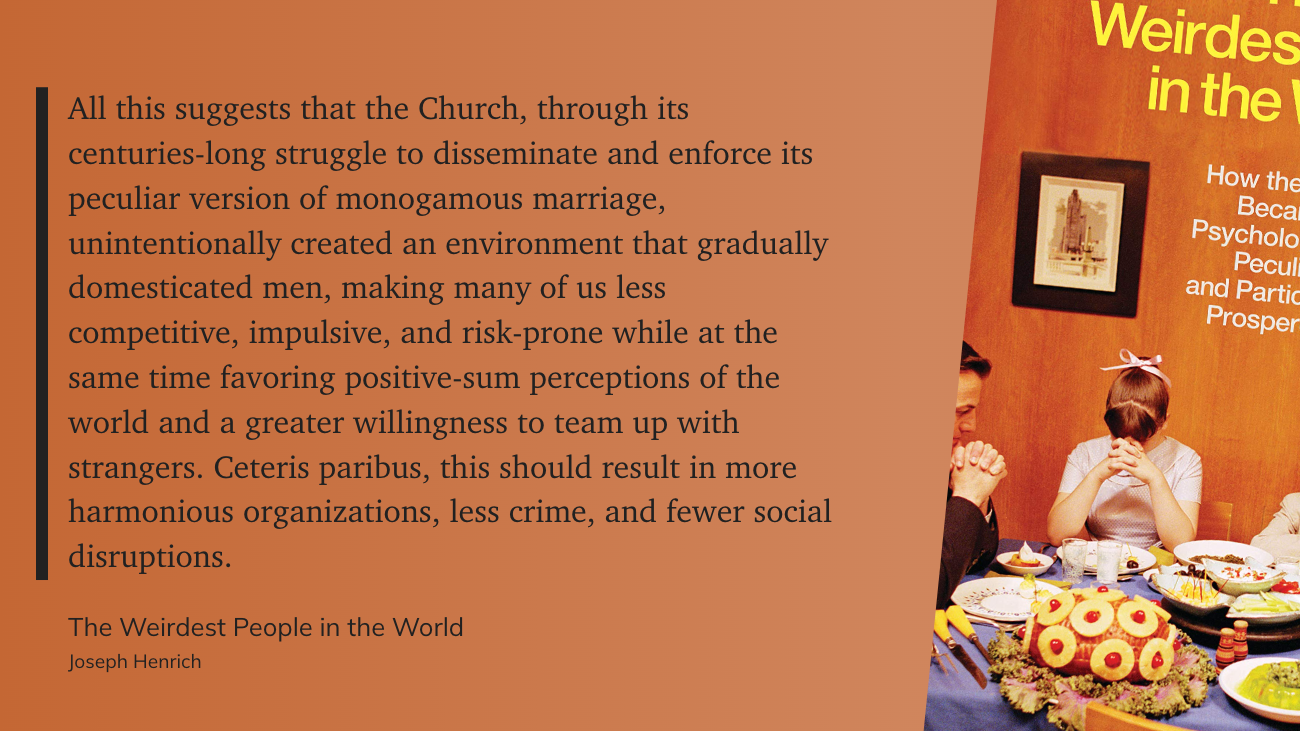
In this book, Henrich explains how the WEIRD roots arose and changed us in ‘the west’ (and later elsewhere as western ideas came to dominate many parts of the world, like in Japan for instance). A huge factor was the Christian Church and its policies. For one, the Church enforced and changed how Europeans thought of marriage. Specifically, the Church established monogamy as the norm and outlawed previously widespread types of marriage such as cousin marriage and polygyny. In societies that allow polygyny, high status men wind up with multiple wives, even harems. However, it also had the effect of making it hard for many low status men in society to find mates.
The quote noted below gets at one of the major positives of this change. Men without wives, Henrich demonstrates, tend to have more testosterone in their systems more often, changing their behavior in many antisocial ways. The flip side is that once men are married, testosterone tends to diminish, leading to generally more caring and mellow dudes. In other words, the rise of monogamy in Europe led, in part, to less less sexual violence, less crime in general, and more trust by men of other men.
This historic development makes me reflect on how many other “givens” in our culture might be the result of centuries-old institutions shaping behavior in ways we hardly notice. If something as personal as marriage norms can be engineered—and can ripple out to influence crime rates, trust, and cooperation—then what other aspects of our daily lives are quietly products of history rather than universal human nature? Even though I remain deeply skeptical of organized religion, I can see how this particular historical turn produced social benefits we still feel today. It’s a reminder that traditions are not simply inherited. Rather, they are crafted, sometimes intentionally, sometimes by accident, and always worth re-examining.
Rush is my Jam
Before I became a devoted Deadhead, I was a huge fan of Rush. Many of my Deadhead friends are also huge Rush fanatics. Certainly the two bands cover different sonic territory, though for rock and roll fans, they are both landscapes that our various moods demand that we cover from time to time.
One of the coolest aspects of the Grateful Dead fan experience was that every one of their concerts were unique. On any given night, there were over a 100 different songs they might play and if you saw a run of three shows, you wouldn’t see the same song played twice. This was one of the reasons Dead fans wanted to see so many shows.
Rush on the other hand, was more traditional and tended to play the same set list on any given tour, though they did switch songs out now and again. Nevertheless, if you saw three shows on a particular Rush tour, you’d be seeing the same show each night.
Despite that, Rush never had any trouble selling concert tickets. Their shows were always amazing, creative, well produced, contained elements of humor, and delivered the goods fans wanted to hear.
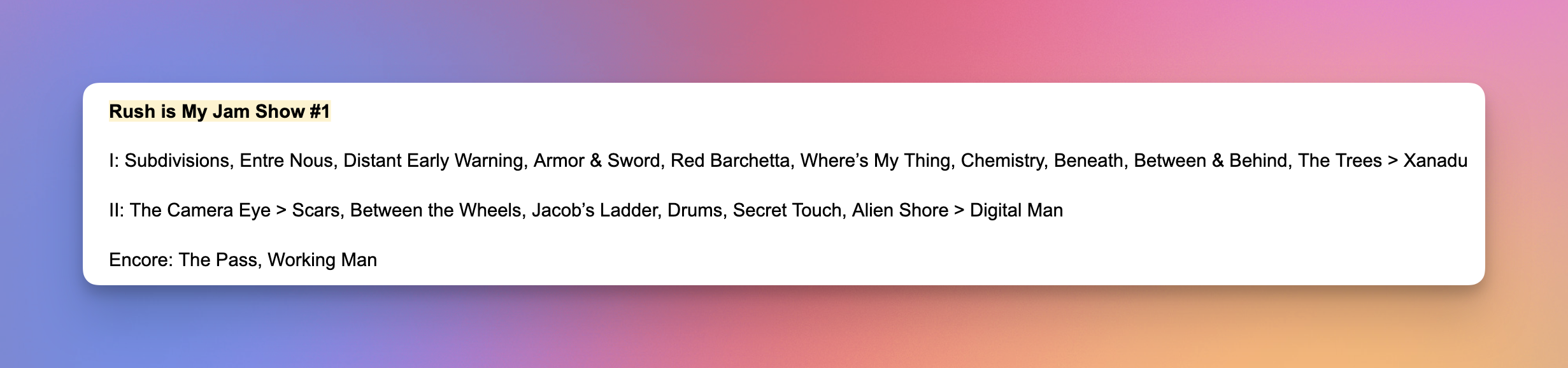
Nevertheless, as a huge fan of the jamband ethos of different set lists every night, and as a huge Rush fan who loves their entire catalog (and live shows), I find myself wondering about what it might have been like to see Rush drop different set lists on consecutive nights. Their catalog is deep and their virtuosity is without peer. I know the band members adopted the approach they did for a reason, but I’d still like to imagine what Rush shows might look like if they mixed it up night to night. If you are a Rush fan as well, I hope you enjoy thinking about this parallel universe.
I am assuming this is happening at the end of their careers when all their albums are in play. I am also going to have some fun with the possibility of the jamming out of one song and into another. This is the hallmark of ‘jambands’ and Rush certainly could have done this. I don’t know enough about making music to know if these transitions would work (as far as the key of each tune), but I’m going to include some in each show anyway.
New Goose Album Chain Yer Dragon
I’ve been really into music most of my life. In high school, it was heavy metal and hard rock; bands like Rush, Led Zeppelin, Metallica, and Judas Priest–bands that are still in my rotation. Early in college I got heavily into Jethro Tull, then my little brother took me to my first Dead show and from then on I was on the bus. Like many Vince-era Deadheads, I also became a fan in the early 1990s of other jamband pioneers like Widespread Panic and Phish. Fast forward to the pandemic and a new band out of Connecticut started making waves with fans of improvisational rock music. That band was Goose. In short, they took the Dead model and applied it to a new era. Their set lists were different every night, they sprinkled quirky and beloved covers into their shows, they shared their live music free (on YouTube and Bandcamp), and they delivered the goods live. A good friend saw them out in Colorado in 2022 and raved about them.
Fast forward to the summer of 2025 and it is fair to say I am listening to Goose more than any other band. I like their studio stuff, but I mostly listen to live stuff that I buy from Bandcamp or download from YouTube. I’ve been lucky enough to catch them live four times thus far (hopefully with many more to come). This morning, a Thursday in mid-August, they dropped another full length studio recording titled Chain Yer Dragon. This is their second album of the year, after Everything Must Go, which was released in the spring. Their summer tour starts today, so it makes sense. I love the timing of this for two reasons. For one, it has ‘indie marketing’ vibes, which I believe was integral to their meteoric rise after the pandemic. Secondly, they are prolific. Taking cues from Trey Anastasio, one of their heroes, they are musicians who are consistently making great new music and getting it out for their fans.
The tracklist contains mostly songs that have been staples of their shows for years, including Rockdale, The Empress of Organos, and Echo of A Rose. There are also some new tunes, including Madalena and Royal. I’m sure many Goose fans will dismiss these versions because they aren’t live, but I enjoy the contrast between the stretched out live performances and the tighter, more highly produced studio versions. (Although, to be fair, the Factory Fiction that closes the record is nearly 17 minutes long.) It is also great to hear a studio version of a song that has only ever been experienced live before, even if I’ll spend more time going forward with the live tracks.
A couple quick reactions. I get strong Jackson Browne vibes from some songs on this record, such as Madalena. Rick’s ethereal guitar is also ubiquitous and I continue to love his voice. That said, there are no Pete (Anspach) songs, which is a bummer. There are also no covers. Oh well, all the more reason to go see ‘em live!

What I Remember from High School Is Not My GPA
One issue nearly all high school teachers face is students who are excessively worried about their grades. To be sure, the student that doesn’t care about their grades presents a more worrisome dilemma, but that does not make the ‘grade grubber’ student any less real or frustrating. As a teacher, when I talk to this young person I hope to convey the idea that the process is more important than the result. I also attempt to convince them that getting a B in an AP class in high school is not the end of the world. I always add that this grade they are worried about iis something they likely won’t think about once they’re out of high school. Like, ever. Sometimes my arguments ease the student’s worry, but I suspect most often my words don’t do all that much good.
A related problem arises when a student who has high A continues to stress out about their grade. This type of student typically has the habits to maintain their success. The quote below, from a 2024 book by Jennifer Breheny Wallace about the dangers of ‘achievement culture’ in America, makes an important point about this type of student that I strongly agree with. Put simply, a meaningful adolescence should involve more than just academic performance. Indeed, thinking back now on my high school experience–many years ago, that is true-–I remember hardly anything about the academic nature of my experience, including specific grades. What I do remember are my friendships, playing football, cutting class on Wednesdays during senior year to drive to Oakland to catch Oakland A’s day games in the bleachers (for something like $5!), and the other emotional highs and lows of my particular experience in the late 80s in a small college town in Northern California. I recognize in hindsight that earning decent grades (I was a straight B student) helped me get into college. However, the grades and their meaning faded quickly.
It is worth noting that our current system is organized in a way that promotes student worries about grades. That is a whole other topic that I will refrain from getting into, but I do think is important not to forget.
Today, I hope my students, as well as my daughter, will approach high school with the wisdom to discern that while grades matter, so do relationships, extra-curricular activities, travel (if one is so lucky), and the pursuit of other interests in the margins of the high school experience. Of course, students today have additional pressures caused by phones and social media that I didn’t have to deal with in the ‘80s. Nevertheless, it’s a critical balance; and while it is hard to nail it, having a well rounded experience in high school is worth the effort. Wallace nails this idea with these 12 words.
Greetings!
Hello folks! I have been wanting to have a blog for a very long time and I am finally getting started. Whoop, whoop! I believe I’ll have a lot to say about what interests me, which includes books and ideas, teaching high school social studies in this crazy era, music, life in beautiful Portland, QS stuff, and being a dad/husband. Hopefully I will meet some kindred spirits out there as I continue this part of my journey.