3 Gifts from the Algorithm
As I’ve said before, I am not on social media. I do, however, spend time on YouTube. Today, while enjoying some college football and in between sips from the various books I’m reading, the Youtube algorithm served me up some winners.
-
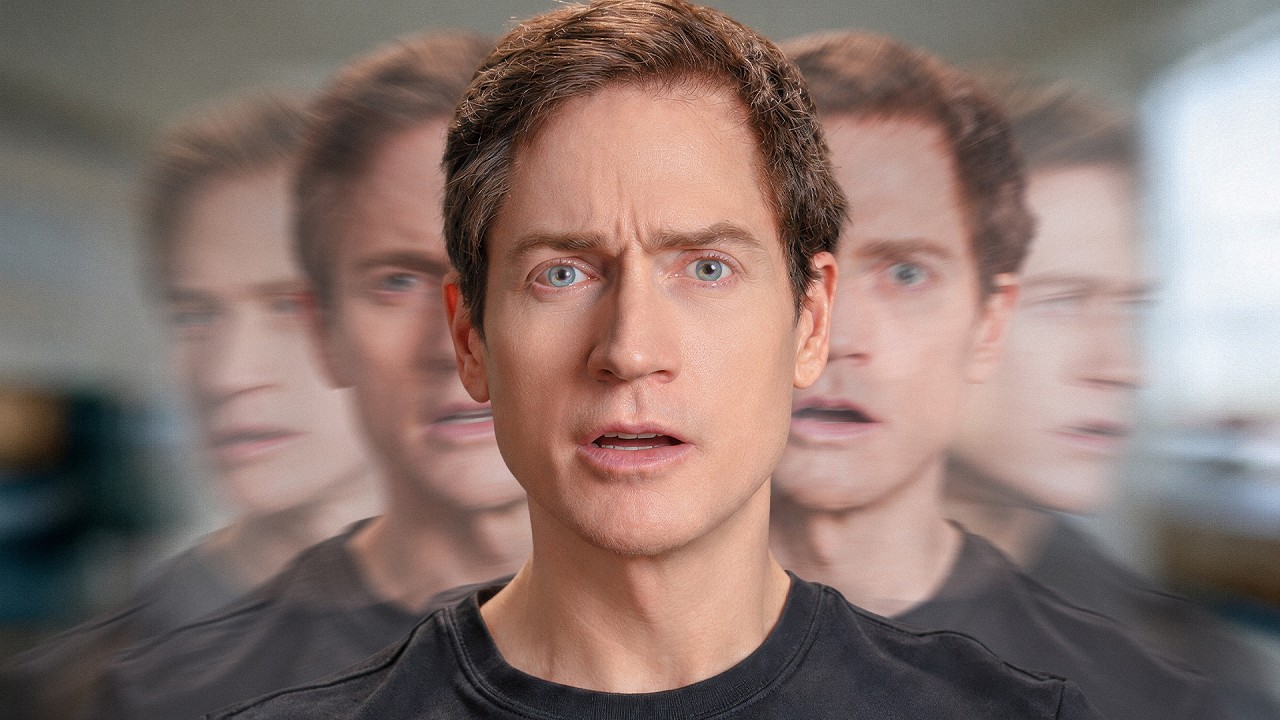
Bryan Johnson’s deep dive into psychedelic mushrooms and their impact on his body. Johnson is successful entrepreneur turned Quantitied Self devotee. I also found it interesting that he did his highly quantified trip in Portland. See below.
-
New music from Morphine. The weird thing about this is that Morphine hasn’t been around since 1999, when their lead singer died of a heart attack on stage in Italy. Somehow, they have a new album coming out soon and the first song is already hitting the Internet. It is safe to say, there is no band that sounds like Morphine.
-
Joshua Charow’s YouTube channel Charow is a documentary film maker and photographer and has created a series of videos that introduce the viewer to older artists living in New York. However, in addition to interviewing these interesting people, he also features the lofts and studios in New York City they live and work in. What I love about his videos are the deep looks inside these wildly unique living spaces.
5 Quotes from Jack Kerouac
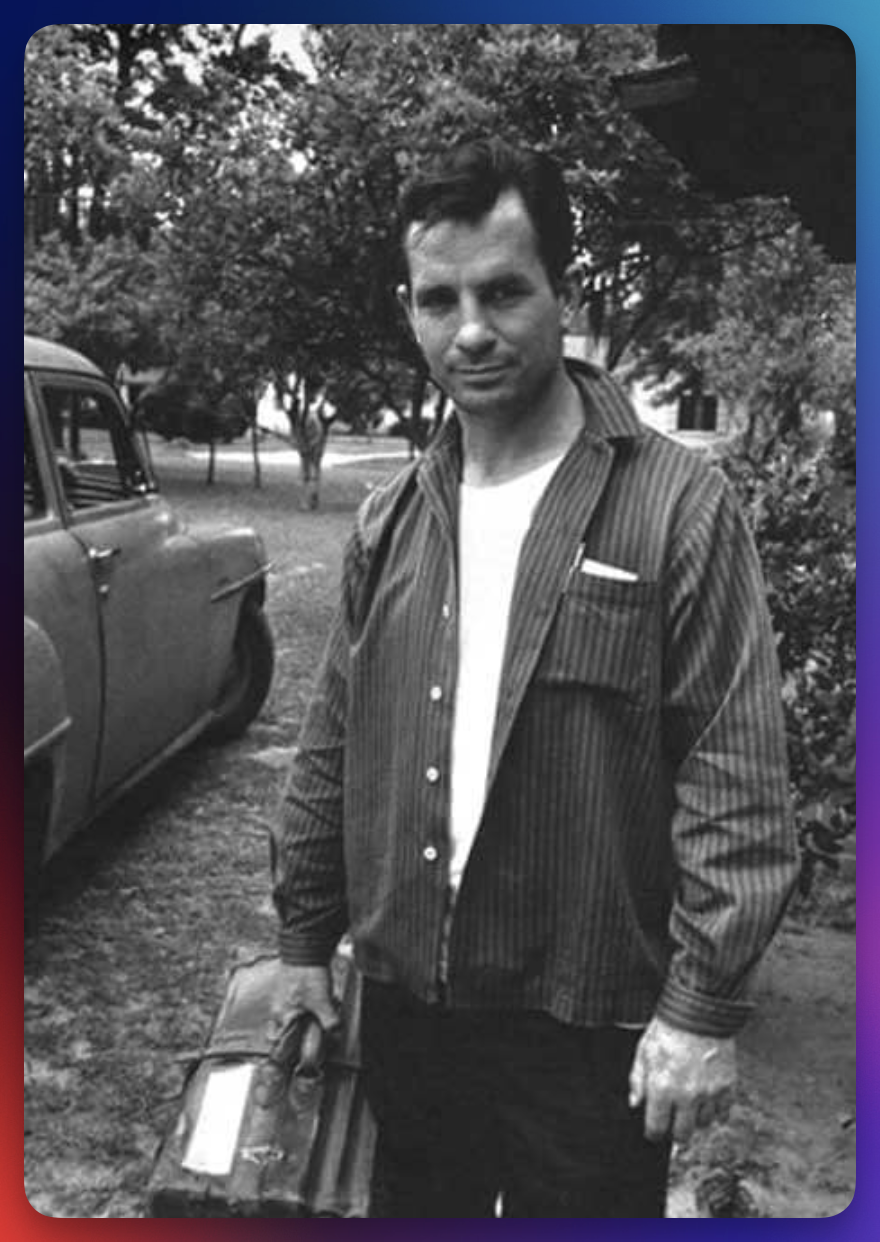
Jack Kerouac died on this date in 1969 as a result of his alcoholism. I’ve read two of his books, the two most readers are familiar with: On the Road and Dharma Bums. In hindsight, I think the first book is a bit over-rated, but the later is definitely a worthwhile read. That said, Kerouac the man was an interesting dude, though obviously flawed (like all of us). Being a Deadhead means I’m well aware of his connection with the even weirder Neal Cassidy.
In honor of Kerouac, I thought I’d share 5 interesting quotes by the author.
-
“Be in love with your life, every detail of it.” — Selected Letters
-
“Maybe that’s what life is… a wink of the eye and winking stars.” — The Dharma Bums (1958)
-
“Nothing behind me, everything ahead of me, as is ever so on the road.” — On the Road (1957)
-
“One man practicing kindness in the wilderness is worth all the temples this world pulls.” — The Dharma Bums (1958)
-
“College or no college, the world is a book and I have read my page.” — Letter to Sebastian Sampas (1941)
Seattle Rush Commentary
Last night I was fortunate enough to see Rush for the third time this calendar year. Considering I thought the band was done with after their last tour in 2015, I see these shows as bonus gifts. Manna from heaven, you might say.
A frustrating part of my pre-show experience yesterday was heading up to the show without tickets. This is not my usual way of seeing shows. That said, despite enormous hassles with both Ticketmaster and my credit card company, my buddy and I ended up scoring great tickets on Alex’s side for about 45% off full face value.
The sound where we were at was amazing. We sat in a very similar spot night two in Toronto in August and the sound last night was much cleaner. For whatever reason, I was able to pick up on the full range of sounds Alex was able to make with this guitar. Geddy’s vocals were in top form, which is truly amazing considering his age and the high notes he is required to hit in several songs, including Freewill. The set list was also fantastic. It is such a breath of fresh air to see Rush mixing up their set lists from show to show. Indeed, each of the six sets I saw this year were different. Of the songs that are not played every night, I was stoked to see Analog Kid, La Villa Strangiato (a masterpiece of rock and roll instrumental music!), Caravan, The Trees, and A Passage to Bangkok,’ their ‘only love song.’
The one thing about Rush shows that is disappointing is the way the fans enjoy the show. I am used to the jamband scene (Dead and offshoots, Phish, Panic, and Goose) where people are mostly up and grooving from the first note through to the encore. Rush shows are not like that. The crowd is older, and being a North American crowd, there are a lot of people who are not looking super healthy. Plus, the music is not really dance music. I get it. That said, sitting down at a rock show, no matter the type, is anathema to me. Oh well, Sitting for ¾ of the show was a small price to pay for a masterclass in rock music. 10/10 as far as the music went.
I am hoping Rush announces shows at Sphere in Vegas next year. That might be my only realistic chance to see them again. We shall see…


The 'Cornerstone' and Lemmon v. New York
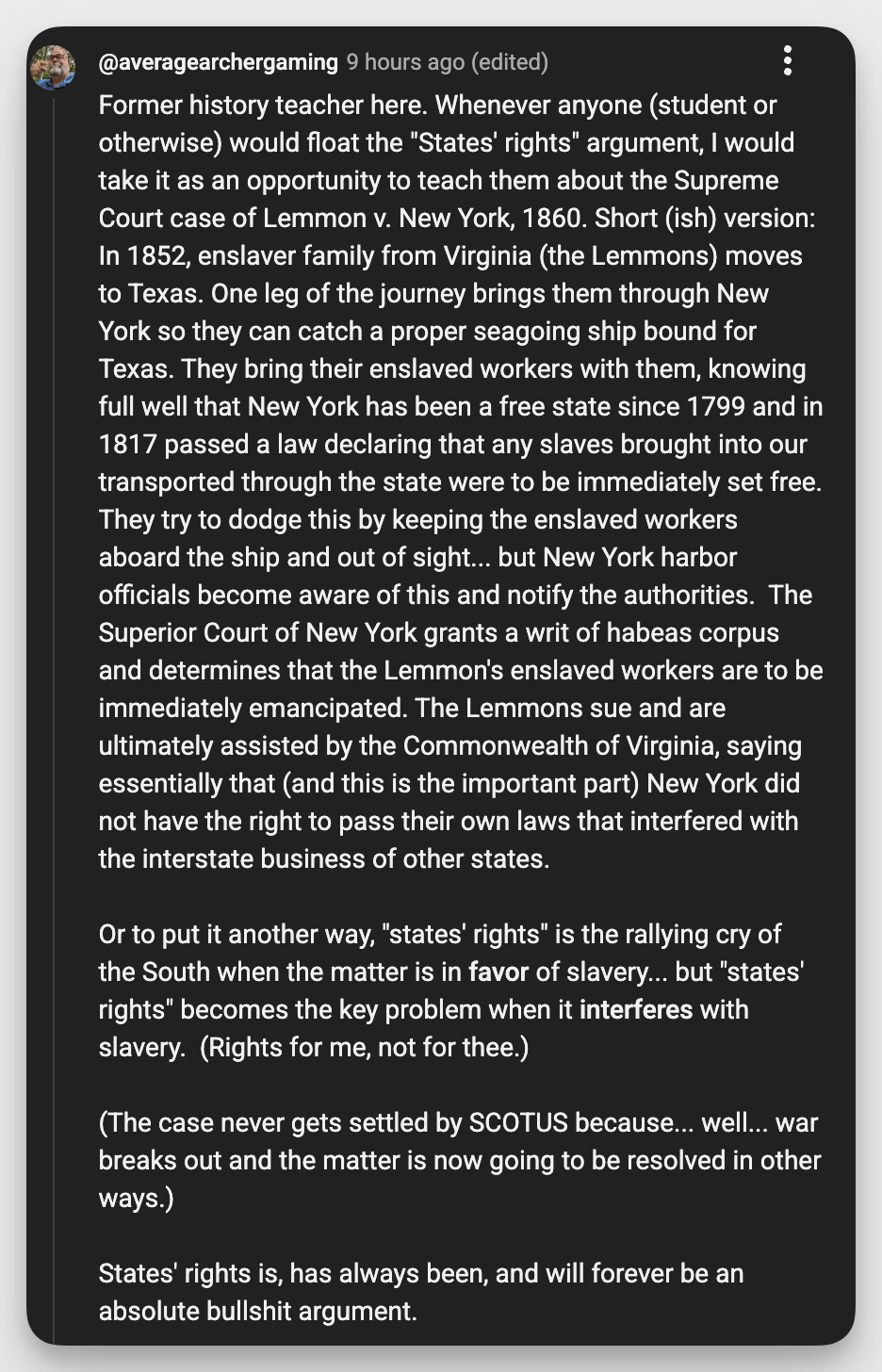
Sometimes I know I couldn’t have said it better myself. In the case of this topic, it is something I teach every year. But @Amandas-Mild-Takes pretty much nails it, much more succinctly than I tend to put it in class. That there are still such ignorant people who try to deny the primacy of slavery to the Civil War is astounding.

Rush is My Jam Show #17
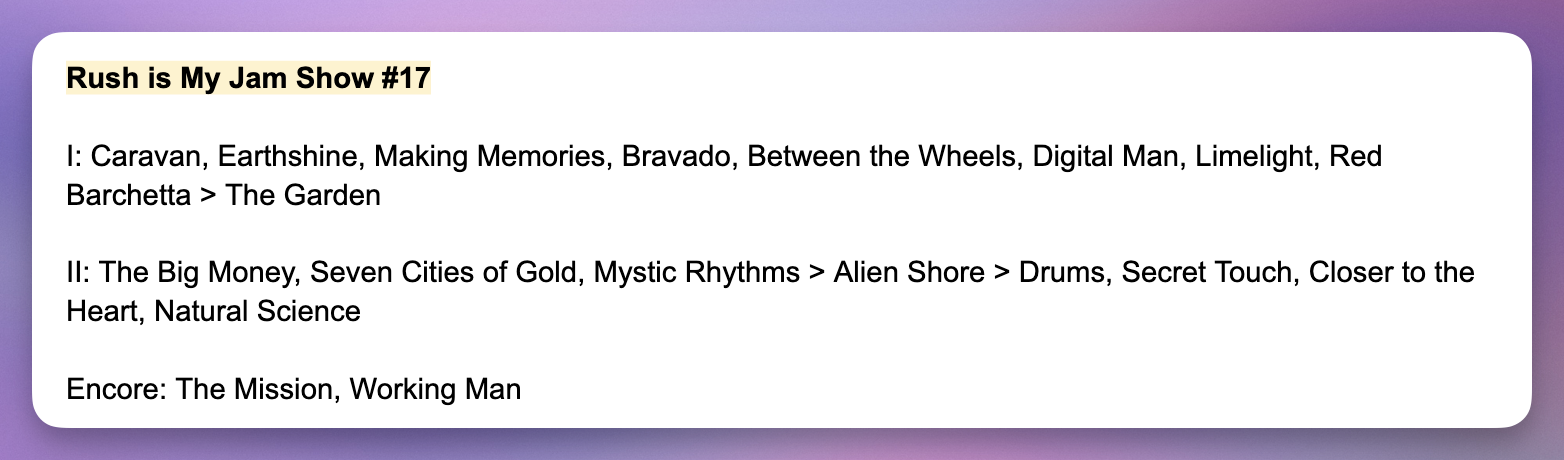
In the honor of a real Rush show upcoming this weekend, it is time to revisit the fantasy Rush tour in my head. Highlights for me would be the Earthshine early in the first set and the Red Barchetta > The Garden first set closer, which would end things in a different, more mellow mood than usual. The Big Money as a set opener would be great, as would a killer jam out of Alien Shore. Double encore to send everyone home happy!
Some Book Recommendations from YouTube for Understanding Our World
My YouTube algorithm serves up quite a bit of videos recommending books. The one below caught my attention because the guy sharing the recommendations doesn’t fit the mold of a typical ‘booktuber.’ I enjoyed the video and am intriqued to eventually read a few of his recs. Indeed, the only one that I have already read is the Ray Dalio book. And while I’m not a fan of Kissinger (or Rudolph Hoess for that matter!), I think the book recommended in the video is probably worth the read if the goal is understanding world politics. I’m a bit surprised that none of Robert Kagan’s books, nor any of Robert Kaplan’s books, were on the list.

Current Stack
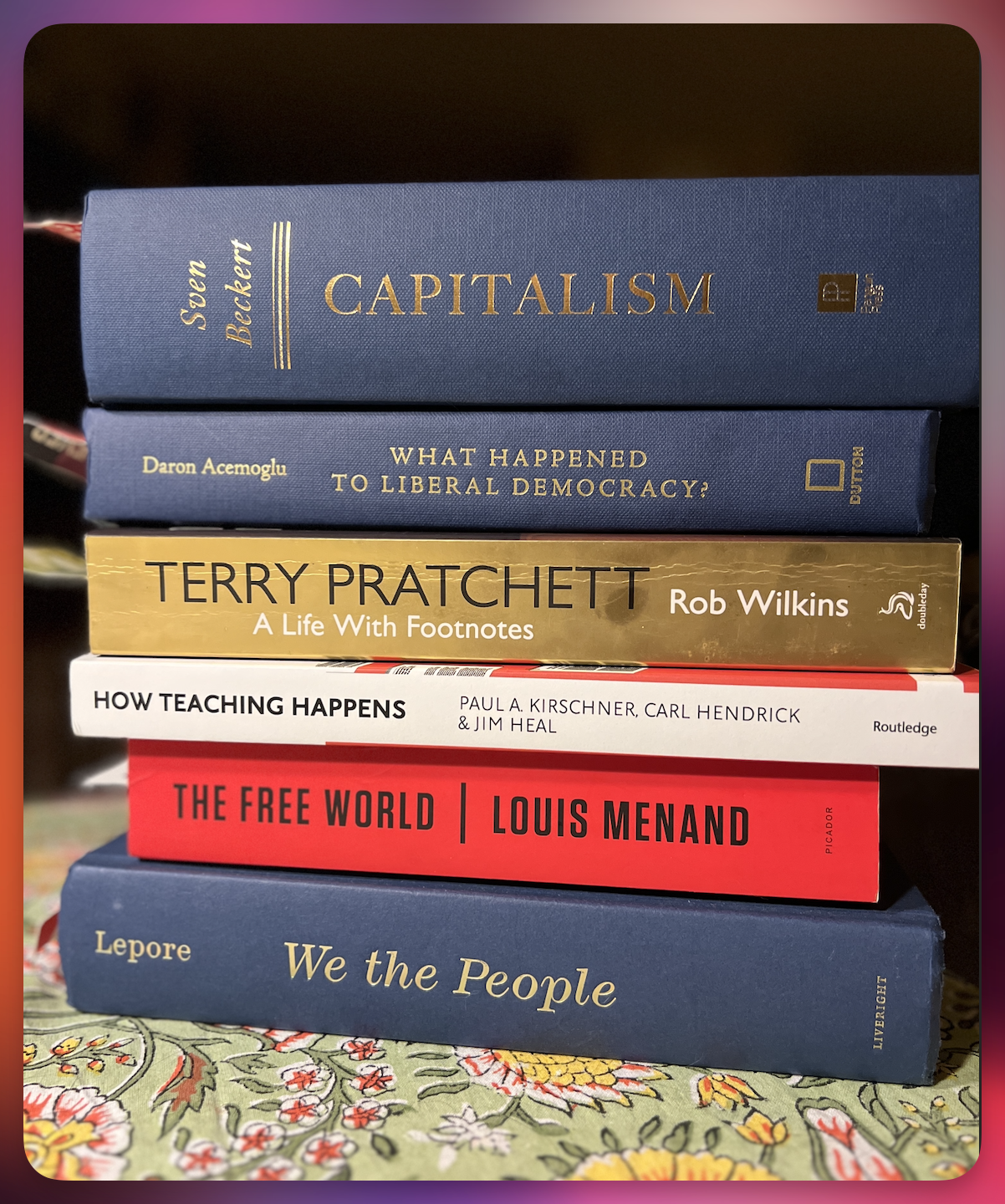
I’m a day late, but here we go: My current reading stack.
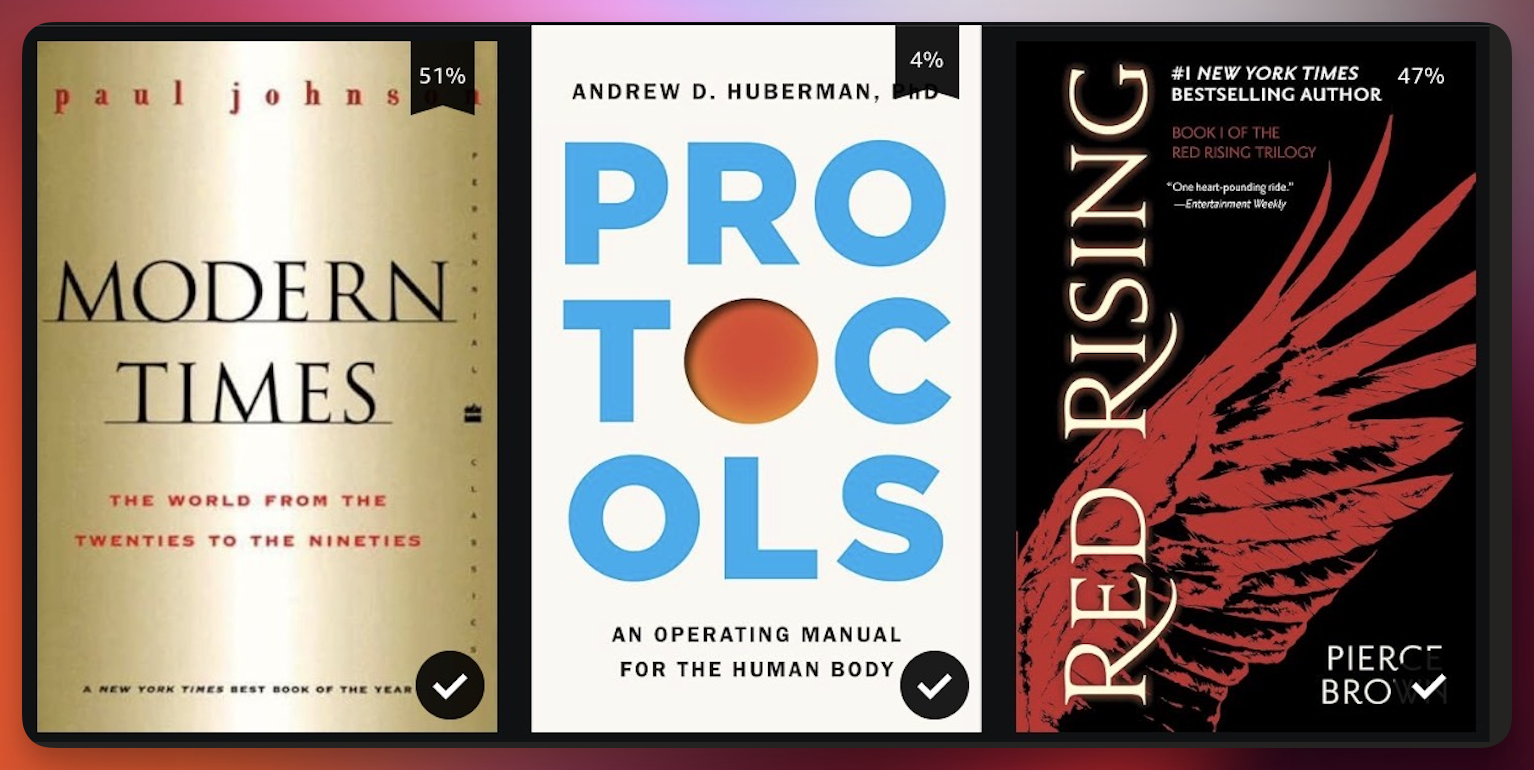
The newest book I have started is Andrew Huberman’s Protocols. I’m likely to skip the detailed explanations of neurobiology, but I’m willing to wade through that stuff for the gold–the protocols. The other really new start is Capitalism by Sven Beckert. I’ve come to enjoy big histories, and so far I am liking this one.
Red Rising is the one novel I’m reading, and though the start was slow, I’m starting to get into it now. The premise is certainly interesting. I am still slogging through We the People. It is relevant enough to what I teach that I want to power through. Not as enjoyable as her book These Truths, which I loved.
The new Daron Acemeglu book is enjoyable, but requires slow deliberate reading for me. One thing I like about it is that not only is it a book about political history, but he is making an argument about the type of liberal democracy that America should adopt and I like that he’s making an argument and marshalling evidence to make his points. So far, so good.
Finally, a word about the Terry Pratchett biography. Prachett is a famous fantasy writer, and while I love a good fantasy book, I’ve never read any of TP’s books. Indeed, they don’t intrigue me. However, I have come to love biographies of writers so I thought I’d give this a go. It isn’t as good as the Hobsbwam biography I finished not too long ago. I keep coming back to it almost every day though so that means it isn’t that bad.
Hope you’ve got some good books to read too at the moment!
Perlego FTW!
I recently discovered a cool resource for book lovers that I want to share. It is a subscription service called Perlego that bills itself as the Netflix of books. They specialize in academic books and textbooks, but after spening about 45 minutes browsing their more than 1 million titles, I’ve noticed they carry a lot of mainstream, popular non-fiction. Prices seem reasonable too if one decides to read using the platform. For instance, for a one year subscription, the cost is $144. That may sound like a lot, but that’s 7 to 10 books if you are buying at a typical retail bookstore. Certainly for those who enjoy reading non-fiction, Perlego is worth checking out. Of course, they allow readers to highlight text and make notes in the app. You can also easily favorite books and have them easy to find in the app when the time is right to dig in. They also offer curated lists on topics and it seems they use AI to suggest books from their massive catalog based on the books you are reading or have favorited. Did I mention they have every single book in the ubiquitious For Dummies series? If you’re a big non-fiction reader and are used to reading on an iPAd, this is worth looking into.


No One's Disciple
I’m not sure how long this will be up on Youtube, but it is up now. I’m talking about the new tribute documentary about Rush drummer and lyricist Niel Peart. This is a must watch for any Rush fan, and frankly any fan of late 20th century rock music.
This is also an appropriate time to recommend Niel’s brilliant memoir Ghost Rider. The TL;DR is that Niel suffered the death of his only daughter and then his wife within 10 months then took the roads of North America on his BMW motorcycle to process his losses. The book is a meditation on death, as well as a travelouge. Read it if you haven’t already.

36 Questions (to fall in love?)
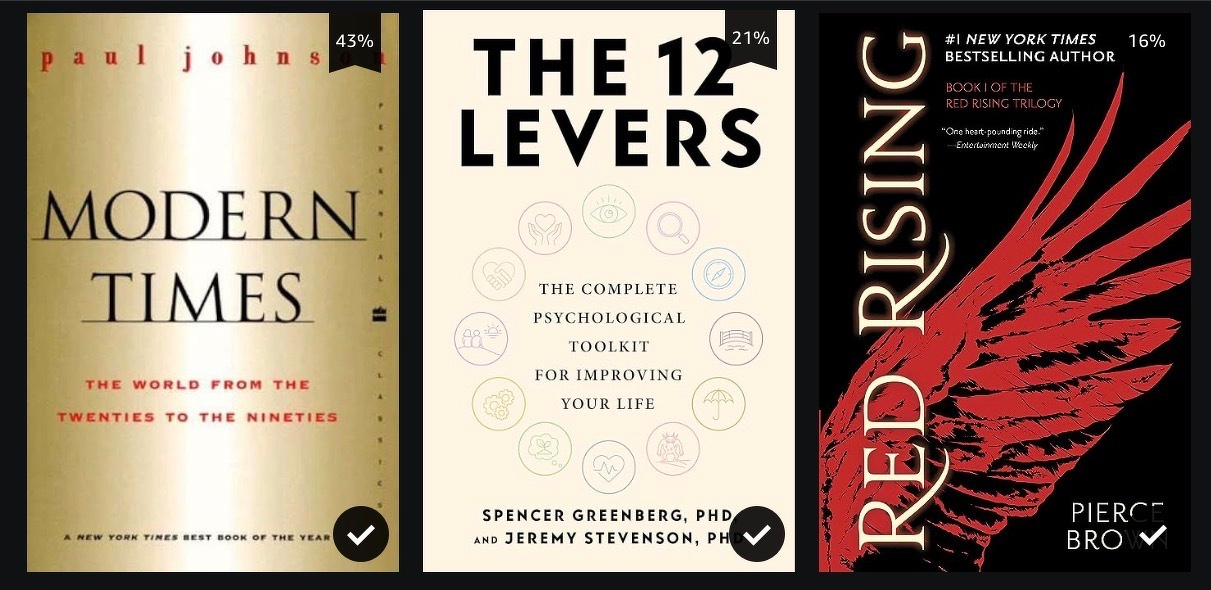
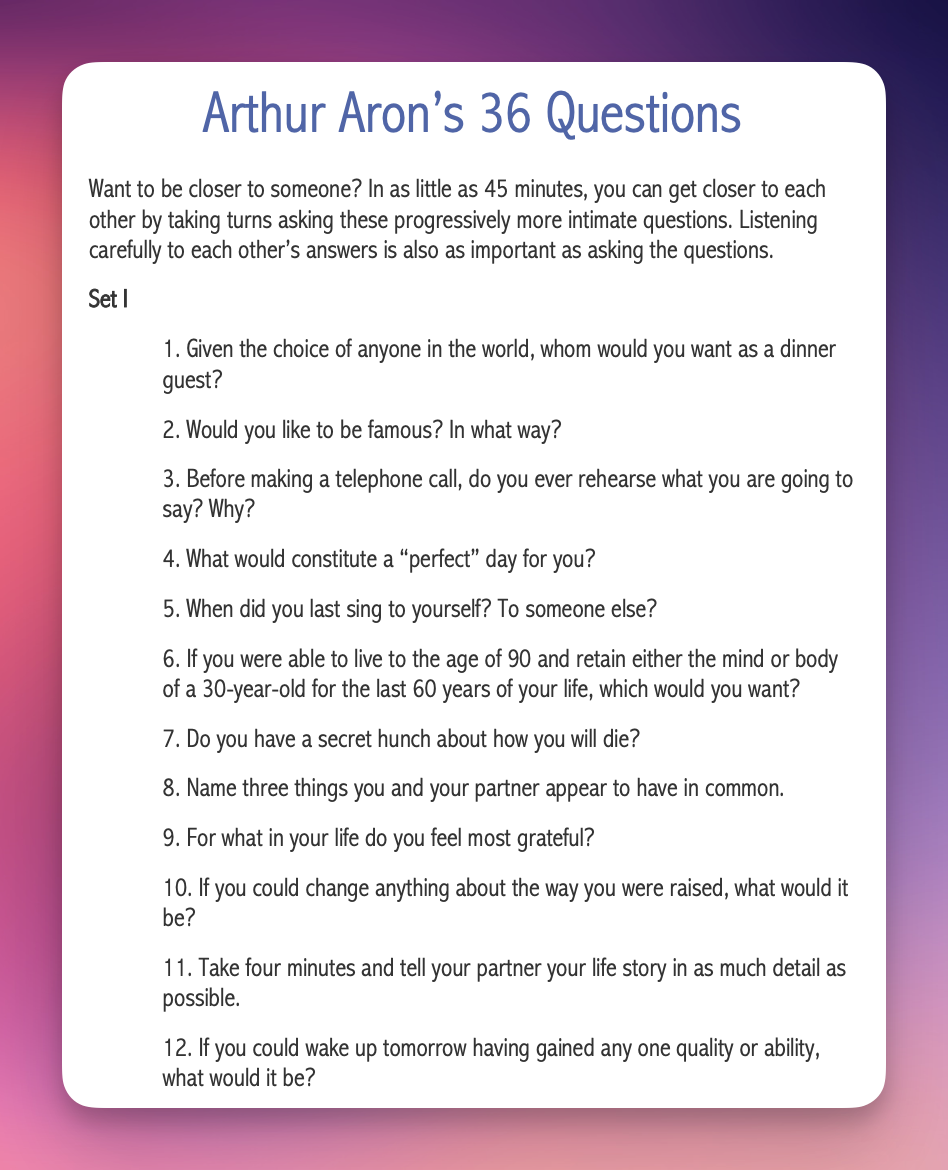
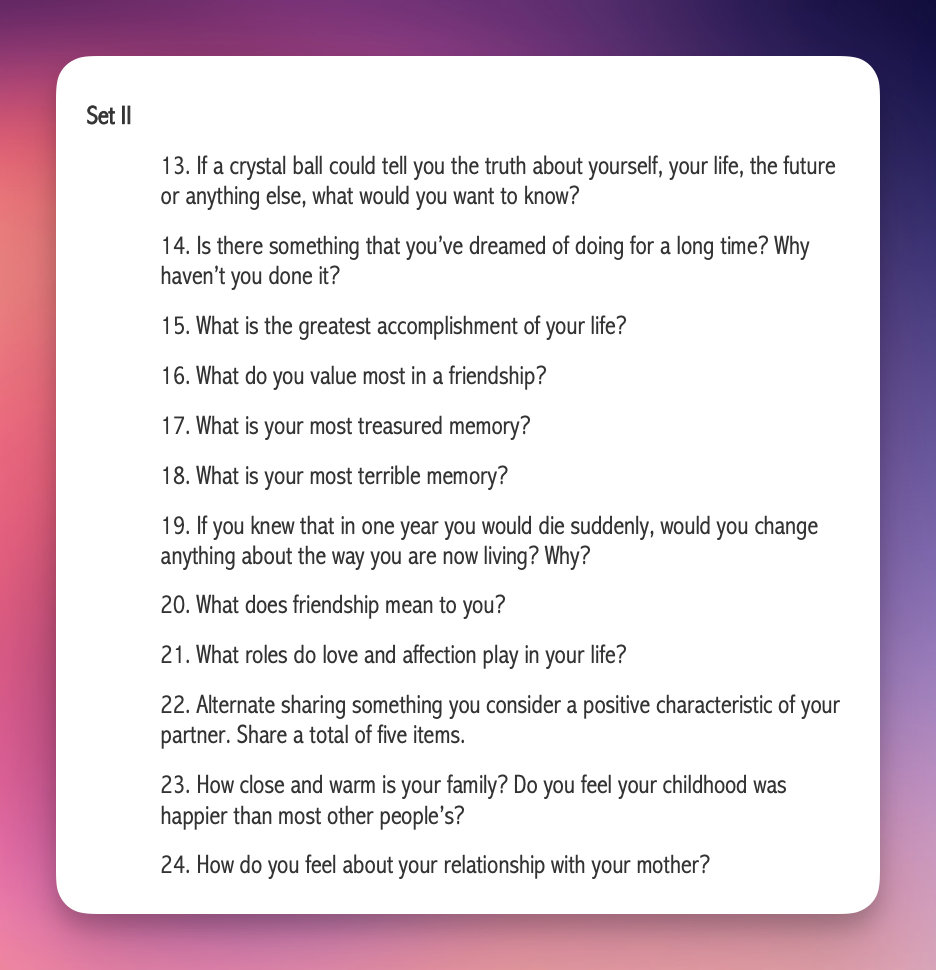
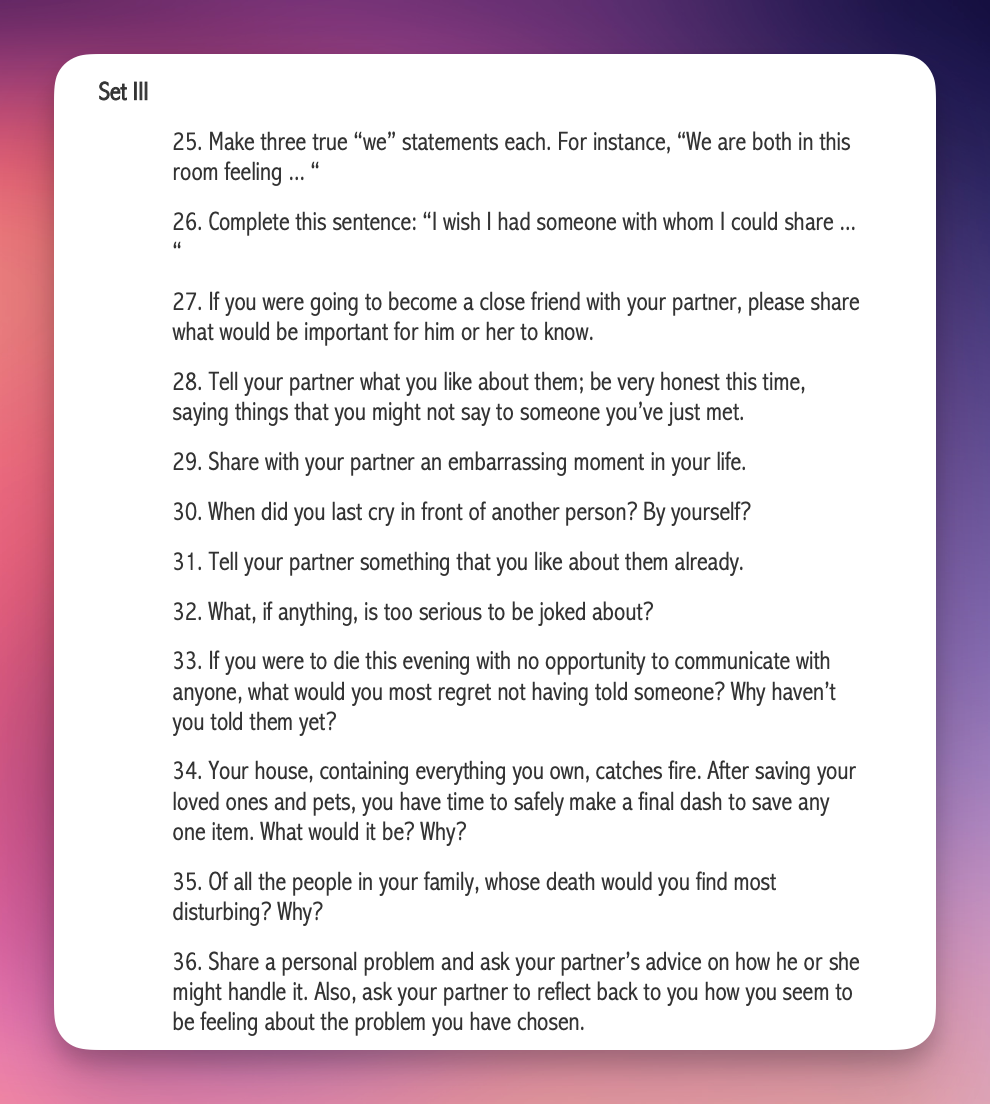
One of the books I am reading right now is called The 12 Levers. It is a self help book, a genre I enjoy. One of the 12 levers is Communicate Skillfully (Lever 10). In that chapter the authors discuss Arthur Aron’s 36 questions. The questions were designed to encourage people who don’t know each other well to get relatively close, relatively fast, by discussing the questions in order. Apparently, the questions have lead some couples in the experiments by Aron and his colleagues to actuallly fall in love and get married. The list of questions is sometimes refered to as the ‘36 questions to fall in love.’
I was curious about the questions so I looked them up. For the most part, the questions also seem like they would work great as journal prompts. Here they are…
Running 'Between the Bridges'
I’m a fair weather runner. From May to early October, I consistently get 3 to 5 runs in a month. Then, when the darkness dominates, my willingness to get out there wanes noticeably. I know, I’m a wuss. But a fact is a fact.
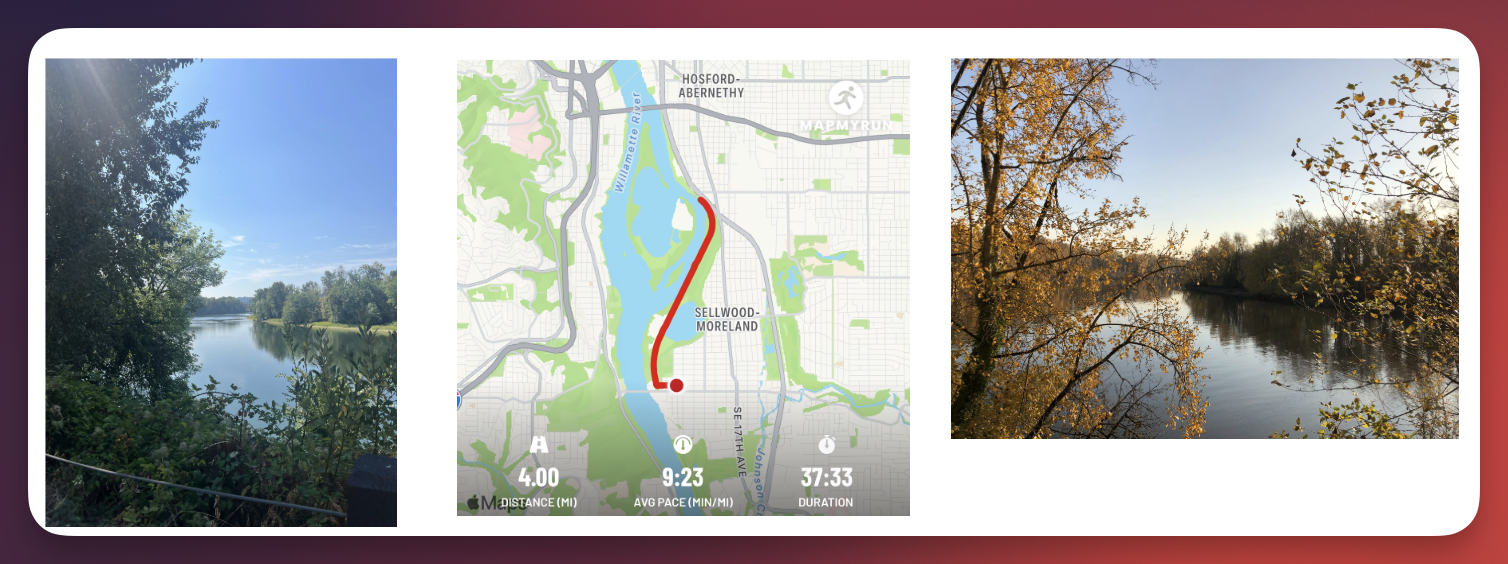
However, today was a beautiful day in Portland. After some morning clouds, it reached the mid 70s and was sunny all afternoon. Lucky enough, I had the ability today to get out there and enjoy it. I decided to go to one of my favorite spots, the trail along the east bank of the Willamette River, between the Sellwood Bridge and the Ross Island Bridge. I assume most Portlanders will know where I am talking about. In my notes, I locate these runs as ‘between the bridges.’
On a day like today there were tons of other runners out there, as well as a slew of bikers (both the tight pants variety and the more laid back folks rocking the casual SE PDX look). My favorite aspect of this particular locale, besides the gorgeous views of the river the appear here and there, is how flat it is. My other favorite running spots are great, but they all force me up and down too much (Tryon Creek, I’m looking at you).
I neglected to take any pics today (running was hard enough that it focused all of my attention). However, I have taken some nice pics in the past. Two are below. One is from summer 2025 and one is a mid-November shot from a few years back. Having enjoyable places to run definitely helps with the motivation.
5 Quotes I've Recently Collected
I am a quote collector. One reason is because I have always shared a ‘quote of the day’ on my board or digital agenda in my classroom throughout my career. Another reason is because I love a good quote. Indeed, one can’t get enough wisdom, so collecting quotes and using an app like Readwise to periodically resurface them is a no-brainer for me. Finally, collecting and categorizing quotes feeds my inner digital packrat.
The last quote I added to my collection came from a surprising source: George W. Bush. Indeed, good quotes from surprising sources is part of the fun of hunting them down. The Bush quote came from a short review of Bush’s new book of portraits (he has taken to painting as an ex-president). The quote struck me for two reasons.
For one, it is striking to me that I long for a traditional Republican president. When Bush was POTUS, I loathed him. I still think he was a horrible president who set our country on its dramatic decline (allowing 9-11 to happen then over-reacting and invading Iraq, not to mention the irresponsible tax cuts and devastating Great Recession that started on his watch). However, he wasn’t pathological. He had a semblance of a moral compass. He wasn’t a racist narcissist.
Another reason why the quote struck me is because it is clear that he is, in his own way, rebuking the current Republican administration. That is worth noting. I also happen to believe in the sentiment. If you are lucky enough to live in freedom, you have a moral obligation to help others experience the same thing. That means treating immigrants with families and two feet in this country with decency and respect.
I’ll let the other quotes I’ve recently collected speak for themselves.
Quote #1 (collected today)
“…we who live in liberty have a duty to stand with those who do not.” ~ George W. Bush
Quote #2 (collected on September 11th)
“Never give up your right to do the next right thing. This is how we find our way home.” ~ Matthew McConaughey (as read in his recent book of poetry Poems and Prayers)
Quote #3 (collected on September 5th)
“I have read my books by many lights, hoarding their beauty, their wit or wisdom against the dark days when I would have no book, nor a place to read. I have known hunger of the belly kind many times over, but I have known a worse hunger: the need to know and to learn.” ~ Louis L’Amour
Quote #4 (collected on September 4th)
“However mean your life is, meet it and live it; do not shun it and call it hard names. It is not so bad as you think. It looks poorest when you are richest. The fault-finder will find faults even in paradise. Love your life, difficult as it is…You must live in the present. Launch yourself on every wave. Find your eternity in each moment. Fools stand on their island of opportunities and look toward another land. There is no other land; there is no other life but this.” ~ Henry David Thoureau
Quote #5 (collected on September 3rd)
“Being ready is a myth. You start. You suck. You figure it out. You get better.” ~ Anonymous
Cheat Codes and Life Lessons
I am a big fan of writer Dan Pink and have enjoyed many of his books. Today I stumbled on a recent YouTube video of his where he shares 30 ‘cheat codes’ for life. I’m a sucker for these sorts of lists. Watching the video reminded me of many similar lists I’ve come across (and saved in my Second Brain). Here is a short list of some solid life lists, as well as a link to Pink’s video
-
Dan Pink’s 30 Cheat Codes

The Four Horsemen
I’m cynical about some things (corporate motives, for one) but am generally an optimist. That said, I also see myself as a realist. Over the past few years I’ve decided that that there are 4 major threats my fellow Americans are going to have to deal with one way or another in the not too distant future. Indeed, I think of them as the modern ‘four horsemen of the apocolypse.’
1. Climate Change
This one is obvious and it appears to be getting worse. To touch on but one of many indicators, this past July was the hottest month on record. Not only is this going to lead to mass migration and attendant problems, but it is also going to cost governments and people A LOT of money.
2. Rising Authoratarianism in America
Case in point, trump cuck Brendan Carr and FCC. What a joke. I could go on and on, but it is too depressing. The Democrats are going to clean up in November, but how will the authoratarians respond?
3. America’s $40 Trillion National Debt
We know that when Democrats are in charge, Republicans pretend to care about the deficit. When the shoe is on the other foot, the GOP is silent. This congress and president have added to our deficit despite the repeated lies that lower taxes would generate so much growth that the deficit would actually shrink. A related lie is that tax cuts for corporations would lead to more hiring. For instance, Oracle today announced another round of layoffs (21k now for fiscal 2026). The debt is going to lead to higher taxes for the wealthy, or a lot of pain for everyone else. The day of reckoning is near.
4. Unregulated AI
This one is top of mind too sadly, as the leaders of all the major US AI labs agreed this week with Anthropic CEO Dario Amodei that there needs to be regulation of AI. And yet, what is our dear leader’s response? That he is so smart that he will act as the buffer between the technology and any and all catastrophic consequences. Indeed, his response is so assinine it comes off as satire.
Can we navigate these challenges? I don’t know. One at a time, maybe. But they all seem to be hitting at the same time, which has me a bit worried at the moment.
3 Substack Blog Posts and Some Tunes
- WTED Goose Radio
As a massive Goose fan, I was very happy to recently discover this 24/7 streaming Goose radio station. They also have a great Goose 101 page for newbies.
- Substack blogger Rob Henderson on How I Read
As an avid reader I am always interested in other people’s take on reading and how they manage to read at volume. This is an interesting take.
- Substack blogger Joseph Heath on Becoming Less Full of Shit.
This is another Substack blog post I have come across recently that I enjoyed. At this particular juncture, we definitely need less bullshit.
- Substack blogger The Existential Contrarian on why modern young people’s liking for socialism suggests a failure of American schools
This one is relevant to social studies teachers, a group I belong to. Good stuff.
- New Stephen Wilson recording, Requiem for a Village
Stephen Wilson is the musical genius behind Porcupine Tree and tons of other great musical creations. He is a prog god and this new tune (it looks to have been released two days ago on Youtube, on September 11) is killer.

The Challenge of Portland's Upcoming Carmageddon
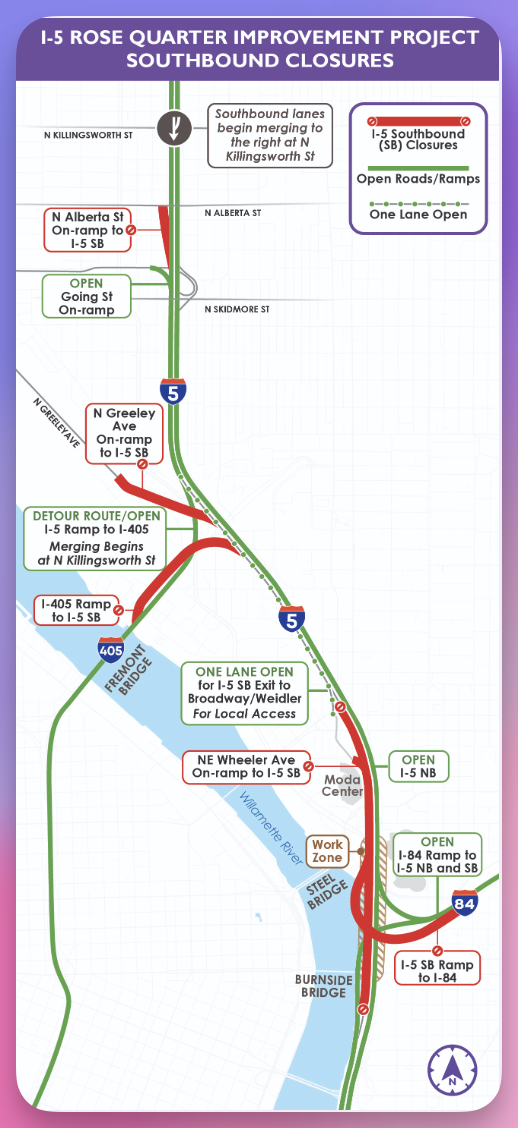
The part about my job that I probably hate the most is my commute. I’ve basically had the same drive to and from work for about 28 years. That means I know the drive like the back of my hand. It also means, sadly, that my patience with drivers along that route is pretty thin. This is a problem; I admit it. My Buddhist practice, honestly, only helps so much. Indeed, my vibrant commentary while driving on Portland’s freeways have become a bit of a joke amongst my family and friends. Indeed, my daughter all the bad words (mostly likely) from being in the car with me. I’m not proud of this, but it is the truth.
So, that means that the ‘carmageddon’ that is going to start in two days on Friday, September 11 is going to be a real challenge for me. I am trying to see it as a great opportunity to practice patience and the stoic idea of not getting upset by things you can’t control. I’ll report back later in the month and talk about how it is going. For now, this is me planting a flag publicly that I am ready for the challenge. I’ve already got my secret route home mapped out in my head. We’ll see if 1) it is ultimately necessary, and 2) if it works.
Wish me luck.
5 Recommendations
- Blog Post by The Grim Historian: Has America Crossed the Asshole Threshold?
This is a must read. I plan on having my AP Gov students read this soon.
- Normal Tools Website
This website contains links to digital tools that we all need from time to time, like a pdf merger. What’s nice is that they are all in one place and the links take you to sites that don’t require sign ups or credit cards.
Dan Koe is the man. The dude’s selling something, but he is a very original thinker whose takes are often nuanced and contrarian. With more than 1.4 million subscribers, he’s earned an audience. I liked this video because I agree with his take on people’s views of AI. He gives a shout out to Ken Wilber’s work and ideas, too.
- The Intentional AI podcast with Chris Bailey and David Sparks (aka Mac Sparky)
I’ve been listening to other podcasts that these dudes host for a while. This podcast is pretty new and approaches AI from the perspective of a modern knowledge worker, but without either the hype or doomerism. Highly recommend to those who want to learn how to better use this new technology.
- Angela Duckworth’s new book, Situated.
Duckworth is a psychologist who teaches at the University of Pennsylvania. She wrote a massively popular and influential book many years ago called Grit, which I love. This book, while I haven’t read it yet, builds on her earlier book and takes into account pushback she received about Grit. As a parent and an educator, I can’t wait to read it.
Priceless
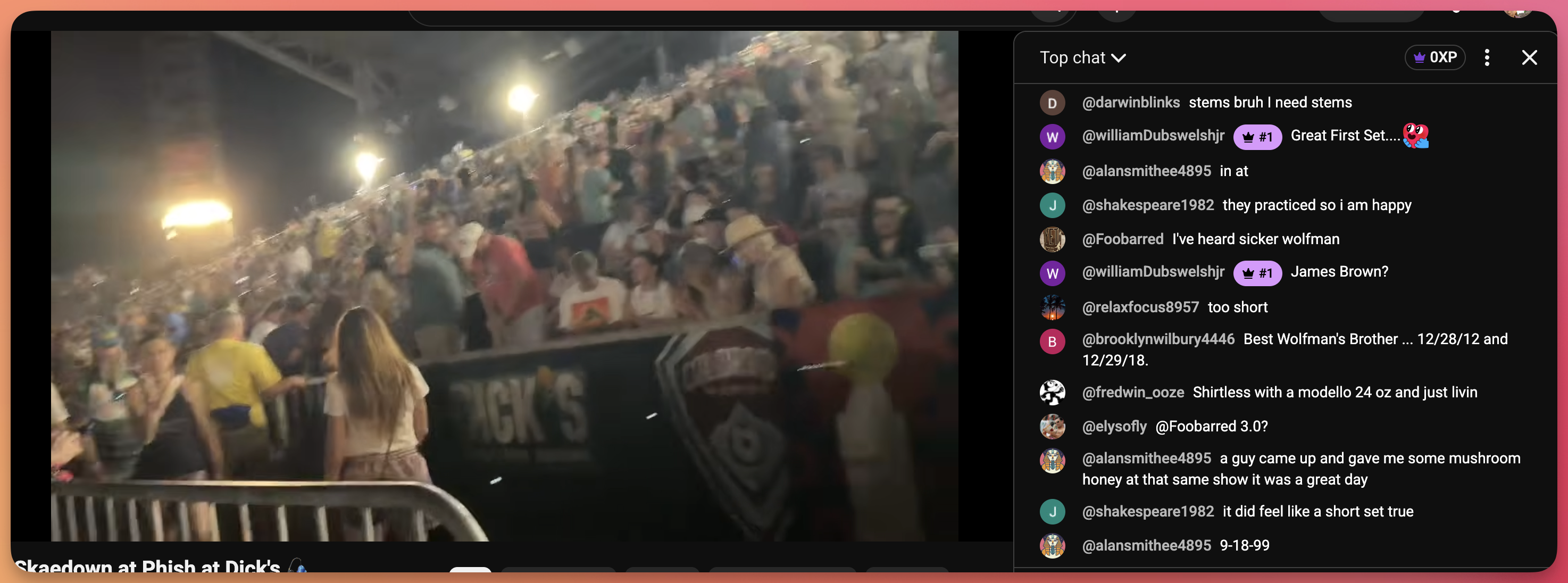
Modern life grates in many ways. However, there are also quite a lot of elements I greatly appreciate. For instance, right now I am sitting in my favorite reading chair on a Friday night watching my beloved Stanford Cardinal play football (not very well at the moment) against Miami down on The Farm, while simultaneously listening (and half watching) a live stream from the floor of Phish’s first set at ‘Dick’s’ in Commerce City, Colorado where I have several friends dancing the end of summer away. This sort of entertainment may seem standard in our day and age, but I don’t take it for granted. Grooving to a unique jam, knowing your friends are there in attendance, while watching your favorite football team play, while sneaking in some reading at the same time is, as the old, classic Mastercard ad said, priceless.
Current Stack
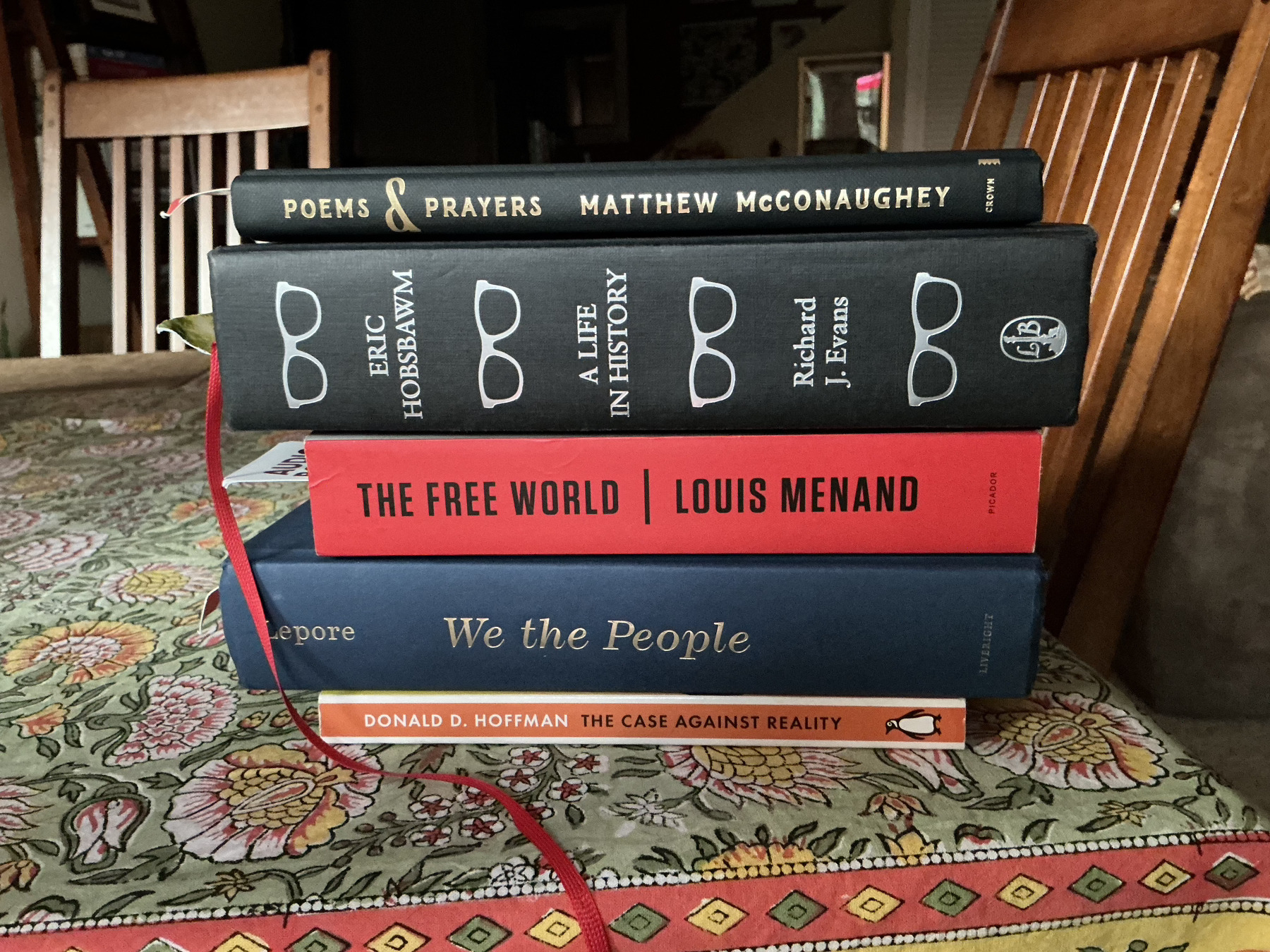
Being summer, I had more time to read than usual and as a result I was able to finish 6 books this month. I don’t anticipate finishing that many in September. The pictures below show my current stack. The novel Red Rising came highly recommended and at about 70 pages in I feel like it is starting to get interesting. The Hobsbawm biography is interesting because it blends several elements I like, history, political theory, and biography. That’s the one I find myself migrating too most often.
I just started the Mathew McConaughey book yesterday. I enjoyed his memoir Greenlights very much. This is a book of poetry, so it is a bit of a wild card. I don’t read much poetry, but after having read his first book, I felt open to what he has to offer in the way of words. So far, so good, though I suspect a poetry snob would think me foolish.
The Jill Lepore history is a slog. For whatever reason, the late 18th century doesn’t spark my interest at the moment. I’ll keep chipping away. Her American history book These Truths was so good, she’s earned my continued focus and attention. The philosophy book is also a difficult read. The ideas are interesting, but require my morning attention, and I do most of my reading in the afternoon, when I am apparently not quite sharp enough for such esoteria.
Nevertheless, I am grateful for my good fortune to have the time, money, and physical ability to continue reading what interests me.