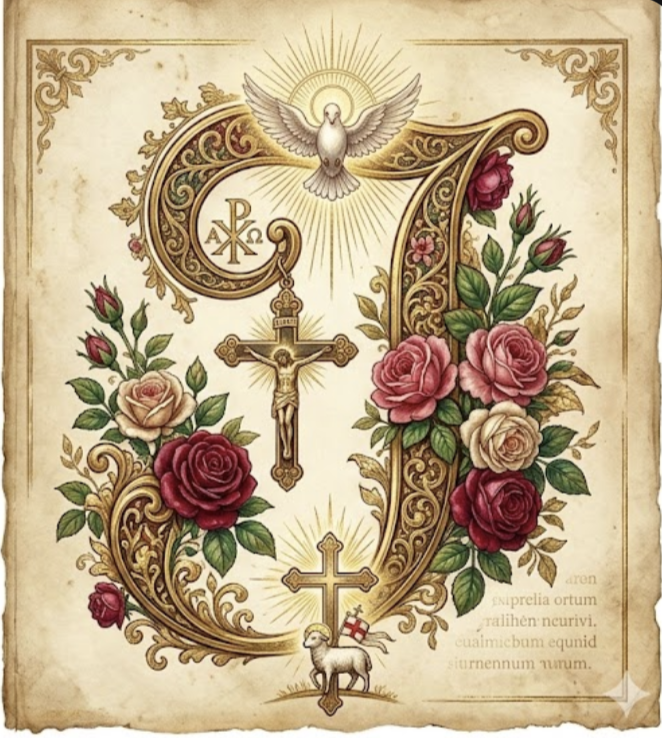
On the Letter J
Those that know me know I have a personal interest in the letter J. I recently learned that it was the most recent letter added to the alphabet. It apparently appears after the letter ‘i’ because it started as a flourish to that letter at the end of a Roman numeral, what is known as a swash.
Take “XIIJ”, or 13. In this case the ‘J’ is used in the place of the last ‘I’ to signify that a series of ones has ended. Apparently, ‘i’ and ‘j’ were used interchangeably to write both the consonant and vowel sounds, The first time the two were distinguished as separate letters was in a 1524 text called (in English) ‘Trission’s epistle about the letters recently added in the Italian language’, written by Gian Giorgio Trissino (1478-1550).
Jesus plays a role, too. Distinguishing the soft ‘j’ sound helped Trissino choose how the Greek word Iesus, a translation of the Hebrew Yeshua, should be spelled, and pronounced, the way it is today.
Change takes time though, and as late as the mid-1700s, English lexicographer Samuel Johnson still argued that ‘j’ was merely a variant of ‘i.’
Not surprisingly, the letter ‘j’ is one of the least common letters in English.