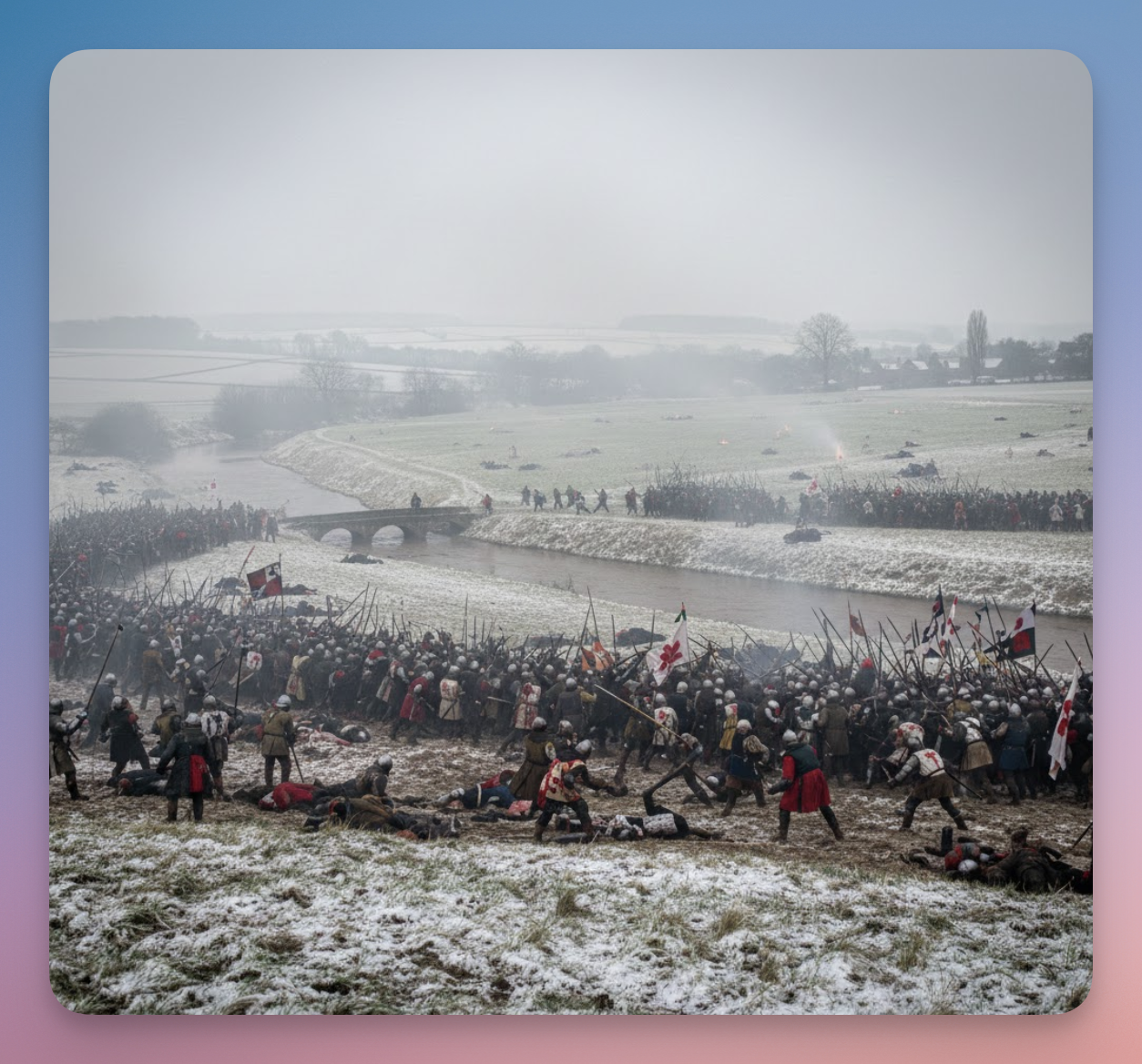
The Bloodiest Day in English History
I came across a reference to the Battle of Towton while reading Neil Howe’s fascinating The Fourth Turning is Here — a book I’ve been pretty absorbed in the past few days, as I mentioned in a recent post. Howe’s central argument is that history moves in cycles, and that every eighty years or so, societies go through a violent, transformative upheaval. Towton shows up in the narrative as a decisive event in the War of the Roses.
Towton was fought on Palm Sunday, March 29, 1461, in the middle of the war, which was England’s brutal dynastic civil war between the Houses of York and Lancaster. The Yorkist forces of the newly proclaimed Edward IV clashed with a massive Lancastrian army in what became, by most accounts, the deadliest battle ever fought on British soil. Estimates of the dead range widely, but tens of thousands of men were likely killed in a single day of savage fighting. When the Lancastrian line finally broke, the retreat turned into a massacre, with fleeing soldiers cut down across the fields and meadows of Yorkshire.
The mentioning of Yorkshire jumped out at me because I spent my junior year abroad at Sheffield University, which sits maybe 35 miles south of where all this took place. I remember the landscape outside of Sheffield fairly well. What comes to mind are the rolling green hills shrouded in fog, the old stone walls, and the way the countryside feels ancient. To think that one of the most violent days in human history happened just up the road is a bit mind-bending.
Howe’s book has me looking at history differently. As I touched on in an earlier post; less as a straight line and more as a recurring pattern of crisis, renewal, and crisis again. The Battle of Towton is a reminder that those cycles can be extraordinarily brutal. England in 1461 wasn’t so different from other moments in history when political order collapses and people settle their differences in the worst possible way.
Worth remembering, in whatever turning we happen to be in right now.