The View from Germany and the UK
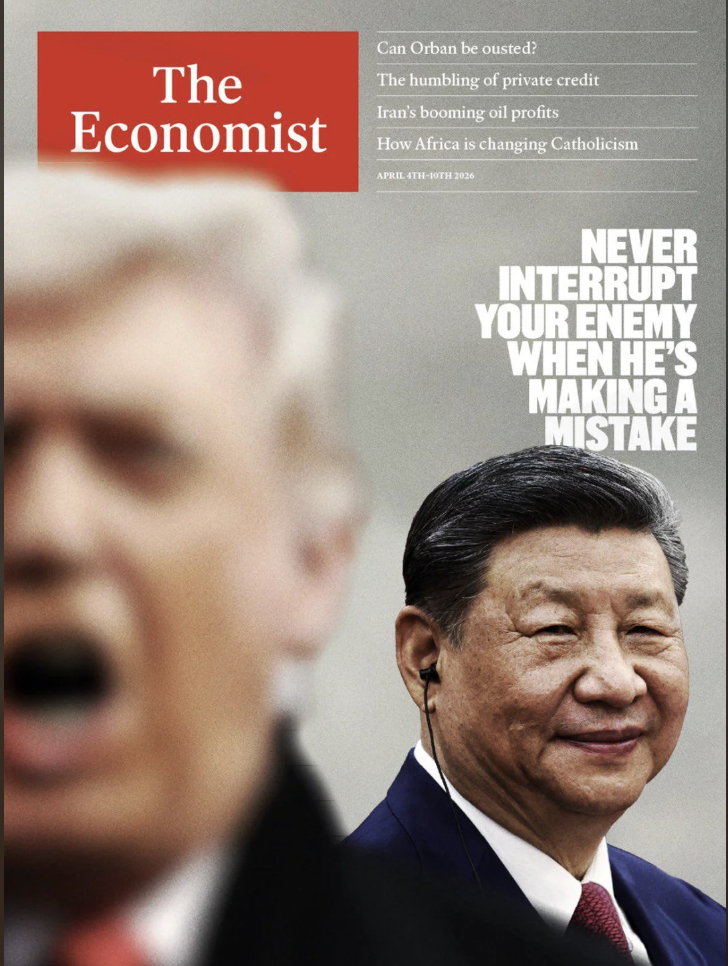
After yesterday’s ‘day late and a dollar short’ address about the Iran War by the faux-king president, I came across two European takes. The first is from the the authoritative German magazine Der Spiegel. The translation below comes from a @Burgerb on Reddit. The second take is the new cover of the great U.K. news magazine The Economist.
Translation from German:
The Strategic Catastrophe of the Iran War
“He appeared tired. When Donald Trump addressed the nation on Wednesday evening to explain for the first time why he had led his people into a war with Iran, he spoke for nineteen minutes and said nothing new. Instead: boasting, threats, exaggeration. He spoke of bombing the Iranians back to the Stone Age—a remarkable strategy for winning the ‘hearts and minds’ of the local population. He said he would destroy the power plants. He would be finished in two or three weeks. He held all the cards. He had won.
Trump again spoke of Venezuela as a shining example for Iran—referring to the kidnapping of the local ruler, Nicolás Maduro. But in doing so, he only illustrated how badly he had misjudged the Iranian regime from the start. At the same time, he called Iran one of the most powerful countries in the world. Yet, even before the war, Iran was at best a middle power. What we saw was the opposite of control. It was the image of a man who has stumbled into an adventure for which he can find no end.
The Reality: There is no regime change, no surrender, not even negotiations. The regime has not become more pragmatic through the war, but more radical. Instead of a containment of the Iranian nuclear program, an expansion could follow the war. And with far inferior means, Iran has shown that it can take the world economy hostage at the Strait of Hormuz. Trump claims that is not America’s problem. Others should take care of it.
The head of the International Energy Agency calls what could follow the greatest energy security threat in the history of the world—worse than the oil shocks of the seventies, worse than Covid, worse than the Russian attack on Ukraine. In the Philippines, there are already four-day weeks. In India, people are once again cooking over wood fires.
With this aimless war, the American empire is not only burning its political capital. It is literally burning its ammunition. Over 850 Tomahawk cruise missiles have been fired—replenishing the arsenal takes years. While America is tied up in Ukraine and actually wanted to focus on the Pacific, it is wearing down its military in the Middle East of all places, where Trump allegedly never wanted to lead his troops again. The Iran war is a strategic catastrophe for the USA.
Imperial powers rarely destroy themselves through defeats. They destroy themselves through overconfidence—through the belief that military superiority alone means power. Rome is the oldest lesson: its legions remained effective until the end. What decayed first were the institutions. The British Empire shows the same pattern, only faster: in the 19th century, the Royal Navy was superior to any other fleet, and yet London got bogged down in too many wars on too many continents. Every single campaign was winnable. Together, they ate up the capital that held the empire together: the finances, the alliances—and the allies' belief that London knew what it was doing.
The United States did not win its global position through battlefields alone. After 1945, they created a system in which others participated voluntarily: institutions, alliances, dollar hegemony, moral credibility. Political capital, saved over generations. Trump is currently gambling it away systematically.
In Europe, Secretary of State Rubio has threatened to “review” NATO after the war ends—the clearest questioning of the alliance by a sitting U.S. Secretary of State in its history. Allies whose bases America wants to use for a war they do not support are insulted as cowards. In the Middle East, Trump publicly boasted that the Saudi Crown Prince had not expected to have to “kiss his ass.” Allies treated this way will not put up with it forever.
While Washington fires off its ammunition and damages its alliances, Beijing only has to wait. The Economist put a smiling Xi Jinping on its cover looking at Trump, with a line attributed to Napoleon: Never interrupt your enemy when he is making a mistake. Xi has built up strategic oil reserves for several months, secured supply chains, and is betting heavily on renewable energies. China’s three largest battery manufacturers are together worth $70 billion more since the start of the war. Trump’s America, the most fossil-fueled government in the Western world, is accelerating the energy transition—in China’s favor. There is a bitter irony at the core of Trumpism: He is obsessed with the decline of America. And he is accelerating it.
And at home? In his speech, Trump explains that America can afford wars—but not childcare, not Medicaid, not Medicare. The cost-of-living crisis was already the dominant issue in the country before the war. Now come rising energy prices. People who can no longer afford life eventually present the bill. In the midterm elections in November.
Trump asked Americans to put the war into perspective. Vietnam lasted almost twenty years, Iraq almost nine. His war has only been running for a good month. You have to read that twice to understand what it means: Don’t worry, there are much worse wars I could lead you into.”