Buddhism
The Challenge of Portland's Upcoming Carmageddon
The part about my job that I probably hate the most is my commute. I’ve basically had the same drive to and from work for about 28 years. That means I know the drive like the back of my hand. It also means, sadly, that my patience with drivers along that route is pretty thin. This is a problem; I admit it. My Buddhist practice, honestly, only helps so much. Indeed, my vibrant commentary while driving on Portland’s freeways have become a bit of a joke amongst my family and friends. Indeed, my daughter all the bad words (mostly likely) from being in the car with me. I’m not proud of this, but it is the truth.
So, that means that the ‘carmageddon’ that is going to start in two days on Friday, September 11 is going to be a real challenge for me. I am trying to see it as a great opportunity to practice patience and the stoic idea of not getting upset by things you can’t control. I’ll report back later in the month and talk about how it is going. For now, this is me planting a flag publicly that I am ready for the challenge. I’ve already got my secret route home mapped out in my head. We’ll see if 1) it is ultimately necessary, and 2) if ti works.
Wish me luck.

5 Public Intellectuals I Keep Tabs On
I’ve written before here about my respect for the late intellectual Christopher Hitchens. Boy, could we use his wit nowadays! There are other living writers, thinkers, and pontificaters that I continue to enjoy learning from. Here are 5 of them.
1. David Brooks
Brooks was a long time columnist for the New York Times, one of their ‘conservative’ writers. He is also the author of several 5-star books, including The Social Animal, The Second Mountain, and How to Know a Person. Brooks has moved to the center over the past 10 years or so. While I don’t agree with all his takes, I admire his thoughtfulness and his willingness to acknowledge changes to his thinking on important issues.
2. Sam Harris
Sam Harris pisses everybody off. Liberals don’t like him because he condemns the ideology hiding behind organized monotheistic religions, and conservatives don’t like him because he is one of the most effective verbal butchers of MAGA stupidity. He’s also an AI doomer, which can be off putting to those who are AI optimists. Most importantly though, Harris speaks clearly about the benefits of a meditation practice and his app Waking Up is arguably one of the most comprehensive secular tools for waking up from the ongoing and persistent delusion of the self.
3. Ryan Holiday
Holiday is a writer, book store owner (yes!), podcaster, and general promoter of Stoic wisdom. His books, like those by Brooks and Harris, are fantastic collections of history and all-purpose wisdom. He also walks his talk regarding virtue, calling out racism and greed that are commonly dressed up as patriotism and ‘family values.’ And did I mention he likes great music?
4. Shane Parrish
Parrish is the Canadian writer and podcaster behind the Farnam Street blog, which is a trove of wisdom about the human condition. He is also thoughtful, smart, and his work is consistently offering new and interesting ideas to explore further. Parrish, unlike the others on this list, generally avoids politics.
I’ve been a fan of Prof G, as he is affectionately known, since I first came across his podcast. Like Harris and Holiday, he is an outspoken critic of the current state of American politics and I tend to agree with most of his ideas. He can be off putting in the sense that he is often crude and has a juvenile sense of humor, but when it comes to the intersection of economics and politics I find that I am nearly always in agreement with him. He also promotes what I consider to be a much healthier version of masculinity, which is important when there are so many tools promoting toxic masculinity online. Galloway’s book Adrift, which I finished reading about a week ago, is also worth reading.
Update to My Daily Wisdom Reminder Protocol
I shared before that I use Notebook LM (on most days) to provide myself with highly curated daily reminders. Yesterday I spent some time building a new Notebook LM that includes curated ‘reminders lists’ from smart people like Morgan Housel. I then used Notebook LM to distill the various lists into a ‘study guide.’ I then shared that study guide with my already created ‘Buddhist and Stoic Wisdom" notebook that I use for my daily reminders.
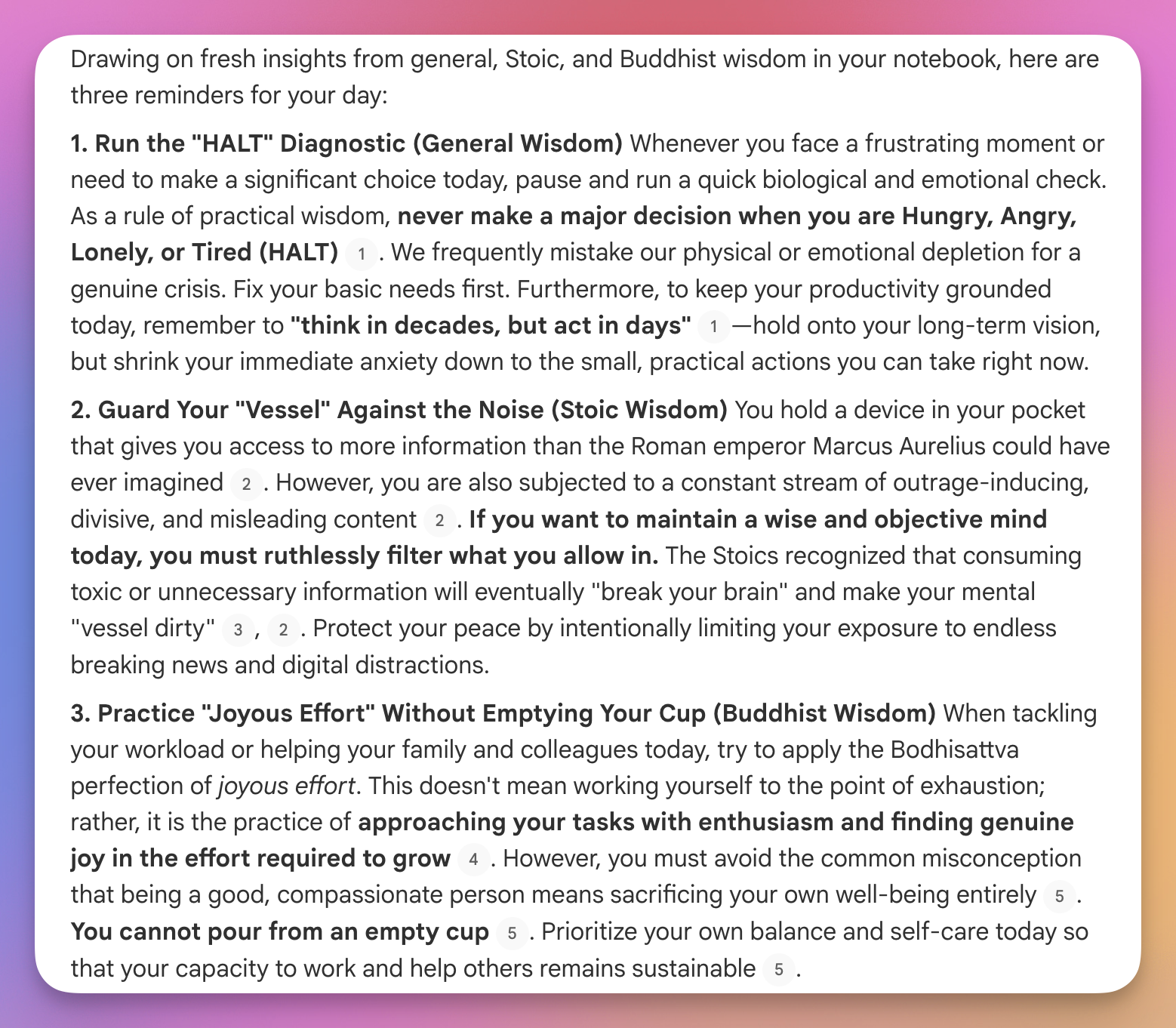
When asking for reminders today I asked that it included a newly added ‘general’ reminder, pulled from the study guide I created. Below is a screenshot of today’s reminder output. I’m pleased with the result and look forward now to getting 1) a general life reminder, 2) a Stoic wisdom reminder, and 3) a Buddhist wisdom reminder.
As I said before, a lot of people will likely find this practice useless and a waste of time. However, I need the constant drip-drip of wisdom or wisdom doesn’t sink into my mind. Current consensus about learning supports my practice, particularly around the benefits of spaced repetition.
The Possible Connection Between Bodhisattva Guanyin and the Nestorian Christians
I’ve been working my way through a Great Courses class on the Middle Ages, and it sent me down a bit of a rabbit hole I wasn’t expecting: the feminization of Guanyin, the beloved Buddhist “Goddess of Mercy.” As someone who has had Avalokiteśvara on our family altar for twenty years, I found this story interesting.
Guanyin is famously female. But here’s the thing: Guanyin started out as a dude. The original figure — Avalokiteśvara in Sanskrit — was a male bodhisattva, essentially a handsome Indian prince of compassion. Early Chinese Buddhist art reflects this clearly. Indeed, paintings from the Dunhuang caves dating to the tenth century show the figure with a moustache. The full feminization into the graceful, white-robed goddess we recognize today was largely complete by the Song Dynasty, making it a uniquely Chinese transformation.
So why the change? Mostly internal Chinese forces, including the needs of laywomen for a relatable female figure, Confucian social dynamics, and the gradual indigenization of Buddhism as it took root in China. The folk legend of Miao Shan, a compassionate princess who sacrifices herself for her father, became enormously influential in giving Guanyin a distinctly feminine Chinese biography.
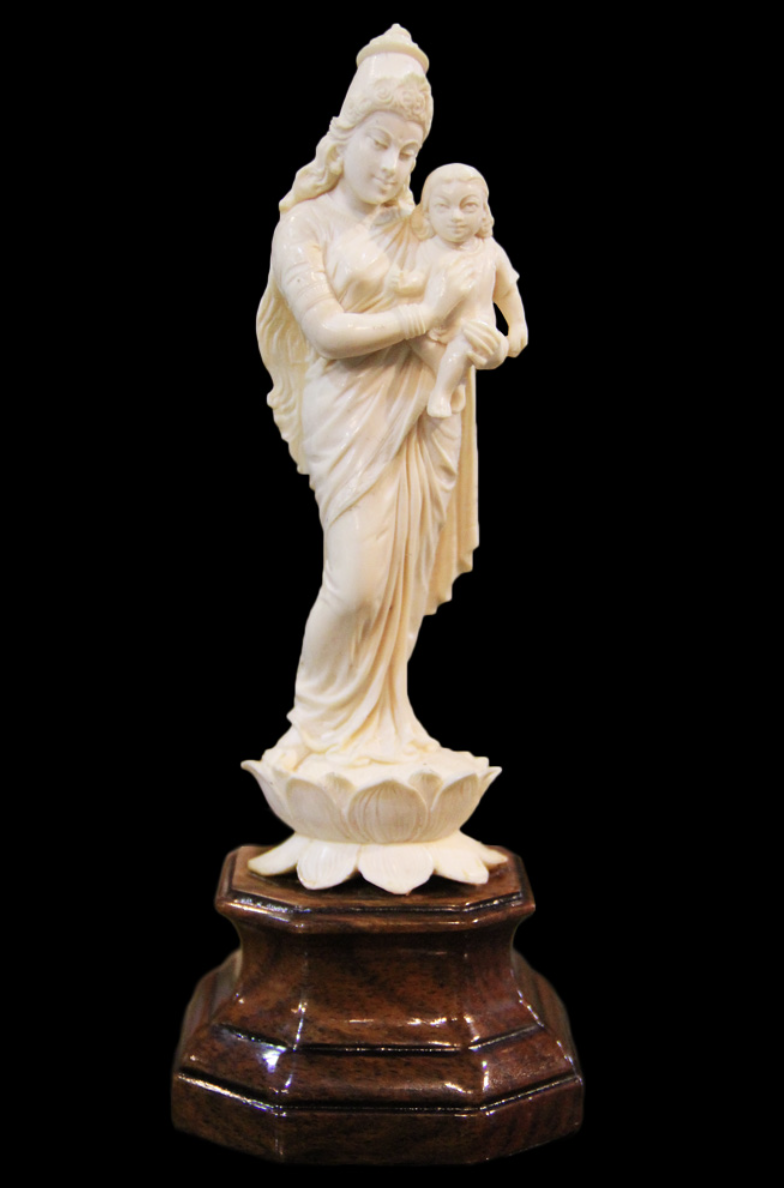
But here’s where it gets really interesting and what specifically stoked my initial curiosity about this. Some scholars argue that the Nestorians — a Christian sect that traveled the Silk Road and established a presence in Tang Dynasty China — may have nudged things along. Their veneration of Mary, and specifically stories of holy women who were pure and compassionate intermediaries, may have influenced how Chinese people imagined a female divine figure. The “child-giving” Guanyin, holding an infant in a pose unmistakably reminiscent of the Madonna and Child, likely reflects later Jesuit influence in the Ming Dynasty, but according to professor teaching the Great Courses class I am learning this from, the Nestorians may have planted some earlier seeds. Crazy!
Apparently this is not totally settled among scholars. Nevertheless, the idea that a modern female Buddhist bodhisattva may have transformed from male to female in part due to a small Christian sect that settled in Asia in the 630s is nuts. This is the sort of story that illustrates why I love learning history.
Reflecting on the Ides of March
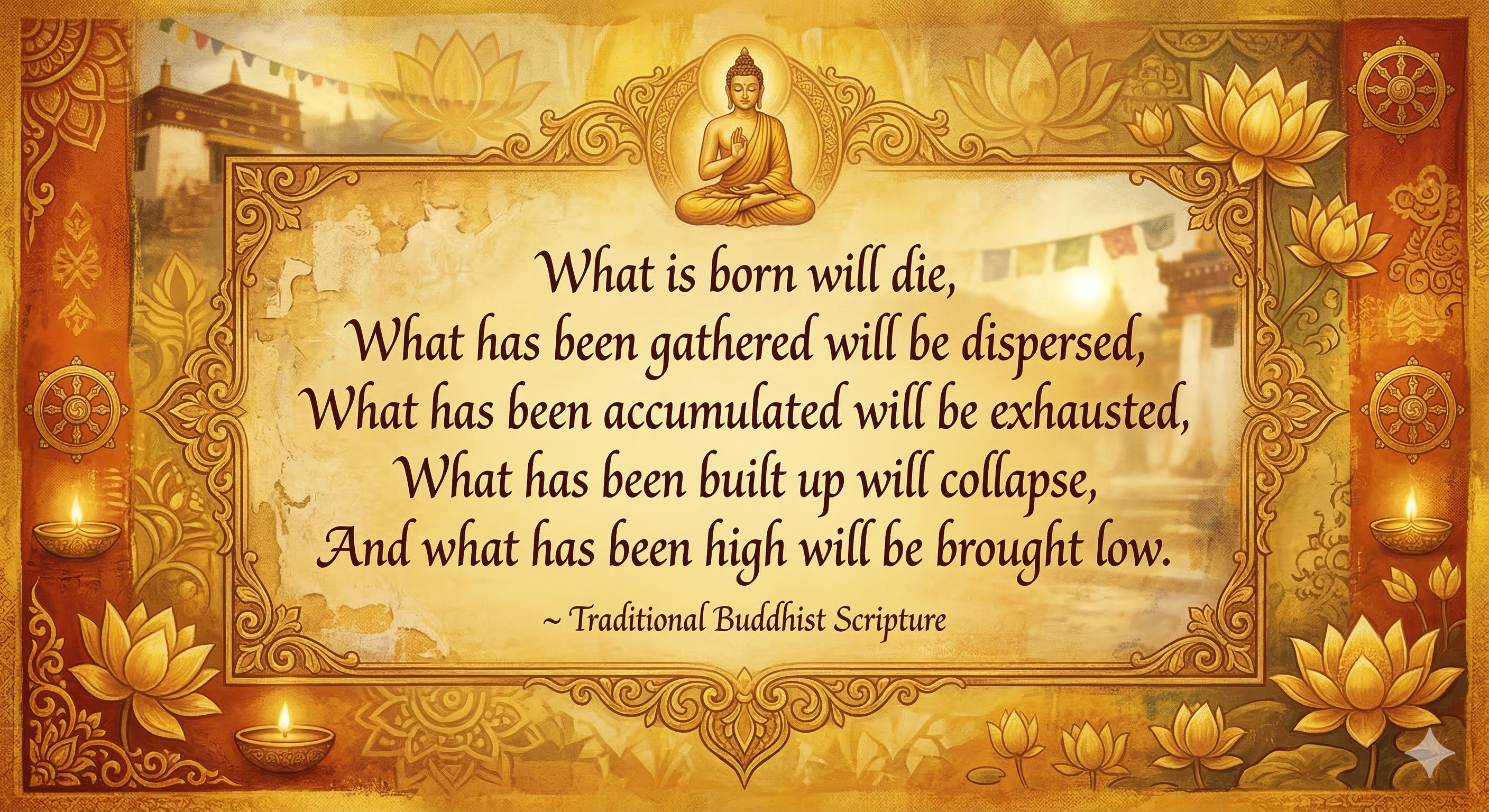
Yesterday was the Ides of the March, the anniversary of the violent fall of Julius Ceasar. The Buddhist scripture below came to mind today when thinking about the date.
Caesar, of course, had “gathered” absolute power and “built up” an empire, yet in a single afternoon, that height was brought low. The transition from the zenith of Roman authority to a cold stone floor is a reminder that no amount of worldly accumulation can stall the inevitable cycle of death and decay. It’s a sobering reminder: even the most monumental human achievements are ultimately subject to the same laws of exhaustion and dispersal as the smallest flower.
Indeed, ‘there is nothing you can hold for very long."
New Pew Polling on Buddhism in America
The Pew Research Center recently published polling about Buddhism in America. A few interesting facts include the following:
-
As of 2020 only about 1.3% of the U.S. population was Buddhist.
-
American Buddhists are much more likely to live in the West. This isn’t surprising considering the West Coast’s relative proximity to Asia.
-
There is high turnover in that many who are Buddhist converted and many who were Buddhist left the religion.
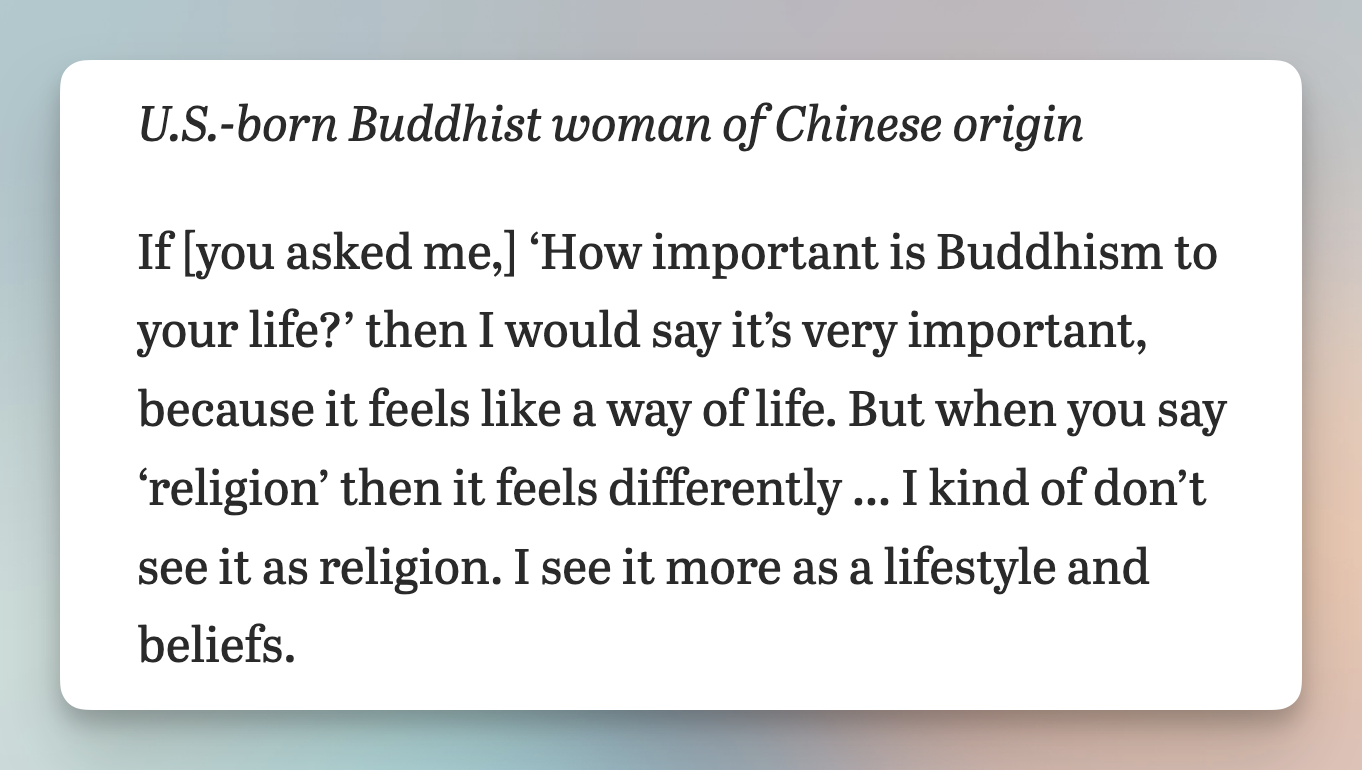
I, of course, live in the West so I am a typical ‘American Buddhist’ in that regard. I also connect with the fluidity of being Buddhist, as I was raised with no religion and my specific beliefs about Buddhism have evolved over the past 30 years since I intially took refuge in the Three Jewels. In my case, I’ve moved from being more religous to what I’d describe as a ‘secular Buddhist.’
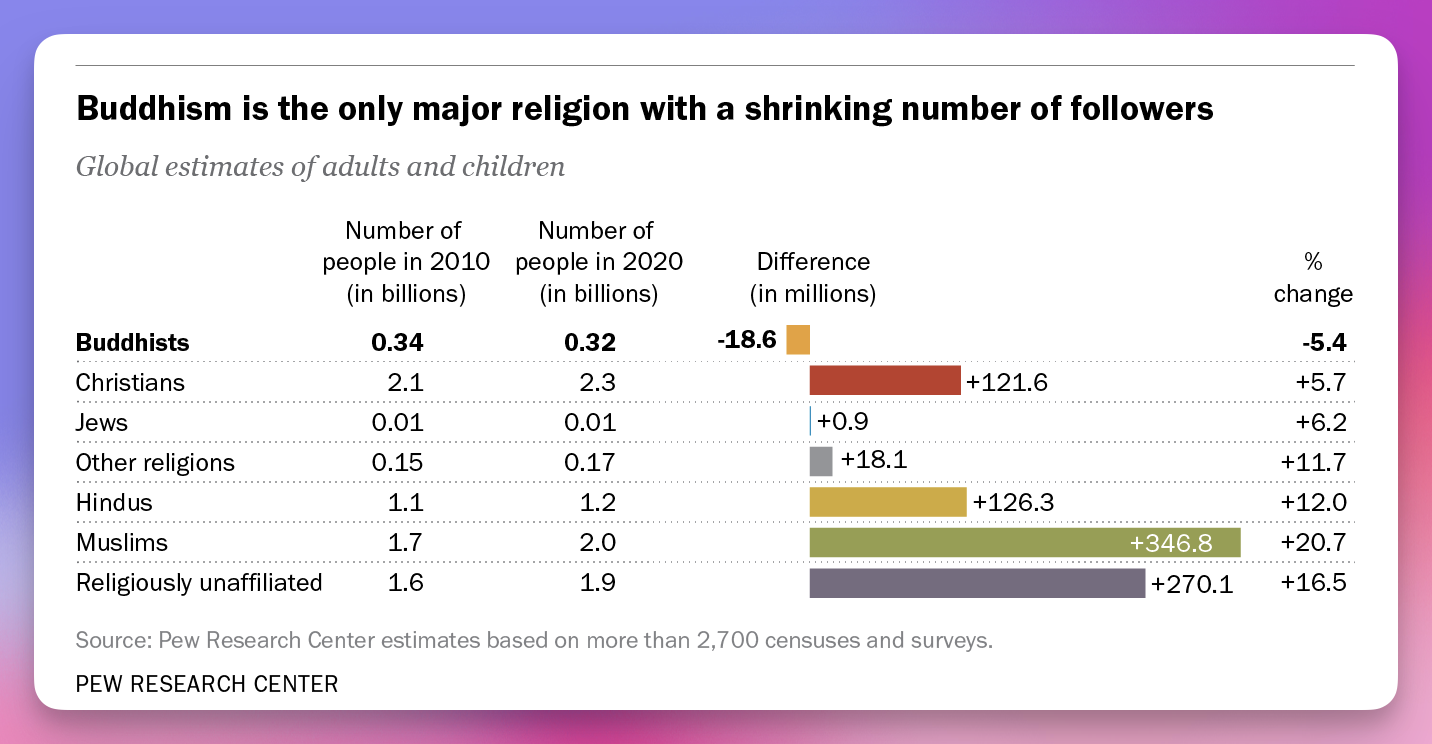
Pew also reports that Buddhism is shrinking world wide. I take heart that ‘religiously unaffiliated’ is a growing group worldwide. Sadly, the theistic religions continue to grow. (See the second image below)
The quote shared below is from Pew’s related focus group interviews.