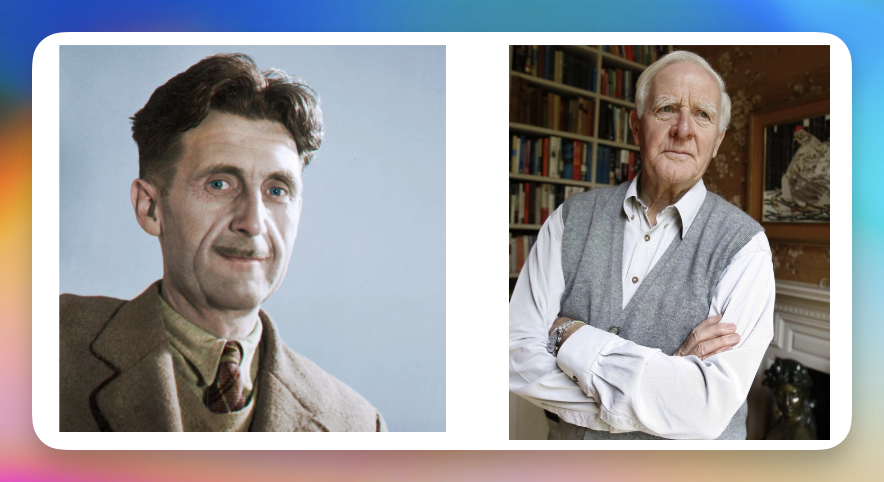
Orwell & le Carré
I love reading biographies. A sub-genre of biography that I like are those written about writers. One of the books I am reading now is a biography about the thriller writer John le Carré. Have I read any of le Carré’s books yet? No, not yet. Nevertheless, the life of a successful writer is endlessly fascinating to me.
Another book I just started (that I am really enjoying) is Louis Menand’s Free World: Art and Thought in the Cold War. In it, Menand has a long section about the writer George Orwell. Like most Gen Xers, I read Orwell’s 1984 and Animal Farm in middle school and/or high school. However, I didn’t know much about him. What struck me right away are some of the similarities between le Carré and Orwell.
Here are a few:
-
Both were British writers.
-
Both wrote with pen names. le Carré’s real name was David Cornwell. Orwell’s given name was Eric Blair.
-
Orwell attended Eton College (which isn’t actually a college) in his youth and le Carré taught there.
-
Both were anti-Stalinist. Orwell was famously a leftist, but was never a fan of Stalin, which helped him to stand against many of his fellow leftists in the early years of the Cold War. le Carré actually worked for a time for the British secret service in the Cold War (experiences which helped lead him to become a writer of spy novels).
-
Both writers were deeply skeptical of concentrated power. Whether it was Orwell’s critique of totalitarianism in 1984 or le Carré’s critique of the “Circus” and the cynicism of Western bureaucracy, both viewed big institutions as inherently dehumanizing.
-
Both lived lives characterized by a sense of not quite belonging. Orwell was an highly educated man who spent years living among the “down and out” ; le Carré was a spy who felt like an outsider within his own service due to his father’s criminal background.
-
Finally, both authors were fiercely independent thinkers who refused to follow a party line. Orwell was a socialist who critiqued the Left; le Carré was a patriot who remained one of the most vocal critics of British and American foreign policy (particularly the Iraq War).