People
No One's Disciple
I’m not sure how long this will be up on Youtube, but it is up now. I’m talking about the new tribute documentary about Rush drummer and lyricist Niel Peart. This is a must watch for any Rush fan, and frankly any fan of late 20th century rock music.
This is also an appropriate time to recommend Niel’s brilliant memoir Ghost Rider. The TL;DR is that Niel suffered the death of his only daughter and then his wife within 10 months then took the roads of North America on his BMW motorcycle to process his losses. The book is a meditation on death, as well as a travelouge. Read it if you haven’t already.

RIP Dolly Parton
Another musical legend passed away today, the very well loved Dolly Parton. She was 80 years old. I was not a fan of her music, but everything that I’ve read about her makes me like her. To be clear, I did think she had a wonderful voice, I just never listened to her music much. However, I was well aware of her philanthropy. Perhaps her most well known giving had to do with reading. Her father grew up illiterate in Appalachia so Dolly started a program called the Imagination Library that, according to their website, has gifted over 332 million books to young children! The way it works is that a child can be signed up and will then receive a book each month until they are 5 years old. So cool!
As a massive Judas Priest fan, I also need to mention Dolly’s relatively recent collaboration with Priest’s Rob Halford.
Here is a link to the New York Times obit.

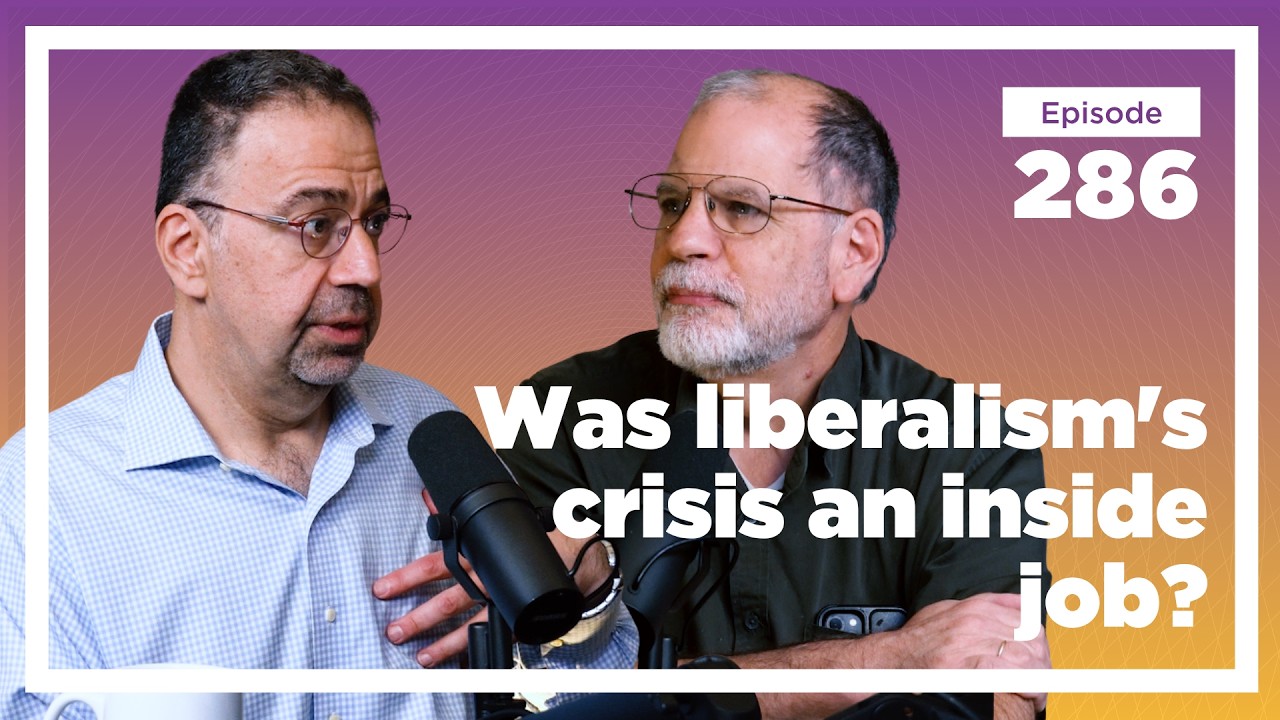
Daron Acemoglu on What Happened to Liberal Democracy
I have read two of Daron Acemoglu’s books, Why Nation’s Fail and The Narrow Corridor. Both books were co-authored and hard books to read because the arguments were a mix of history, economics, and politics. Challening but fun reads. Acemoglu has a new book out called What Happened to Liberal Democracy? that I definitely want to add to my TBR pile. He’s also a Nobel Laureate in Economics.
He is making the rounds to promote his new book. Below are two interviews worth listening to, especially if you aren’t planning on reading the book.

5 Public Intellectuals I Keep Tabs On
I’ve written before here about my respect for the late intellectual Christopher Hitchens. Boy, could we use his wit nowadays! There are other living writers, thinkers, and pontificaters that I continue to enjoy learning from. Here are 5 of them.
1. David Brooks
Brooks was a long time columnist for the New York Times, one of their ‘conservative’ writers. He is also the author of several 5-star books, including The Social Animal, The Second Mountain, and How to Know a Person. Brooks has moved to the center over the past 10 years or so. While I don’t agree with all his takes, I admire his thoughtfulness and his willingness to acknowledge changes to his thinking on important issues.
2. Sam Harris
Sam Harris pisses everybody off. Liberals don’t like him because he condemns the ideology hiding behind organized monotheistic religions, and conservatives don’t like him because he is one of the most effective verbal butchers of MAGA stupidity. He’s also an AI doomer, which can be off putting to those who are AI optimists. Most importantly though, Harris speaks clearly about the benefits of a meditation practice and his app Waking Up is arguably one of the most comprehensive secular tools for waking up from the ongoing and persistent delusion of the self.
3. Ryan Holiday
Holiday is a writer, book store owner (yes!), podcaster, and general promoter of Stoic wisdom. His books, like those by Brooks and Harris, are fantastic collections of history and all-purpose wisdom. He also walks his talk regarding virtue, calling out racism and greed that are commonly dressed up as patriotism and ‘family values.’ And did I mention he likes great music?
4. Shane Parrish
Parrish is the Canadian writer and podcaster behind the Farnam Street blog, which is a trove of wisdom about the human condition. He is also thoughtful, smart, and his work is consistently offering new and interesting ideas to explore further. Parrish, unlike the others on this list, generally avoids politics.
I’ve been a fan of Prof G, as he is affectionately known, since I first came across his podcast. Like Harris and Holiday, he is an outspoken critic of the current state of American politics and I tend to agree with most of his ideas. He can be off putting in the sense that he is often crude and has a juvenile sense of humor, but when it comes to the intersection of economics and politics I find that I am nearly always in agreement with him. He also promotes what I consider to be a much healthier version of masculinity, which is important when there are so many tools promoting toxic masculinity online. Galloway’s book Adrift, which I finished reading about a week ago, is also worth reading.
On William T. Sherman
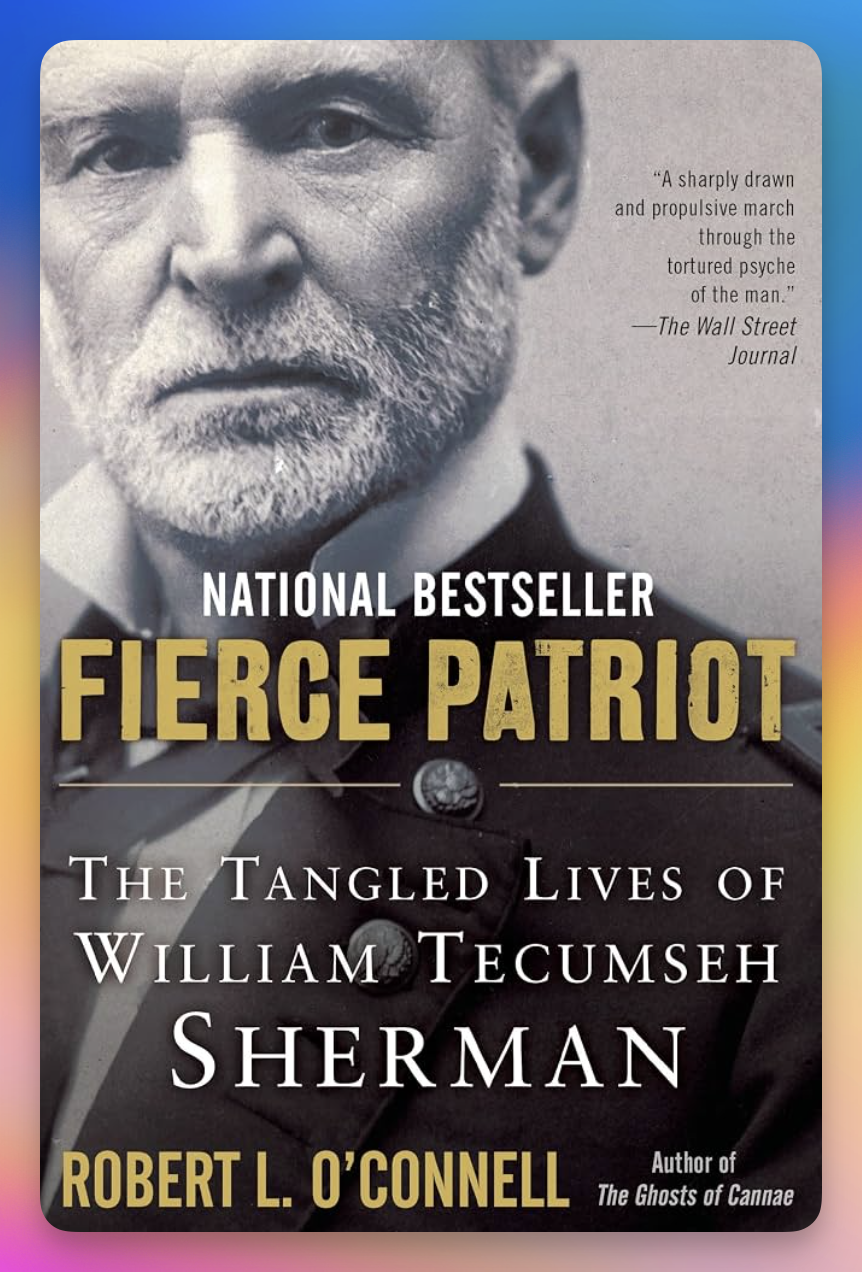
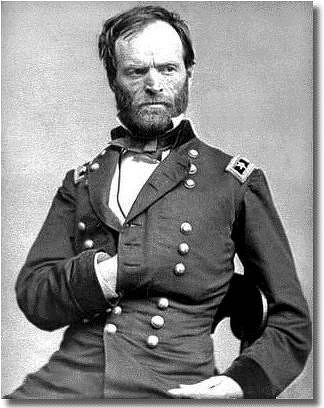
I’ve written about William Tecumseh Sherman before. However, I am inspired to share a little more about him as I am partway through Robert L. O’Connell’s wonderful, and relatively short, biography of the American warrior.
Here are 5 facts interesting facts about Mr. Sherman.
-
His middle name comes from the great Shawnee warrior Tecumseh who fought against the Americans in the War of 1812. This was something I was familiar with because Tecumseh comes up in my APUSH curriculum.
-
Sherman had 10 other siblings and his father died when he was young, so he and several of his siblings were orphaned out to family and friends. In Sherman’s case, he was adopted by a wealthy, good friend of his father’s named Thomas Ewing. The Ewings also took in William’s brother John, who would go on to become a congressman and the author of the famous (if ineffectual) Sherman Anti-trust Act of 1890.
-
Sherman was one of the first government officials to verify the discovery of gold at Sutter’s Mill in what is now Sacramento. He had been stationed a bit south along the California coast during the Mexican War (he was bummed not to be near where the fighting was). Nevertheless, he visited Sutter, saw what had been discovered, and mailed gold dust with confirmation to Washington, helping to start the California Gold Rush.
-
Sherman married his foster sister, a woman named Ellen Ewing. They weren’t blood siblings, but to the modern eye it still seems a bit off. And it was a bit off then, too. But they got married anyway in 1850.
-
Because his foster dad/father-in-law was a very well connected politician from Ohio, many powerful politicians from that era attended their wedding in Washington DC. Their wedding guests included the current president, Zachary Taylor (a military man, like Sherman), members of the cabinet, and congressional giants Henry Clay and Daniel Webster. It was definitely a Whig wedding.
William Tecumseh Sherman was clearly an interesting dude.
And yes, the Sherman tank was named after him.
That One Random College Roommate
Sometimes, we cross paths with famous people, or in my case, with people whoe who would become famous. The summer after my freshmen year in college I lived in a small, affordable apartment with two other dudes behind the Safeway in east Davis. One was my buddy MI, who I befriended in 2nd grade and with whom I am still friends. Our other roommate that summer was another Davis kid named Josh Davis. I don’t recall how it is that Josh became one of our roommates, as he was a year younger than us and wasn’t part of our crew. As I compose this, I think the connection was that he also worked at Steve’s Place Pizza, which was the local pizza joint (owned by the father of a classmate) that many of my friends worked at at one time or another during the early 90s. Yeah, that’s it–he was a Steve’s Place co-worker!
MI and I lived with him that summer, which was a fateful summer for us because it was the summer we became fully immersed in the world of the Grateful Dead, and all that that entailed. (Suffice to say, we didn’t get in to the Cal Expo shows that summer, but we did visit the parking lot.) Anyway, Josh was going in a very different direction. Keep in mind, this was 1990. Josh was getting into hip hop and had a show on KDVS, the local college radio station. From there, after parting ways with him that summer, Josh eventually became a world renowned DJ with moniker DJ Shadow. Being an era before social media and the era I went down the Grateful Dead rabbit hole, I lost touch with Josh and didn’t realize until about 15 years ago that he became a successful musician. I remember that he was a pretty chill roommate and a good co-worker.
The reason I am sharing this story today is because I came across an article announcing that DJ Shadow is playing a concert this December with the BBC Symphony Orchestra in London. Pretty cool!
An Obit, Three Recommendations, and Some Interesting News
- New York Times obit of hIstorian of the American Revolution Gordon S. Wood
I haven’t read any of Wood’s books, but many are still in print and claim real estate in most American bookstores.
- New history podcast by author of 1491 and 1493, Everyday Abundance.
Charles C. Mann has teamed up with a partner to create a cool new history podcast. This just launched, but it looks promising. Mann is the author of the popular and respected books about indigenous America, 1491 and 1493.
- Cool blog at www.kottke.org
I recently discovered this blog, which is a curated stream of fascinating links, technology, art, and culture updated daily by OG blogger Jason Kottke.
- Netflix presidential biography documentaries
I was fishing around for a relevant documentary to show to the small AP Gov classes I have this week (most of my students were seniors and their last day was last Friday). I came across this collection of Netflix documentaries about our better, more note-worthy presidents. Each series consists of a handful of roughly 90 minute episodes. They are a mix of dramatic re-enactments (with solid, look-a-like actors), real footage (for the modern presidents), and interviews with a who’s who of renowned historians, including H.W. Brands, Jon Meacham, and Doris Kearns Goodwin. I’ve now seen episodes on the two Roosevelts and really enjoyed them. My students gave them high marks, as well.
What Real Leadership Looks Like
Yesterday was the 82nd anniversary of D-Day. I spent some time in class on Friday in all my AP classes reviewing its significance. I believe strongly it is one of the seminal events in American history that all Americans need to know about (my APUSH classes are just at WW II as the year is ending). I also briefly mentioned the fact that Supreme Allied Commander Dwight D. Eisenthower had prepared two letters to share with the press that day, depending on how the invasion went. The one he didn’t have to read was the one taking full responsibility for the failure of the operation. As my students heard about this it was clear they understood this sort of leadership is very different from what they see today.
Yesterday, Heather Cox Richardson, the great historian and documenter of our times, shared the video below, which touches on Eisenhower’s willingness to take responsibility had D-Day not been successful. It is short but worth watching.

Jackson Pollock's Demise
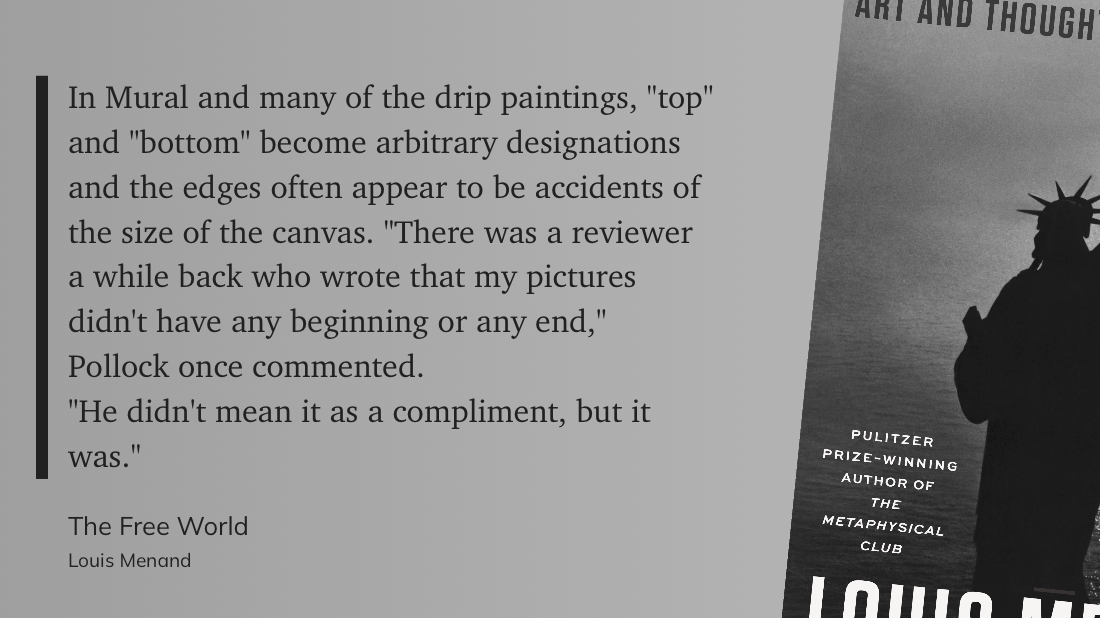
Reading Louis Menand’s The Free World I came across the section on artist Jackson Pollock. I had heard of Pollock and knew he was most famous for his unique ‘drip’ style paintings. What caught my attention about him was how his life ended. Like many, many incredibly talented artists, Pollock was an alcoholic. According to Menand, he had essentially stopped making art in 1954, but kept boozing. He also suffered from depression. On a summer night in 1956, after drinking, he crashed his car with two female passengers. One of the women, along with Polllock, died in the crash. He was just 44 years old.
What sticks in my mind is the connection between his drinking and his life being cut short. As I said, he had quit making art, but who knows if he had lived longer if he wouldn’t have cleaned up and got back down to the business of being creative and blowing people’s minds (the drip art definitely blew people away in the early 1950s!). He also killed another person, a recklessness that I pin on his drinking. What a fucking waste.
Some quick research reveals that he is one of many, many talented artists and thinkers that died in similar circumstances. For instance, others that died in car crashes include Albert Camus and James Dean. Alcohol and/or drugs doomed Jimi Hendrix, Janis Joplin, Jim Morrison, Jean-Michel Basquiat, John Bonham, and Welsh poet Dylan Thomas.

Rush is My Jam Show #16, for Geddy!
To celebrate the great new Rick Beato interview with Geddy that dropped today, I’m sharing another setlist in my ongoing fantasy Rush tour. This interview reminds me of one of the reasons I love Rush so much, which is that the guys in the band seem like such down to earth, nice guys.
This show, #16 on the tour, would be killer. Heavy hitters and deep cuts aplenty. Thanks Geddy and Alex!


Knock Down the House
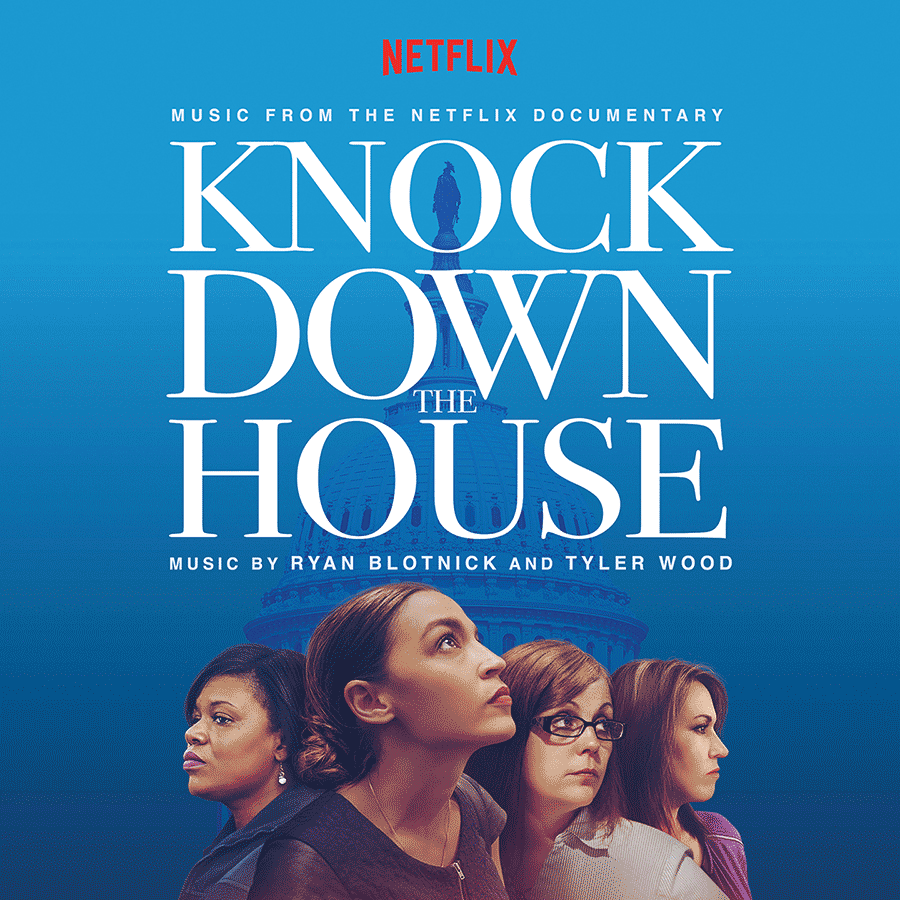
Today was the AP Gov exam, so I had many students out of class for the test. On such days, I often do something in class that I hardly ever do–show a film in it’s entirety. Today I screened the same documentary that I showed last year. Not only is it relevant to what we are learning about in class (elections and campaigning), but it features a politician most of my students have heard of…Alexandria Ocasio-Cortez.
If one is remotely interested in politics in general, or left-leaning politics in particular, this film is worth your time. In a nutshell, the film follows four women running in the 2018 congressional primaries. AOC gets the most screen time because she is the lone winner.
What struck me about the film was learning about the struggles that lead these four women to try and win a seat in the national legislature. Amy Viela’s story is the most heart wrenching. Her 22 year old daughter was denied tests after being admitted to the hospital because she didn’t have insurance. She died soon thereafter of a pulmonary embolism. So sad, and so very fucking American. AOC’s father, whom she was very close to, died while she was in college.
I was also struck by AOC’s confidence and tenacity. Watch the film, see if you see it to. I know she has become the boogyman of the right, and it is clear to see why–she’s smart, articulate, passionate, and has learned from the trevails she’s faced how to approach daunting challenges. Knowing more about her having seen the film, I am definitely rooting for her. She’e absolutely pissing off the right people.
The Revolutionary and the Existentialist
The beauty of reading a few books at the same time is that it provides an opportunity for a bit of “intellectual cross-pollination.” On one hand, I’m working through Paul Johnson’s Modern Times, which paints an extremely chilling portrait of Vladimir Lenin. I knew he was no angel, but I honestly didn’t know that much about him. On the other hand, I’m navigating the mid-century Parisian scenes of Louis Menand’s The Free World, focusing on writer and philosopher Jean-Paul Sartre. At first glance, they seem like an odd pair for a blog post, but for shits and giggles, and because I’ve done a few posts like this before, I figured I’d briefly compare these two 20th century giants with each other since they have both been renting space in my head of late.
Both men were intellectuals who felt a deep “moral rot” in the bourgeois systems they inhabited and were sort of ‘insider-outsiders.’ They shared a totalizing “bullet over ballot” mentality, believing that meaningful change required a violent break from the past rather than incremental reform. Whether it was Lenin’s Dialectical Materialism or Sartre’s later attempts to marry Marxism with Existentialism, they both sought a “synthesis of ideas” to explain the entire human experience.
However, when it comes to the “individual,” they were diametrically opposed. To Lenin, a person was a tool, a simple cog in the “Iron Discipline” of the party machine. He was, according to Johnson, ruthlessly quick to ‘put up against the wall’ those who were not willing to go along with his revolution. To Sartre, the individual is the ultimate source of meaning. Because he argued there is no pre-designed “human nature,” we are thus entirely responsible for creating our own truth through authentic, subjective choices. To him, hiding behind social roles or party lines (or dogmas) was a form of “bad faith”—an attempt to escape the terrifying reality that we, and we alone, are the masters of our own destiny. Indeed, for Sartre the ‘freedom’ we are born with is not a lighthearted gift, but a heavy burden, because there is no external moral authority or biological blueprint to blame for our failures, we alone are the masters of our destiny. Indeed, this existentialist idea is very Buddhist in my mind.
Ultimately, I find myself repulsed by Lenin the more I learn about him, especially his cruelty and his dogmatism. Sartre, despite being someone who apparently didn’t really take care of his body or personal hygiene (what kind of choice was that?), was accurate in his emphasis on authenticity and taking responsibility for our choices.

Orwell & le Carré
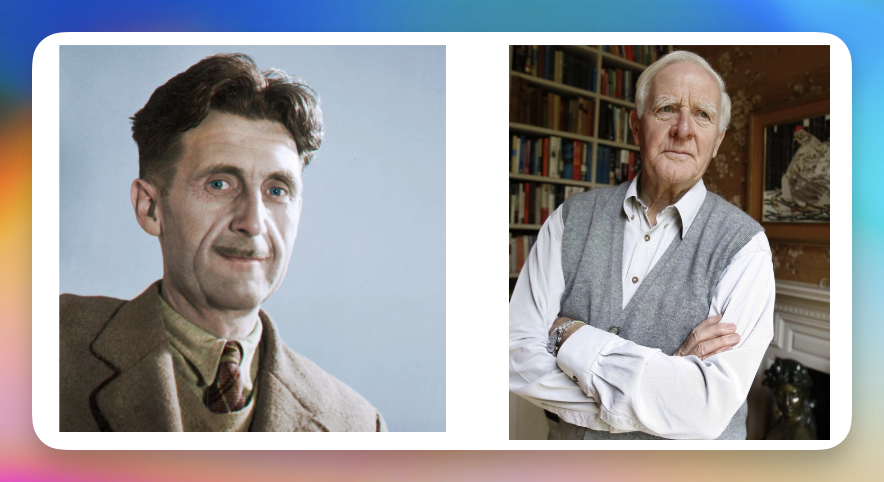
I love reading biographies. A sub-genre of biography that I like are those written about writers. One of the books I am reading now is a biography about the thriller writer John le Carré. Have I read any of le Carré’s books yet? No, not yet. Nevertheless, the life of a successful writer is endlessly fascinating to me.
Another book I just started (that I am really enjoying) is Louis Menand’s Free World: Art and Thought in the Cold War. In it, Menand has a long section about the writer George Orwell. Like most Gen Xers, I read Orwell’s 1984 and Animal Farm in middle school and/or high school. However, I didn’t know much about him. What struck me right away are some of the similarities between le Carré and Orwell.
Here are a few:
-
Both were British writers.
-
Both wrote with pen names. le Carré’s real name was David Cornwell. Orwell’s given name was Eric Blair.
-
Orwell attended Eton College (which isn’t actually a college) in his youth and le Carré taught there.
-
Both were anti-Stalinist. Orwell was famously a leftist, but was never a fan of Stalin, which helped him to stand against many of his fellow leftists in the early years of the Cold War. le Carré actually worked for a time for the British secret service in the Cold War (experiences which helped lead him to become a writer of spy novels).
-
Both writers were deeply skeptical of concentrated power. Whether it was Orwell’s critique of totalitarianism in 1984 or le Carré’s critique of the “Circus” and the cynicism of Western bureaucracy, both viewed big institutions as inherently dehumanizing.
-
Both lived lives characterized by a sense of not quite belonging. Orwell was an highly educated man who spent years living among the “down and out” ; le Carré was a spy who felt like an outsider within his own service due to his father’s criminal background.
-
Finally, both authors were fiercely independent thinkers who refused to follow a party line. Orwell was a socialist who critiqued the Left; le Carré was a patriot who remained one of the most vocal critics of British and American foreign policy (particularly the Iraq War).
New Oteil Arising
Like for millions of other Deadheads, Oteil Burbridge is now part of my musical universe. Part of the musical family, you might say. In hindsight, I sure wish he had sung more of the Jerry tunes as part of Dead & Co. His album covering Jerry tunes is truly sublime.
He has a new album coming out in a week. They dropped one single a month or so ago. Today they dropped a live version of another of the tunes on the disc. Check them out below.


On Woodrow Wilson and His Wife Edith
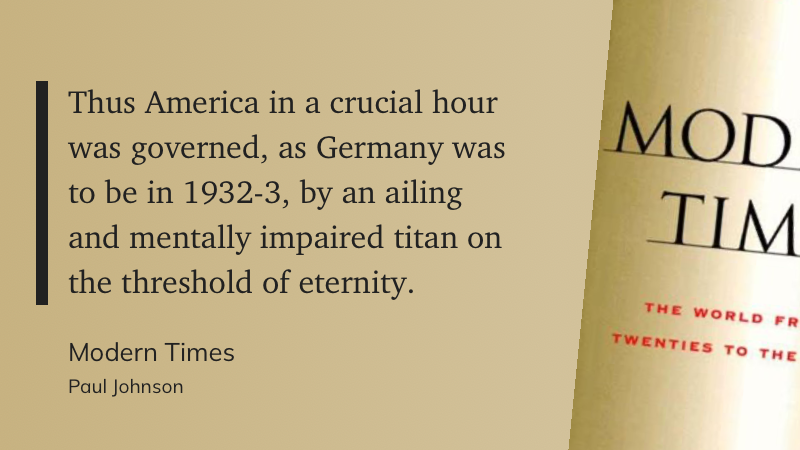
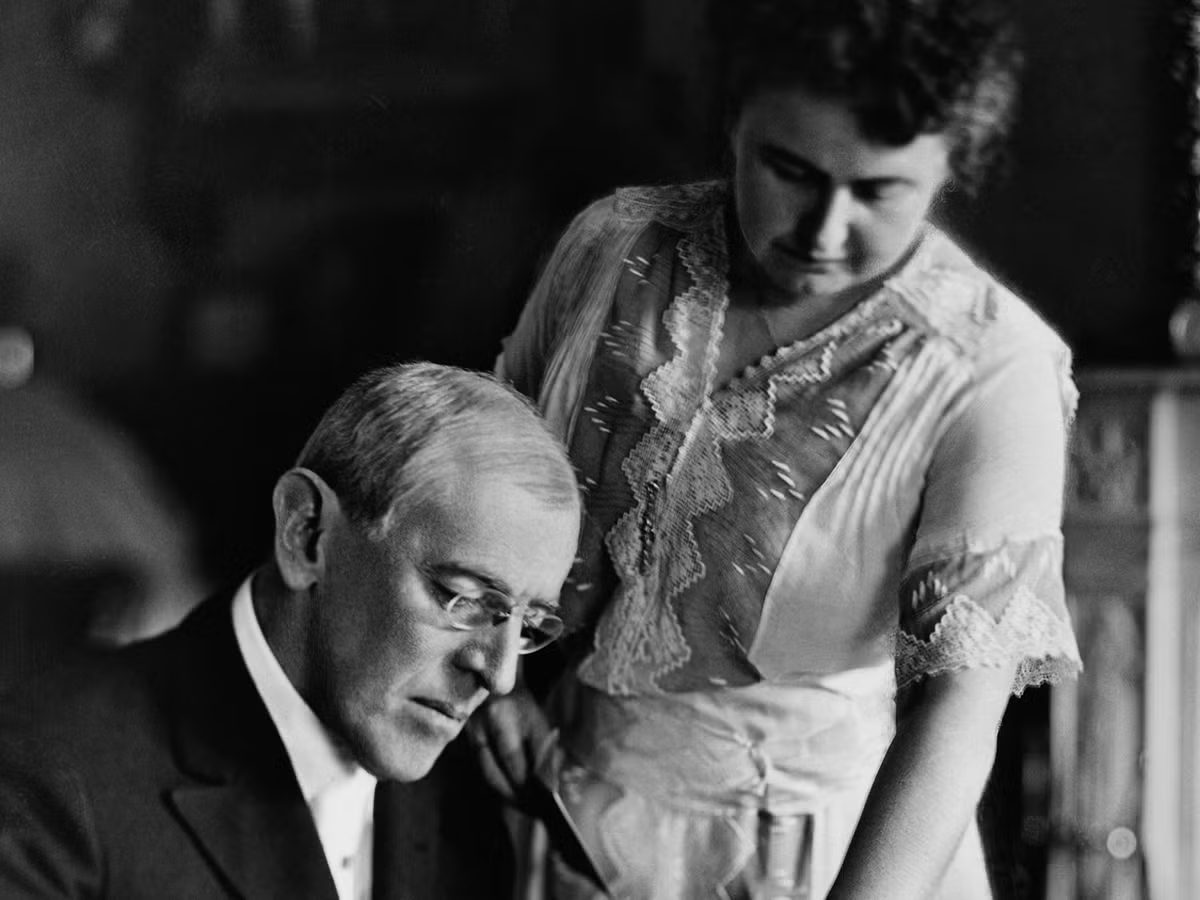
Few Americans know that in a sense, we’ve already had a female president. Back in 1919, after the fighting in World War I had ended, President Woodrow Wilson went to Paris to help negotiate what became the Treaty of Versailles. It was the first time a sitting American president had ever left the country. The negotiations were famously convoluted and difficult. One of the elements of the treaty was the idea of a League of Nations, which had been the 14th point of Wilson’s 14 Points. I’ve learned from reading Paul Johnson’s book Modern Times that the idea for such a league was not actually Wilson’s.
Nevertheless, he came to believe it was necessary and was willing to fight for it. However, treaties in America must be ratified by the Senate. In order to win support for the League, in 1919 Wilson barnstormed the country, speaking to massive rallies in the hopes of turning the focus of public opinion onto the Senate. Wilson apparently had a small stroke in Paris during the treaty negotiations early in 1919. Back in the states, he had a massive stroke in America in the fall at the end of his speaking tour. The stroke was so debillitaing that Wilson was essentially bed-bound and out of commission for the last year and half of his presidency.
During that time, his second wife, Edith Wilson, became a sort of shadow president. Indeed, he had only just married Edith in 1915, so she had only been the first lady for four years when this all went down. I was aware of this episode from my reading of A.Scott Berg’s biography of Wilson, but was reminded about it recently while reading Johnson’s book. Indeed, I make a point to teach this strange episode to my students.
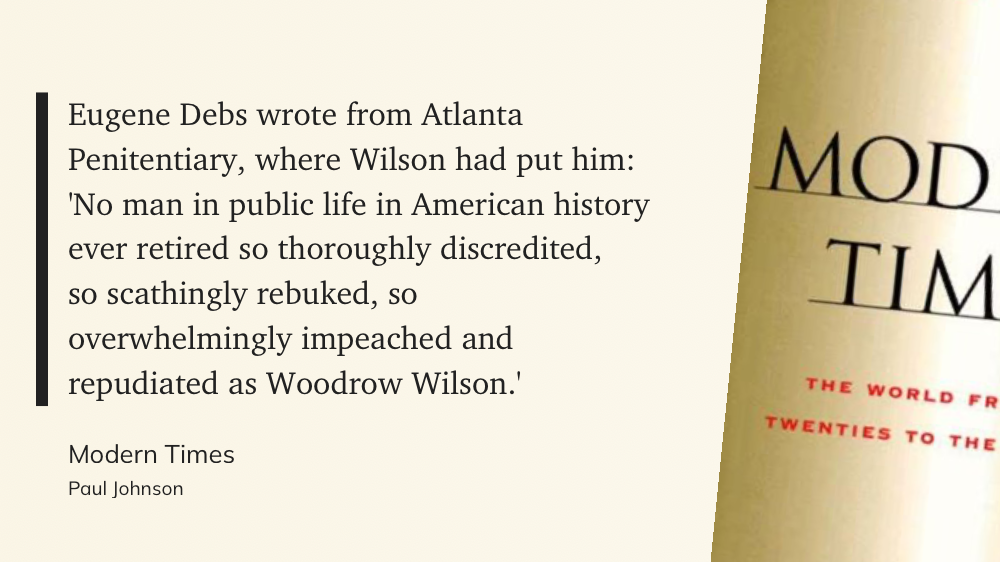
The quote below is from Johnson and it is what sparked this post. Not only do I think it is a great sentence, but I just taught the Treaty of Versailles last week so Wilson was top of mind. The second quote below from Johnson’s book shines a light on another noteworthy event in Wilson’s administration–the jailing of Social Eugene Victor Debs for speaking out against the war. Debs ran for president from jail in 1920 and garnered slightly less than a million votes. His disgust with Wilson is understandable. Debs, luckily for him, was pardoned by the winner of the 1920 election, Warren Harding.
Samuel Taylor Coleridge: Poet, Addict and Underachiever?
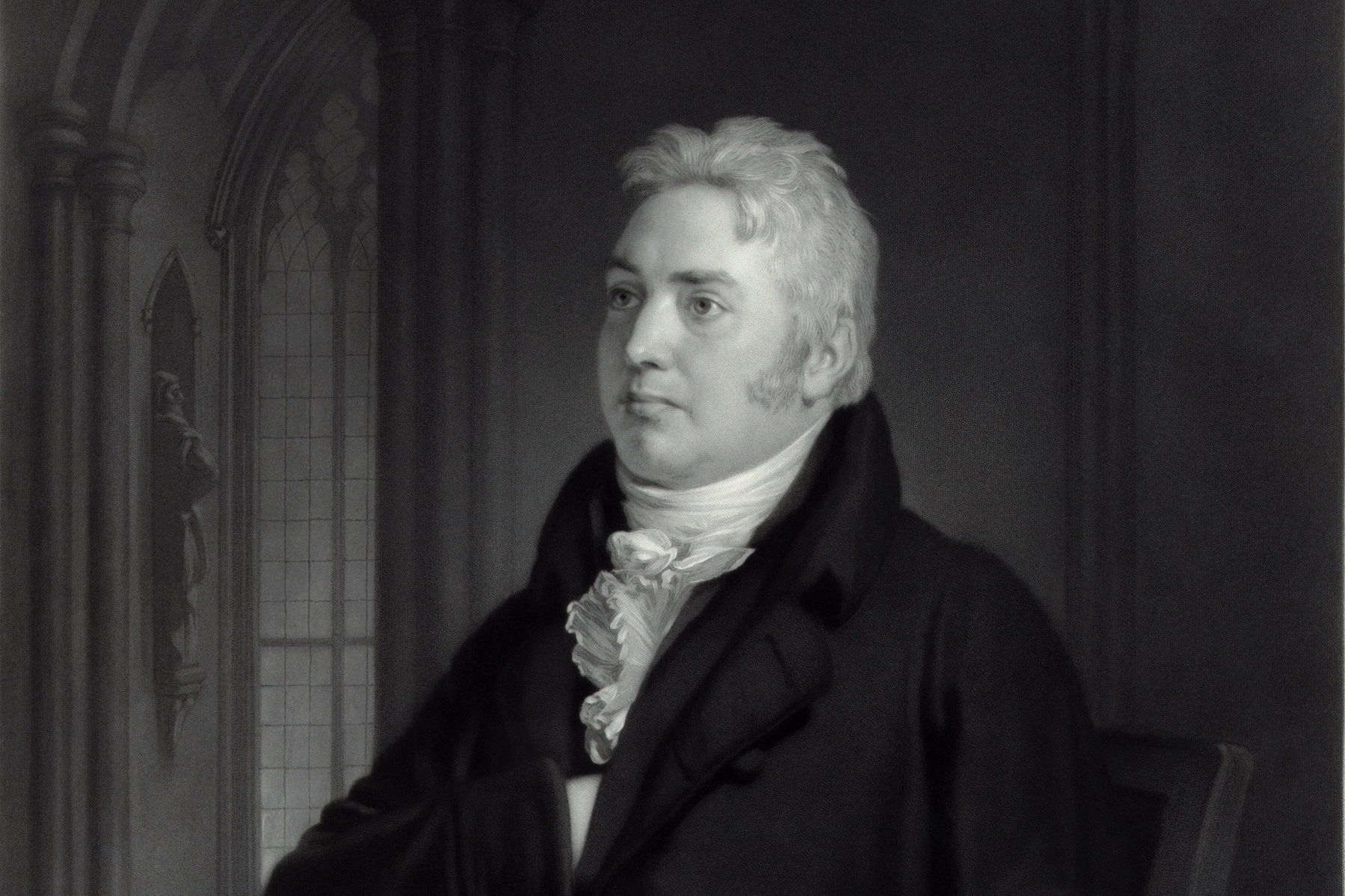
I first encountered Samuel Taylor Coleridge the way many fellow Gen Xers did, through a speaker cabinet. Iron Maiden’s Rime of the Ancient Mariner, from their amazing 1984 album Powerslave, is a thirteen-minute epic based on Coleridge’s poem of the same name. It’s definitely a lot of song. The poem it draws from is a lot of poem; over six hundred lines of albatrosses, cursed sailors, and supernatural dread. Indeed, I remember making my Dad listen to it with me, thinking he’d be more likely to enjoy it since it was based on a Coleridge poem. At the time, I was more focused on Steve Harris’s bass lines than on British Romantic poetry, but Coleridge’s name lodged somewhere in the back of my brain.
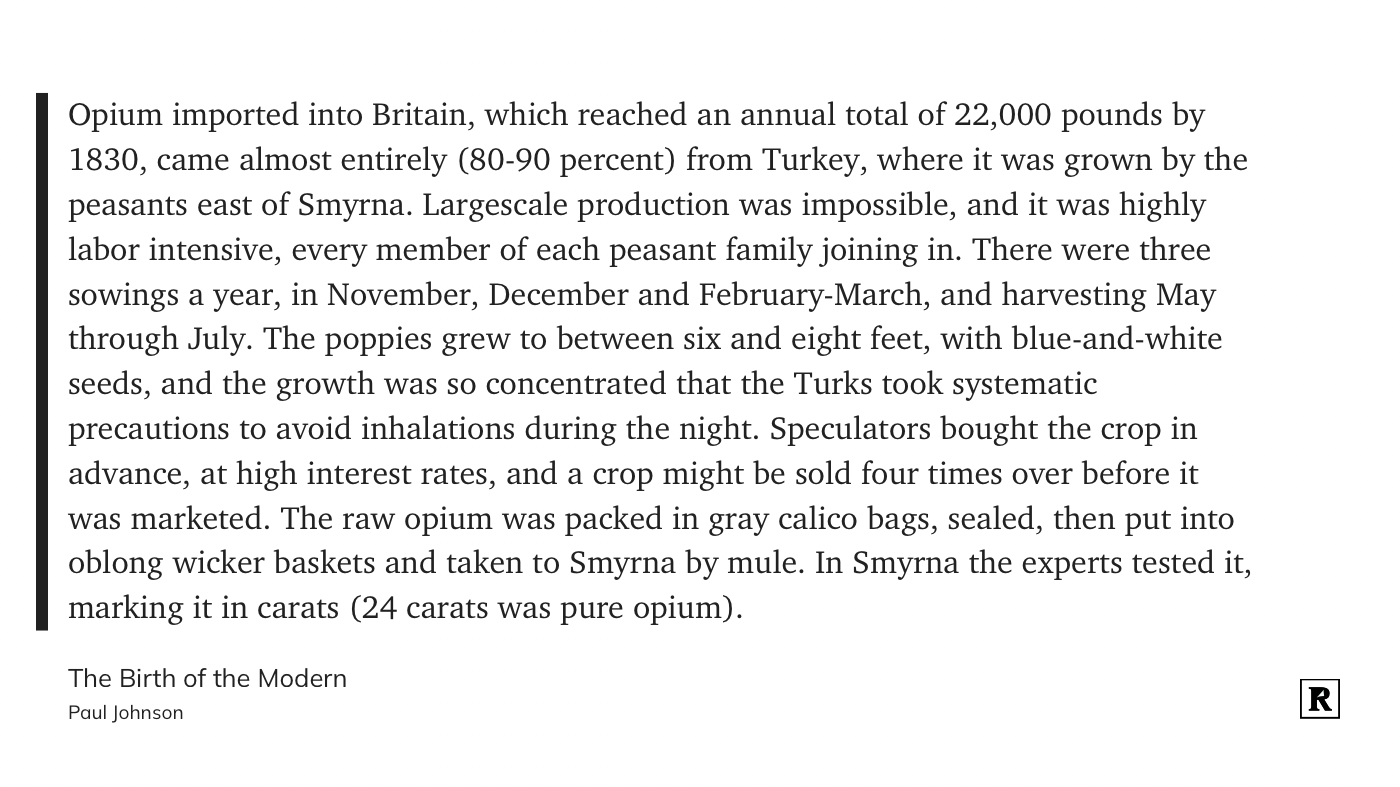
He’s come back around to me recently via Paul Johnson’s The Birth of the Modern, which I continue to happily work through. Johnson covers in great detail the market for opium in Britain in the first decades of the 19th century (see the quote below). Never one to pull punches I’m discovering, Johnson also sketches a rather unflattering portrait of Coleridge. Indeed, his opium addiction is front and center. Apparently Coleridge had developed a serious dependency on laudanum, which in those days was widely available as a tincture. Ostensibly Coleridge used the drug for pain relief, but the habit consumed him. Johnson paints a picture of a man of staggering intellectual gifts who was nonetheless chronically unable to finish what he started. The unfinished poem Kubla Khan is perhaps the most famous example. It is a fragment of fifty-four lines that Coleridge claimed to have composed in an opium-induced dream, only to be interrupted by “a person from Porlock” before he could complete it.
What strikes me about Coleridge is the gap between his potential and his output. By most accounts, he was one of the most brilliant minds of his era — a gifted poet, philosopher, and literary critic. His conversations were legendary. His follow-through, considerably less so. The opium didn’t help. Neither, apparently, did the chaos of his personal life.
History is full of people undone by the distance between what they could have been and what they managed to pull off. F. Scott Fitzgerald, filmmaker Orson Welles, and original Pink Floyd frontman Syd Barret also come to mind in this regard. Coleridge is a particularly affecting case. Water, water everywhere — and yet.
Happy Frederick Douglass Day ❤️
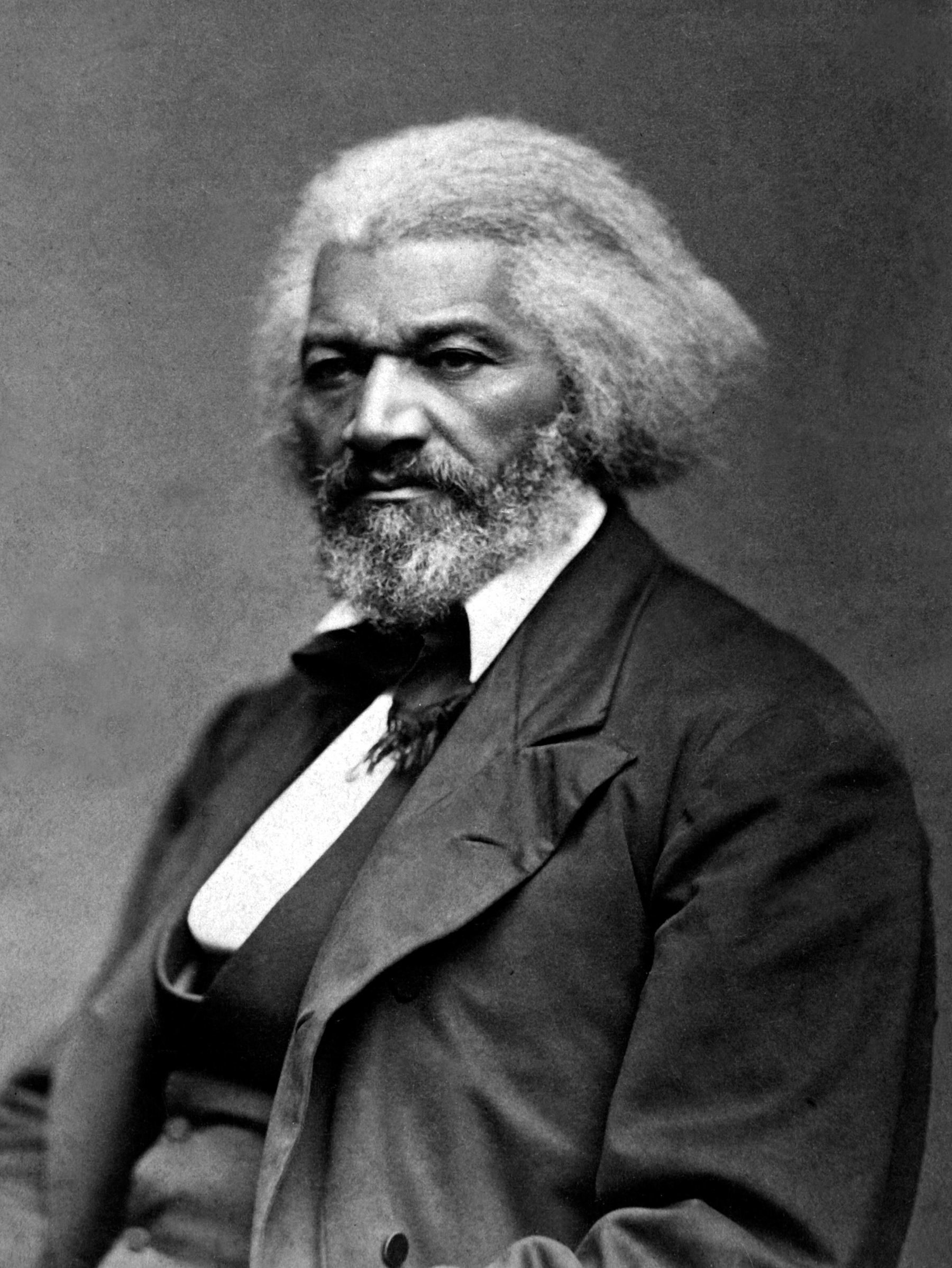
I learned today that the great Frederick Douglass, not knowing exactly what day he was born on, decided on February 14 as his official ‘birthdate.’ I learned this fact about the great human rights advocate from this video by Heather Cox Richardson. In honor of Frederick Douglass, here are 5 other interesting facts about him.
-
He taught himself to read and write in secret. Douglass grew up in Maryland and his master eventually forbade him from learning. He continued to learn in secret, giving food to whites for reading lessons.
-
He was probably the most photographed American of the 19th century, hence all the different pics you’ll see if you Google him. He figured actual photographs would humanize Black Americans and counteract the widespread racial charicatures that were so prevalent then.
-
He named himself. A primary cause of his renaming was to make it harder to be recaptured. The last name he picked is based on a character in Sir Walter Scott’s poem The Lady of the Lake.
-
He was a strong advocate for women’s rights. Indeed, he was the only Black person at the Seneca Falls Convention of 1848, which was the first women’s rights convention in American history. He supported women’s suffrage, believing that the franchise belonged to all Americans.
-
He was nominated as Vice President in 1872 by the Equal Rights Party. The head of the ticket was Victoria Woodhull, but Douglass apparently never acknowledged the nomination.
Making Some Noise
Bruce Hornsby has a new album coming out. Yesterday the title track and first single showed up on YouTube. It is called Indigo Park and I’m digging it. Check it out here.
In honor of Bruce continuing to make meaningful and beautiful music, here are some of my all time favorite Hornsby tunes.
-
Sunflower Cat Can you hear that unmistakable Garcia riff? Sooooooo good.
-
Levitate Nice quirky Hornsby!
-
Take out the Trash This whole album is great. Stanky…
-
Fortunate Son The studio version of this is beautiful, and so is this live pairing with a popular Pink Floyd tune. Sublime.
-
King of the Hill This song rips. Here is a nice live version that segues into a very Hornsby version of Big Boss Man.
Let’s go Bruce! 🎶

Thinking about Robert Reich and William T. Sherman
One of the books I am currently enjoying is economist Robert Reich’s memoir Coming Up Short. The book is not a straight memoir, as Reich works in polemics about American politics and our economy while telling his life story in roughly chronological order. I tend to agree with his views, so I am not put off by the political digressions. Reich was born to a working class Jewish family and eventually earned a law degree from Yale, where he knew and went to school with Hillary Rodham, Bill Clinton, and Clarence Thomas. He worked for the Carter administration in the 1970s and eventually served as President Clinton’s secretary of labor. He eventually became a professor (at Harvard and Berkeley) and is now a pretty outspoken policy wonk advocating for a variety of progressive issues.
I have also been thinking about Union General William Tecumseh Sherman because I recently taught a lesson about his ‘March to the Sea’ during the Civil War. The essential question of the lesson was whether or not it is justifiable to make war on civilians and infrastructure, which Sherman did to great effect. As I write this, I realize that I am overdue in reading one of the biographies about Sherman, because it is clear to me that he is a fascinating character. A fact that I love about him is the willingness he had to do what it took to defeat the traitors during the American Civil War. That said, he was generally conservative, a racist, and was motivated more by keeping the Union together than abolition.
What might these two very different people have in common? The connection that comes to mind has to do with systems. Sherman had his soldiers attack the railroads (leading to ‘Sherman’s Neckties’) and farms (leading to ‘Sherman’s Sentinels’) as they marched through the South. He also didn’t feed his soldiers and instead had them ‘forage,’ which led them to steal from the people of Georgia as they made their way to the coast from Atlanta (which was left in flames). By doing this, Sherman attacked the system that sustained the Confederacy.
I see Reich as someone who thinks a lot about the reality of the economic system we live in. Rather than wallowing in theory, in his book Reich often explains the mechanisms and decisions that many people in power make that impact our society, for better and for worse.
I’m left wondering, what can one do to improve the corrupt and immoral systems we are a part of? Simple, every day choices made by enough people hopefully preclude the need for the type of choices Sherman had to make.
Three Cheers for Brandon Stanton's Work
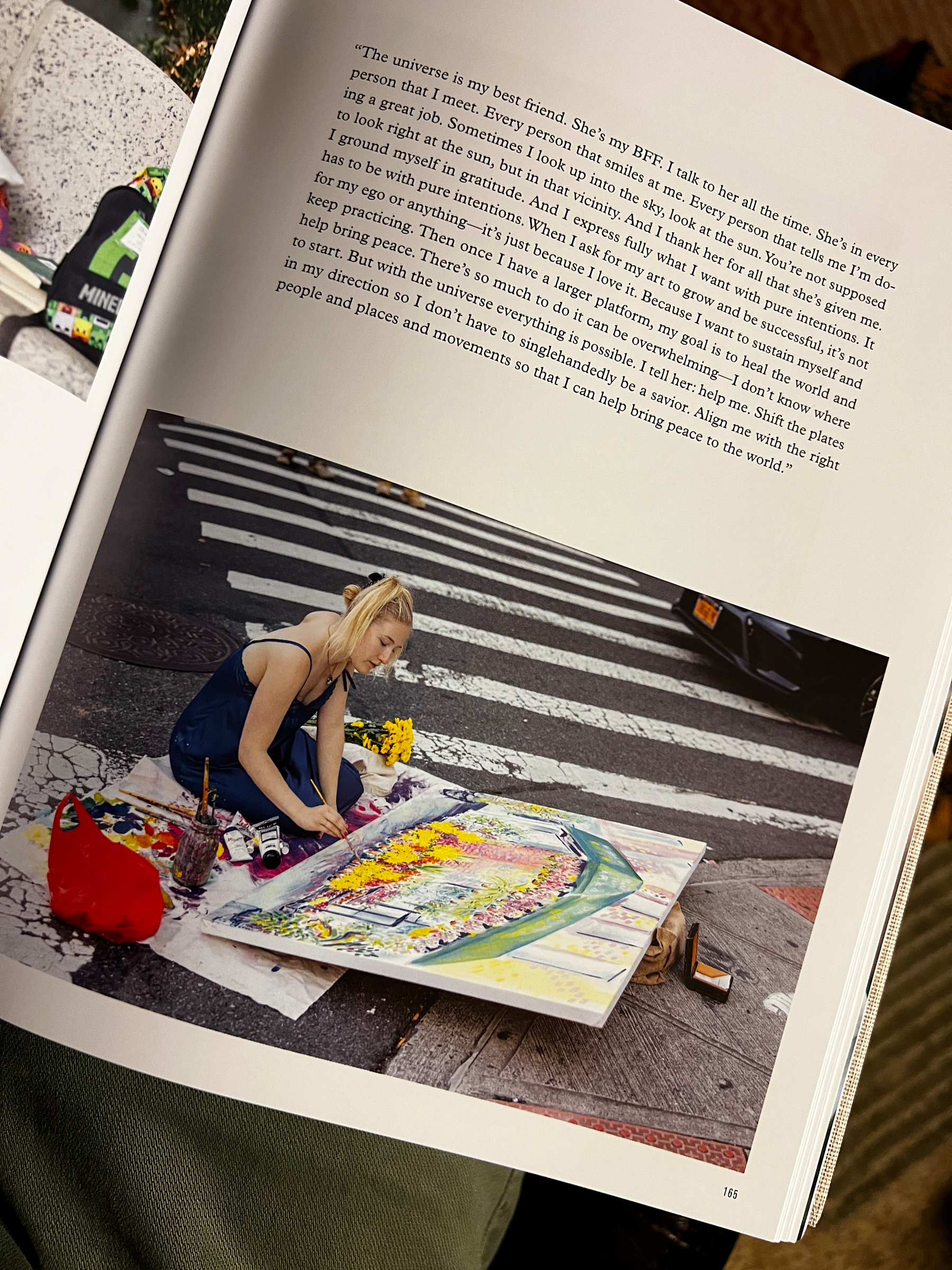
I am a serious fan of Brandon Stanton’s photo books. His first book, Humans of New York, blew up when it was first published. I loved the concept and thought the photos and quotes from the people he photographed were fascinating. I liked his book Humans even more. I am now almost through his latest coffee table book, Dear New York,.
The concept is simple. Each page has a photo and is accompanied by a quote from the person in the picture. I love the books because the people are so unique and often the things they say are entertaining, weird, insightful, revelatory, inspirational, or all of the above wrapped into one monologue. They also provide a similar benefit to traveling, which is to expose oneself to people that are utterly different than oneself.
I can’t recommend these books enough.