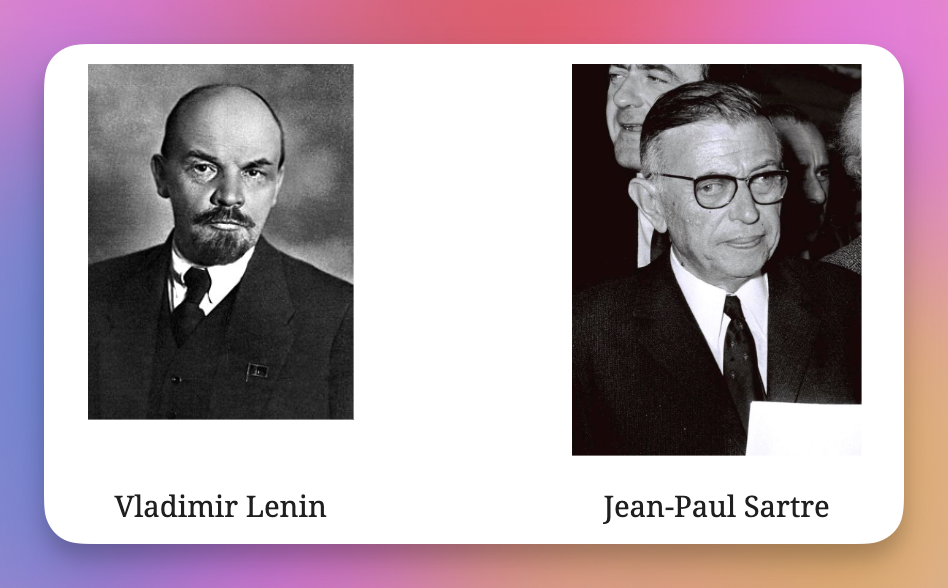
The Revolutionary and the Existentialist
The beauty of reading a few books at the same time is that it provides an opportunity for a bit of “intellectual cross-pollination.” On one hand, I’m working through Paul Johnson’s Modern Times, which paints an extremely chilling portrait of Vladimir Lenin. I knew he was no angel, but I honestly didn’t know that much about him. On the other hand, I’m navigating the mid-century Parisian scenes of Louis Menand’s The Free World, focusing on writer and philosopher Jean-Paul Sartre. At first glance, they seem like an odd pair for a blog post, but for shits and giggles, and because I’ve done a few posts like this before, I figured I’d briefly compare these two 20th century giants with each other since they have both been renting space in my head of late.
Both men were intellectuals who felt a deep “moral rot” in the bourgeois systems they inhabited and were sort of ‘insider-outsiders.’ They shared a totalizing “bullet over ballot” mentality, believing that meaningful change required a violent break from the past rather than incremental reform. Whether it was Lenin’s Dialectical Materialism or Sartre’s later attempts to marry Marxism with Existentialism, they both sought a “synthesis of ideas” to explain the entire human experience.
However, when it comes to the “individual,” they were diametrically opposed. To Lenin, a person was a tool, a simple cog in the “Iron Discipline” of the party machine. He was, according to Johnson, ruthlessly quick to ‘put up against the wall’ those who were not willing to go along with his revolution. To Sartre, the individual is the ultimate source of meaning. Because he argued there is no pre-designed “human nature,” we are thus entirely responsible for creating our own truth through authentic, subjective choices. To him, hiding behind social roles or party lines (or dogmas) was a form of “bad faith”—an attempt to escape the terrifying reality that we, and we alone, are the masters of our own destiny. Indeed, for Sartre the ‘freedom’ we are born with is not a lighthearted gift, but a heavy burden, because there is no external moral authority or biological blueprint to blame for our failures, we alone are the masters of our destiny. Indeed, this existentialist idea is very Buddhist in my mind.
Ultimately, I find myself repulsed by Lenin the more I learn about him, especially his cruelty and his dogmatism. Sartre, despite being someone who apparently didn’t really take care of his body or personal hygiene (what kind of choice was that?), was accurate in his emphasis on authenticity and taking responsibility for our choices.