My Reading & Ideas
A Great, Idea-Rich Sentence by Ralph Waldo Emerson
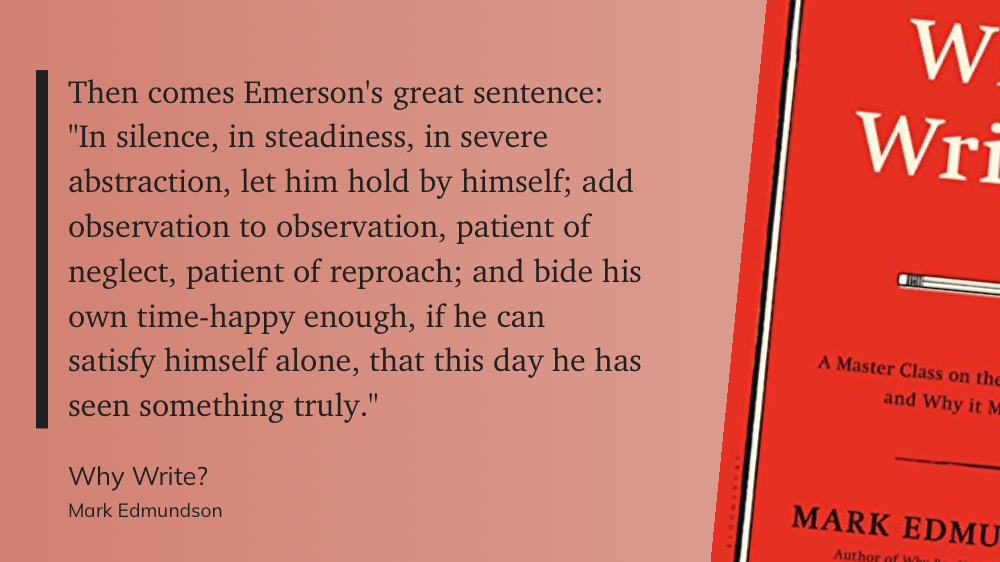
I read some Emerson in college, but nothing since. I came across this great sentence reading Mark Edmundson’s book Why Write? I appreciate Emerson’s message that we must tune out the noise to see reality clearly. I also agree that as independent thinkers, we must be willing to earn reproach from others. Our own truth is not a popularity contest. Finally, I agree with the notion that the ultimate reward for seeing clearly is our own satisfaction, not something external such a public recognition. Our time, like Emerson’s, rewards conformity. Thinking independently is challenging, yet worth the struggle.
A Great Reminder from Derek Sivers
I am sharing this not because I have this practice nailed, but because I need to be reminded of it. The little voice in my head is quick to judge, both others and myself. Indeed, it’s like I have a freakin' arrogant know-it-all camped out in my cranium that defaults to criticism and judgement whenever it apprehends something. I suspect this is true for a lot of people. I notice is most when I’m driving. I have gotten better at noticing it, so I’ll take that as a victory. I am hoping that moving forward I get better at taking Derek Sivers’s advice and slow down the automatic reactions in order to give myself both more time to think and more time to react without anger or judgement. Sivers' blog is amazing, btw.

A Reminder from Mr. Thompson
As we get into the latter half of October, that means it is almost time to vote. Most of us don’t have major seats (Governor, House or Senate, for instance) on the ballot. However, these off year elections often have important local issues that we should weigh in on. It is also time to work our voting muscles. In the last presidential election, ‘didn’t vote’ actually beat the two major party candidates. That is abhorrent to me. Even if the stakes seem low, we need to get out there and have our say.

A Great Sentence From Tom Robbins
The late, great Tom Robbins is the author of many great sentences. If you have never read one of his novels, I recommend trying one. His writing is unique, to say the least. This one is from his memoir Tibetan Peach Pie. He is describing his experience with a particular fungi that is found in the wet woods of the Pacific Northwest. Nailed it.

Dandelions
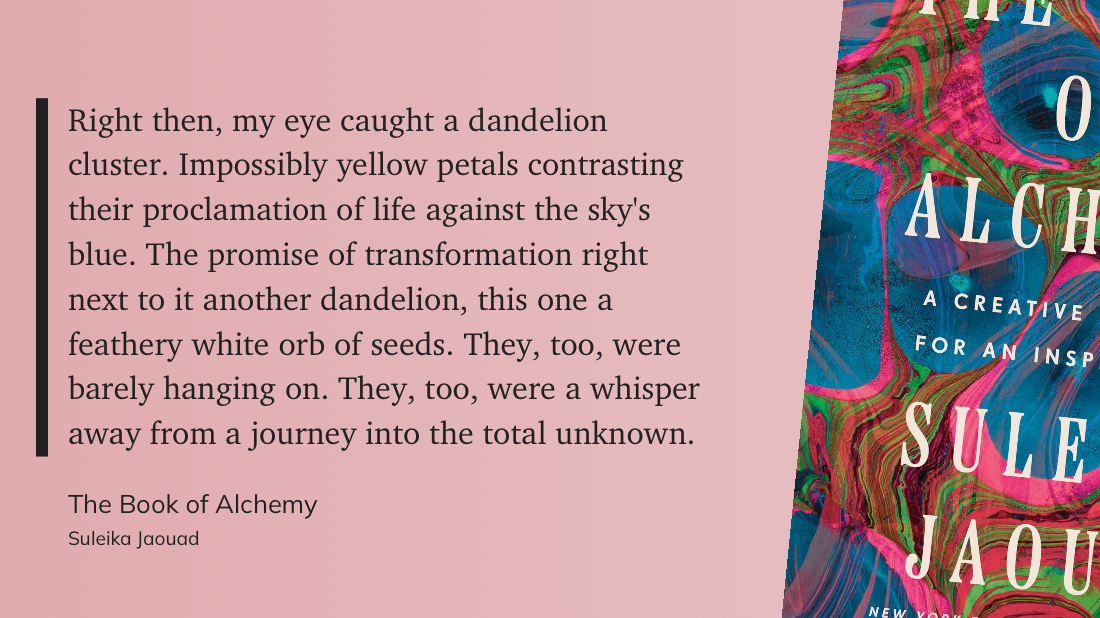
Instead of a simple, beautiful sentence, today I want to share a small beautiful paragraph. This is from a book published this year by Suleika Jaouad, titled The Book of Alchemy. It’s a collection of short pieces in which creative people explore different aspects of the creative process. What struck me about the quote is how it connects an experience we all know — the disintegration of a dandelion cluster — with the inevitable changes we face in our lives. The wind is going to blow — but where will it take our ideas and our dreams? And how will our actions land?
Modern Reminders
I love getting reminders. I need reminders. Productivity guru David Allen famously said, “your brain is for having ideas, not holding them.” I agree 100%. Luckily, I learned a few decades ago that my life ran better when I got things out of my head and onto paper. Back twenty years ago that meant that I still had to open up my planner to see the reminder I had made for myself. Thankfully, life is easier now.
For instance, many people are familiar with and use products such as Apple’s Reminders app to help them offload important details and keep their schedules from falling apart. For whatever reason, that particular option never worked for me, even though I am all in on the Apple ecosystem. It goes to show that we are unique and that what works for several million others, might not work for us.
Appointments and due dates aren’t the only things I want to be reminded of, though. I also want to be reminded of my values, my long term goals, and, as an educator, my philosophy of teaching and learning and what best practices are. Indeed, this is why religious people attend services regularly (or, are supposed to anyway); the spaced repetition helps us remember more deeply what is important. It works for teenagers in high school and it works for adults, too.
One thing I always thought would work for me would be to have a card deck with important reminders on them. I imagine I could keep them at my desk, or in my car, or in my bag, and every day I could shuffle up the deck and be reminded of a bespoke idea that would be great to review again. Being a nerd, I came up with a list of 60 reminders to help me be true to myself. I also came up with 60 reminders about teaching that I wanted to remind myself about on a regular basis. However, instead of manufacturing two physical card decks, I have discovered I can use the new Daily Pulse email option for ChatGPT Plus subscribers to have Chat go into my two lists in Notion and randomly remind me of two ideas via a morning email. Pretty cool. Now, every morning at 6 I get an email from ChatGPT that is tailored specifically to me and what I want to be reminded about before I start my day. I realize some people are wary of AI, but this sort of use case is exciting to me.
They Can't Scroll Us Away
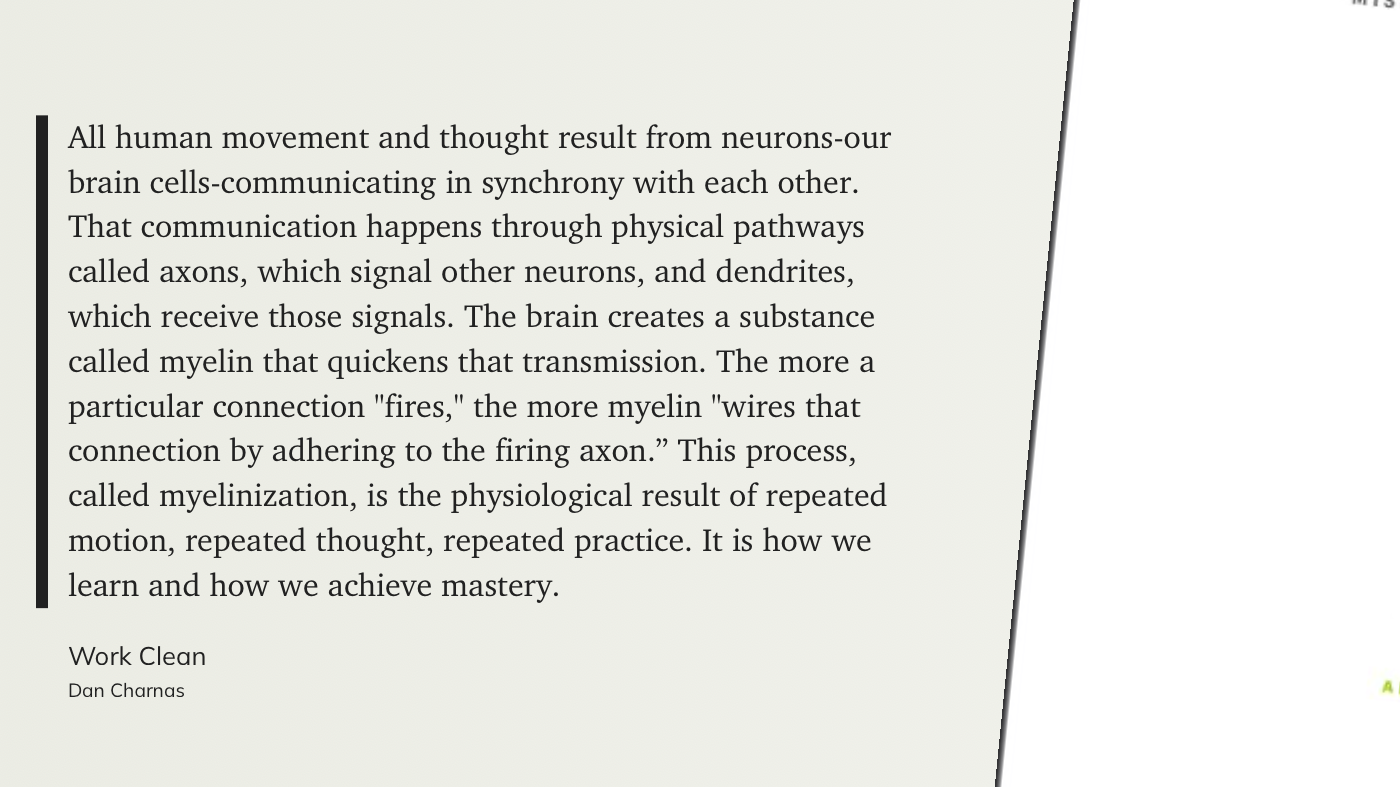
One of the hardest parts of teaching is covering topics that don’t naturally interest most 16- and 17-year olds. Some folks, mostly those that aren’t actually trying to educate young people, claim that the job of teachers is to make topics ‘interesting.’ This sort of cant grates. The fact is, sometimes young people need to be made aware of realities that—on a Tuesday afternoon in October—they won’t easily engage with. This has always been a dilemma for teachers (portrayed humorously by SNL back in 1992), but it is made even more problematic in the Age of Handheld Distraction. Teens today are used to watching a short video on their smartphones and scrolling past it within seconds if it doesn’t capture their interest. And teachers are not entertainers. Students can’t scroll us away.
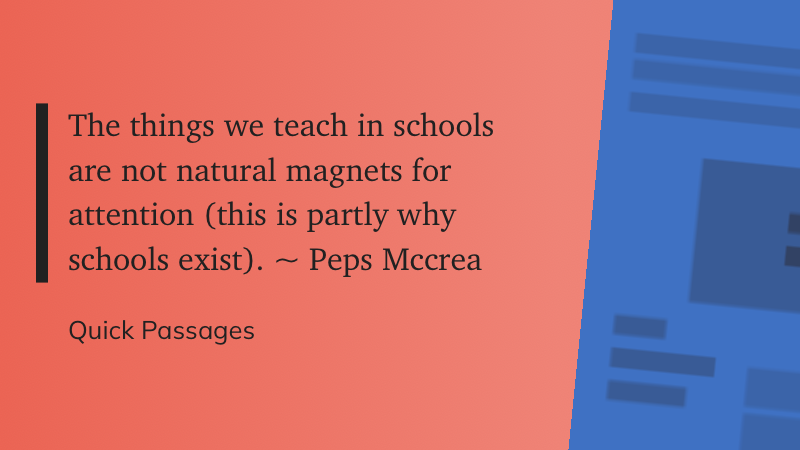
The quote below by educator Peps Mccrea resonated with me because it’s true and because it isn’t something teachers hear all that often. If math was intrinsically interesting to 8 year olds, schools wouldn’t be needed. Indeed, algebra is not always a ‘magnet of attention’ for most people, kids or otherwise.
In my case, I recently taught Brutus No. 1, the most famous of the Anti-Federalist arguments against the ratification of the Constitution. It was written in 1788. It comes off as stilted to the modern reader. It is—Hard. To. Read. Of course, the arguments Brutus made about an overpowerful federal government ruled by a strongman is super relevant to teenagers growing up in Portland, Oregon at the moment. That depressing fact of life today helps make the reading relevant. But the point remains: it is not necessarily interesting (as evidenced by the fact that the vast, vast majority of Americans have no idea a) what Brutus’ arguments were and b) who the Anti-federalists were). Indeed, those who do know it most likely learned it in school.
So, the dilemma remains. We have to teach topics that aren’t always going to interest students, that aren’t natural ‘magnets of attention.’ The art of teaching–the perpetual challenge–is figuring out how to make even the dullest topics come alive for as many students as possible.
Get Into What Interests You
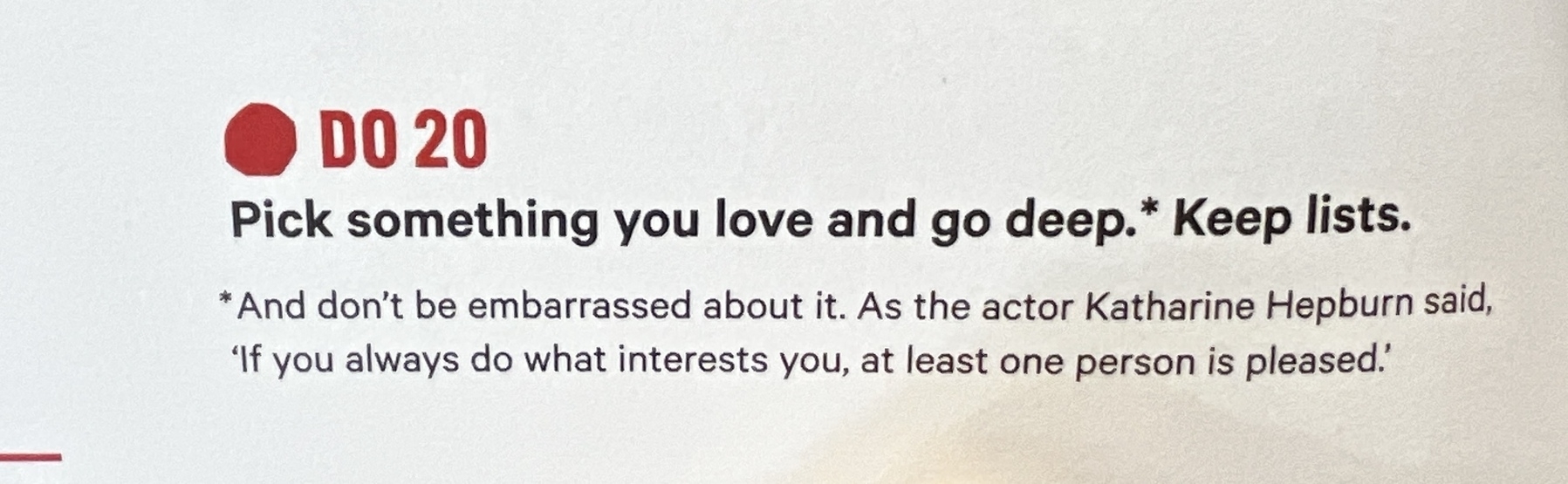
On the way home from work today I had a great chat with one of my oldest and best friends. He was giving me props for blogging, even if ultimately very few people read my posts. I explained I was mostly doing this for myself as a natural outgrowth of my interest in reading and writing. I told him I was enjoying the new habit of trying to post something every day. He shared that he is getting back into Brazilian jujitsu…at 55! He was finding it very rewarding. He also shared his newfound love of Dua Lipa. He knows it is a bit off brand for him, but we both agreed that at this point in our lives we have stopped giving shits about this sort of thing. To paraphrase Mr. Garcia, “we love what we love and we want it that way.” That means he’s got two Dua Lipa concerts to enjoy next week in Seattle. Good for him.
Twenty minutes after our talk I came across the quote below in the excellent book Do/Interesting, which reinforced what we agreed on. Sweet serendipity!
A Beautiful Sentence Written by Zora Neale Hurston
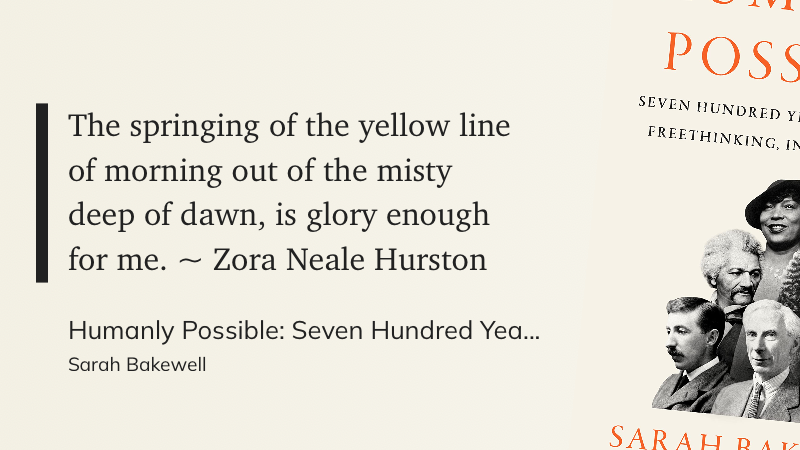
Sarah Bakewell’s excellent book Humanly Possible is a great history of humanism. It is a history book, but it also is a book about a philosophy. Zora Neale Hurston was a writer I was first introduced to in college, when I was assigned her book Their Eyes Were Watching God. Little did I know at the time that Hurston was a free-thinker, which is why this quote showed up in Bakewell’s book. I thought it was both a beautiful sentence and a beautiful sentiment as soon as I read it. No need to make things up when reality is amazing enough.
Beijing and other Ancient Cities
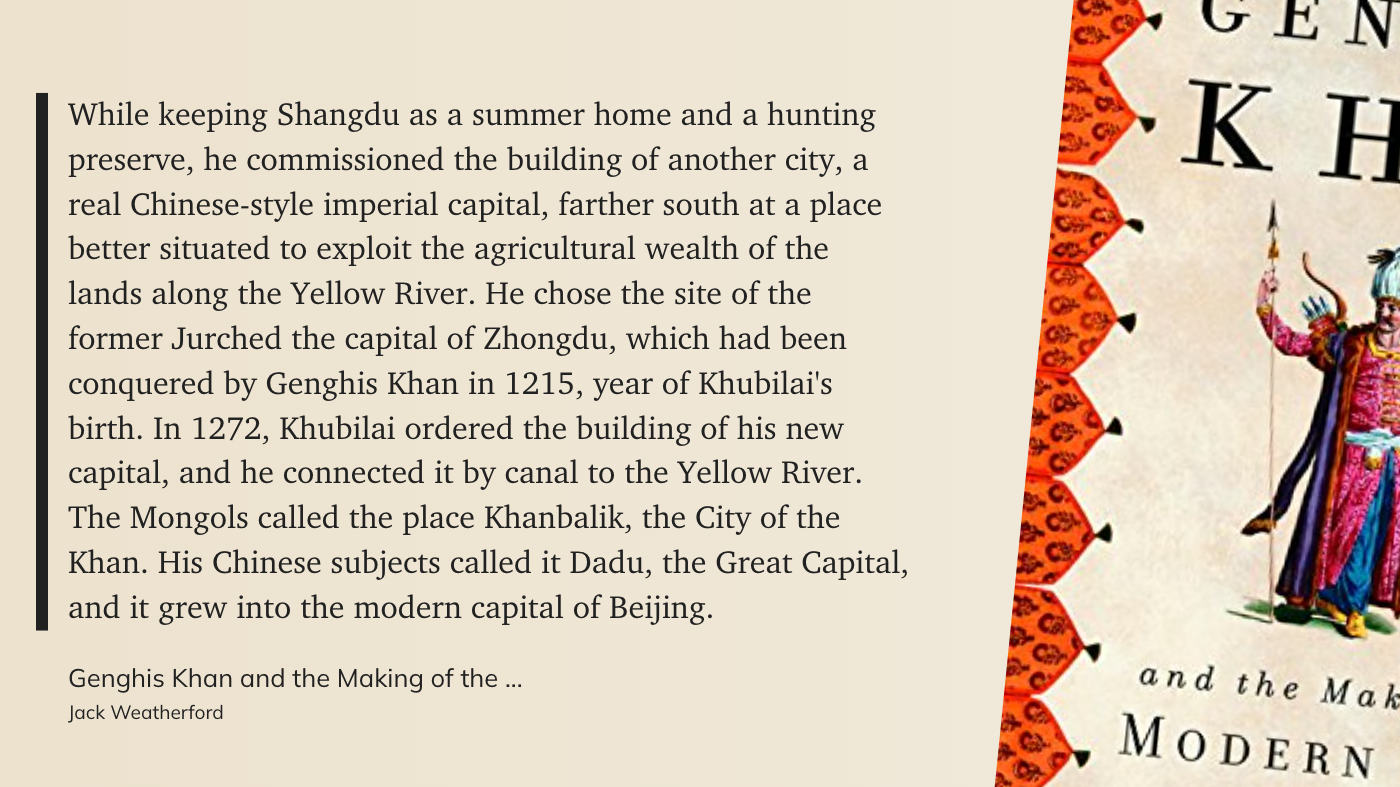
I am fascinated by the great cities of the world. I’ve been fortunate enough to visit some amazing metropolises. Unfortunately, I haven’t yet been to Beijing, today one of the world’s largest and most modern cities. I mention Beijing in particular because of the quote below, that I saved while reading Jack Weatherford’s popular book Genghis Khan and the Making of the Modern World. Before coming across this I didn’t know that Beijing was also the Mongol capital ‘Khanbalik.’ A little further research indicates that people have been living at the site of Beijing for more than 1500 years. This history reminds me of Mexico City as well, as the modern megacity was built on the ruins of the Aztec capital Tenochtitlan, thought the Aztec didn’t settle in central Mexico until the 1200s.
For what it’s worth, here are the world’s longest inhabited cities:
- Jericho, West Bank
- Damascus, Syria
- Aleppo, Syria
- Byblos, Lebanon
- Argos, Greece
Other cities sometimes included on such lists, all with evidence of very long habitation histories, are Plovdiv (Bulgaria), Athens (Greece), Sidon (Lebanon), and Varanasi (India).
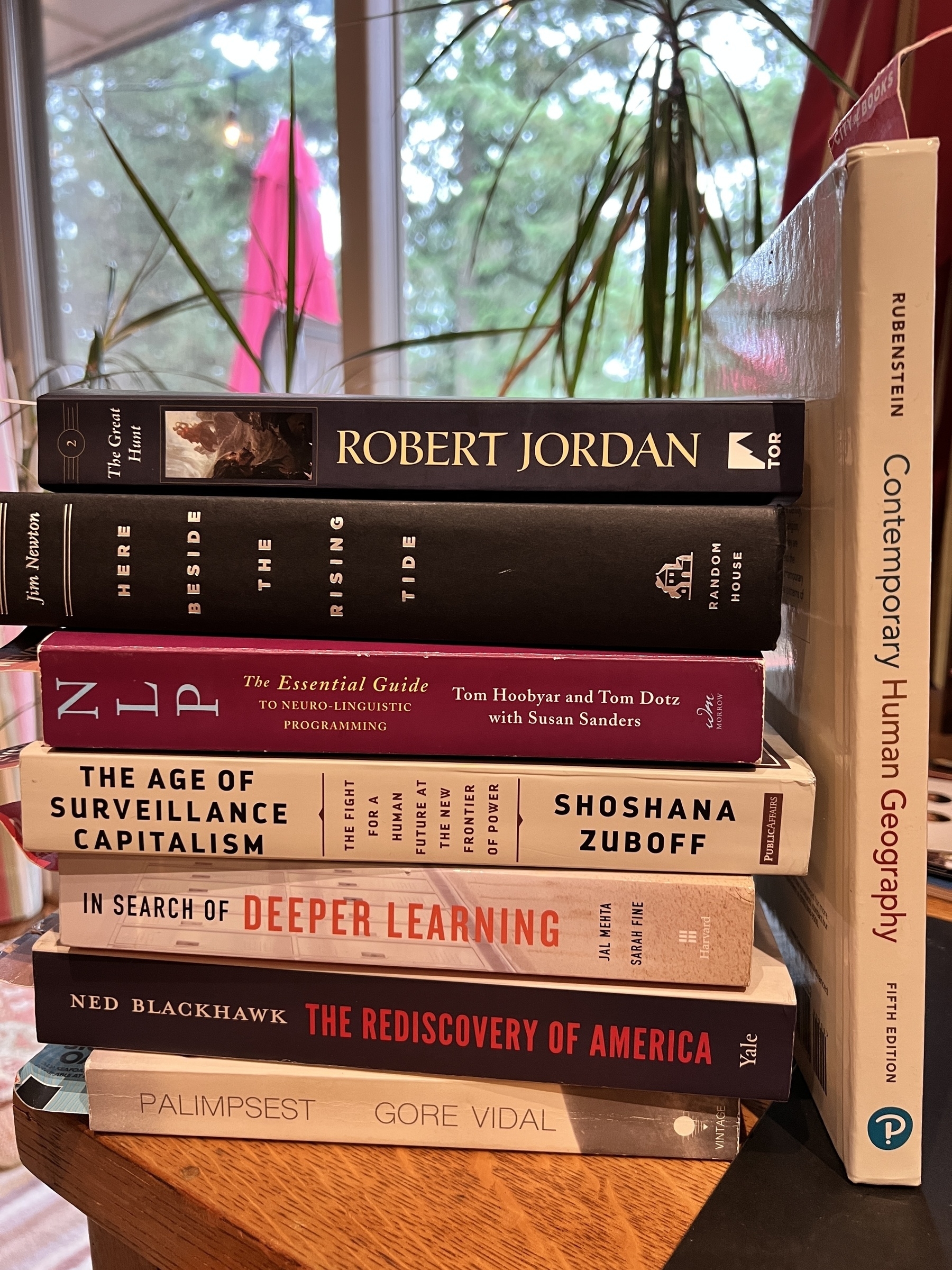
Current Stack
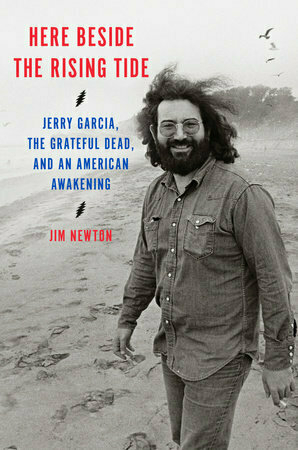
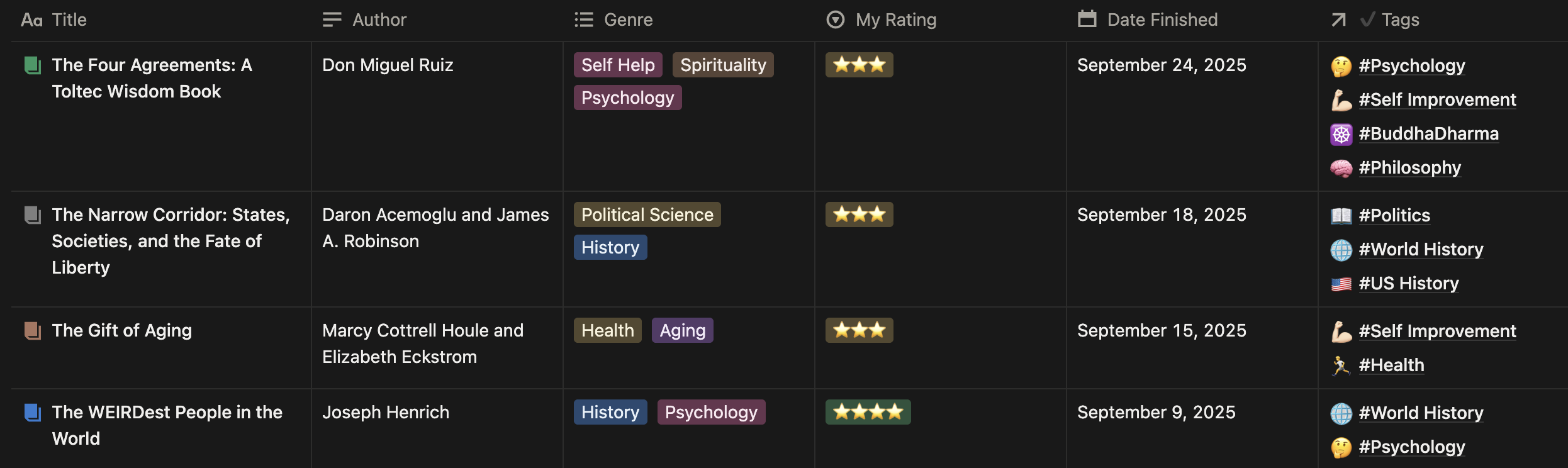
I finished four books this month and am currently reading 7, plus the one high school Human Geography text. As I mentioned in a post last week, I bailed on my one novel and took up book two of The Wheel of Time series in its place. So far I’m glad I did. The two books I find myself reaching for the least right now are The Rediscovery of America and The Age of Surveillance Capitalism. Nevertheless, books that I lag on usually grip me at some point and I am able to make significant progress quickly. That is happening right now with Gore Vidal’s memoir Palimpsest. My quickest read right now is the excellent Garcia biography.
It is How You Live Your Life
The Jerry Garcia biography I am halfway through is enjoyable. Rather than a straight biography of Garcia, it’s really the story of Jerry and the times he lived through. The author spends half the book on his youth and the 60s. But hey, as a history nerd, I’m loving all the historical context.
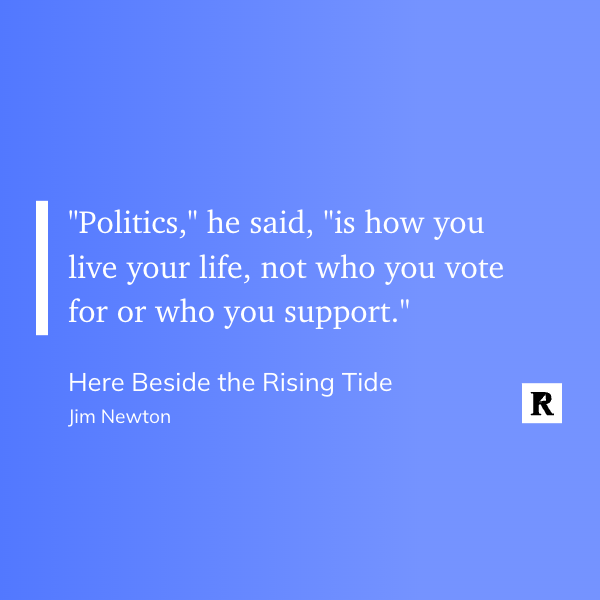
During the description of the chaos of 1968 there is a section that mentions Jerry Rubin and the Yippies. The quote below–attributed to Rubin–which I had never heard before, is great and resonates deeply right now in the back half of 2025. I’d amend the idea a bit in the sense that who we vote for does matter quite a bit. However, as Rubin argues, it is so much more than that. It is what you buy, what you invest your money and time in, what types of people you hang out with, where and how you live, and what values you try to live up day in and day out, including what you do to pay the bills. As a social studies teacher, this is an important idea that I think we all want our young people to understand. Rubin’s quote makes the points succinctly and coming across it, I found it to be a powerful reminder.
Fall Book Reload
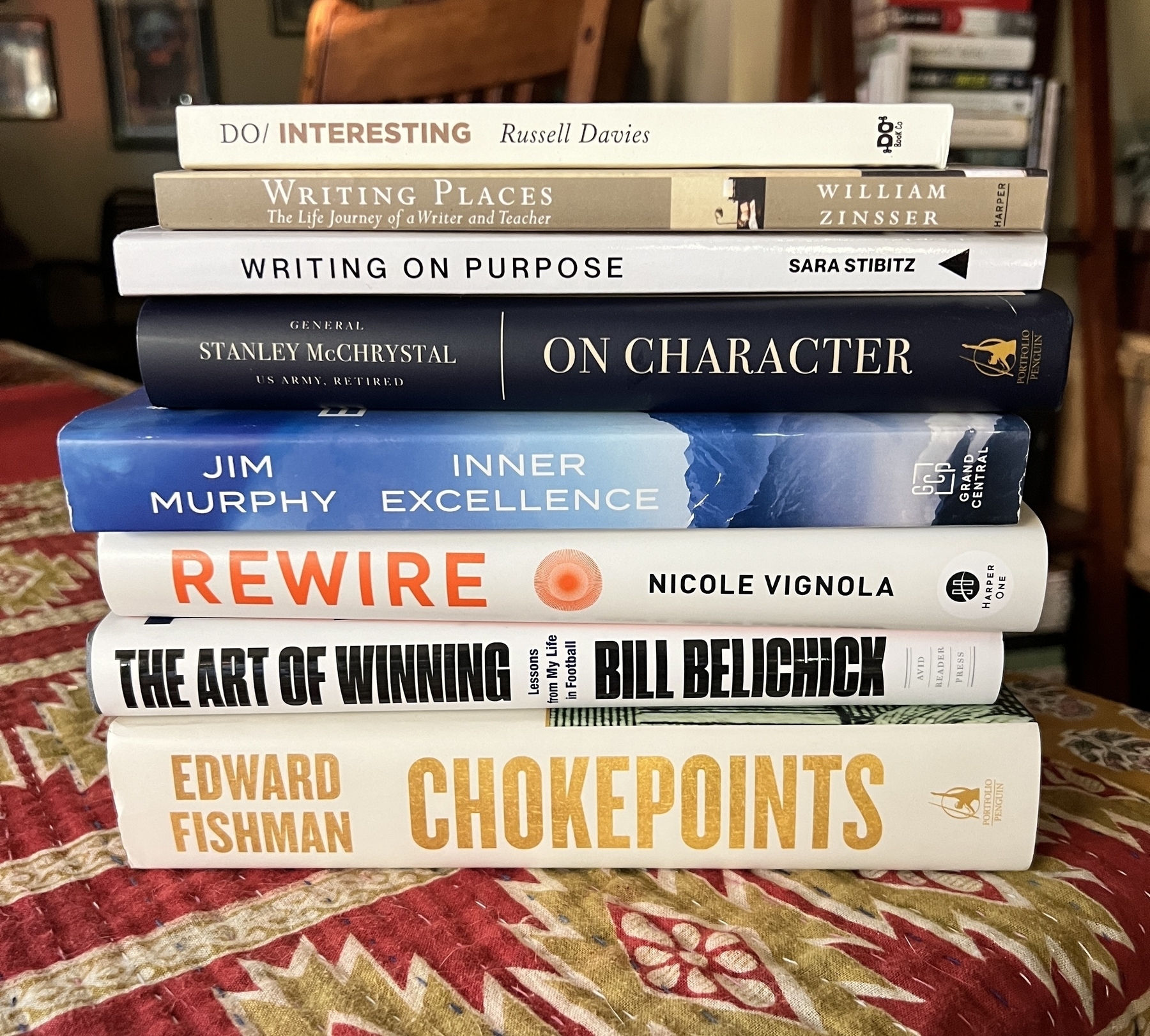
A new season is upon us and I pulled the trigger on 8 new books to add to my TBR collection. This haul touches on many of my interests; football, memoir, writing, foreign policy and economics, and general self improvement. I’ve got to finish one of my current reads before diving into one of these, but I’m pretty sure I’m going to tackle the Zinsser memoir first. Happy days.

Traffic and the To Don't List
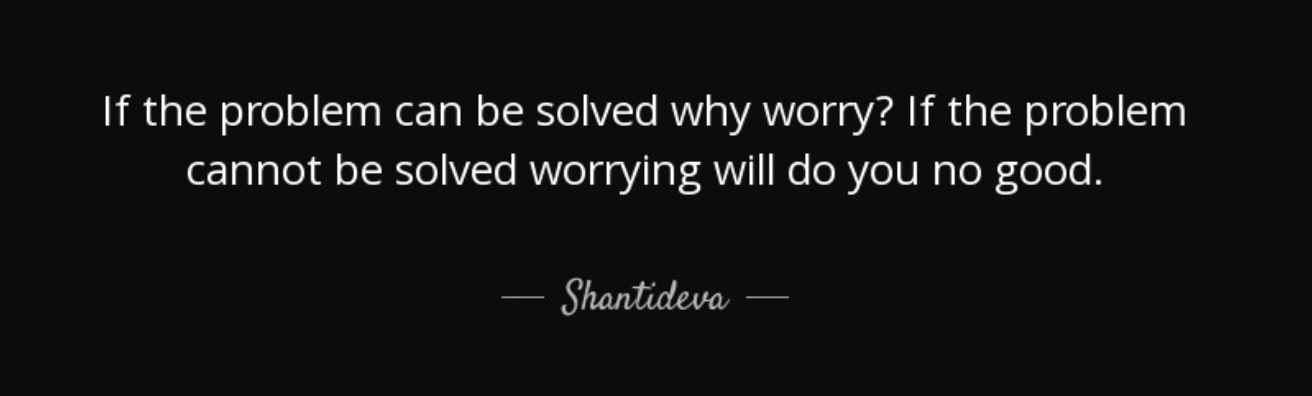
Everyone has heard of a ‘to do list.’ An idea that has been floating around amongst productivity nerds for a while is the related notion of a ‘to don’t' list. Today I was stuck in traffic on my way home and I was reminded of this idea. Having the same commute for 25 years has led me, unfortunately, to be a bit impatient driving home. I tend to get easily frustrated in traffic and today was typical in that regard. However, I eventually remembered (admittedly, it took awhile) the uselessness of getting angry at traffic, as my feelings one way or another were going to have zero effect on my ability to get home any faster. The advice of Shantideva and the Stoics came to mind. Indeed, “don’t get upset about things you can’t control” became my mantra today and that led me to try and think of other behaviors I should keep atop my personal ‘to don’t’ list. Here a few more that came to mind:
-
Gossip
-
Compare myself to others
-
Doom scroll the news
-
Ruminate about the past
-
Think rigidly or ideologically
Easier said than done for sure, but definitely worth the effort.
Quitting Time
I finish the vast majority of books that I start. However, every once in a while I find myself reading 100 pages (or thereabouts) into a book that isn’t interesting. For me, it almost always happens to be a novel. I used to feel the weight of the sunk cost fallacy and felt like I should finish every book I started. However, as I get older I realize that logic doesn’t work for me. Life is too damn short to read just for the sake of reading. I’ve got to be getting something out of the book.
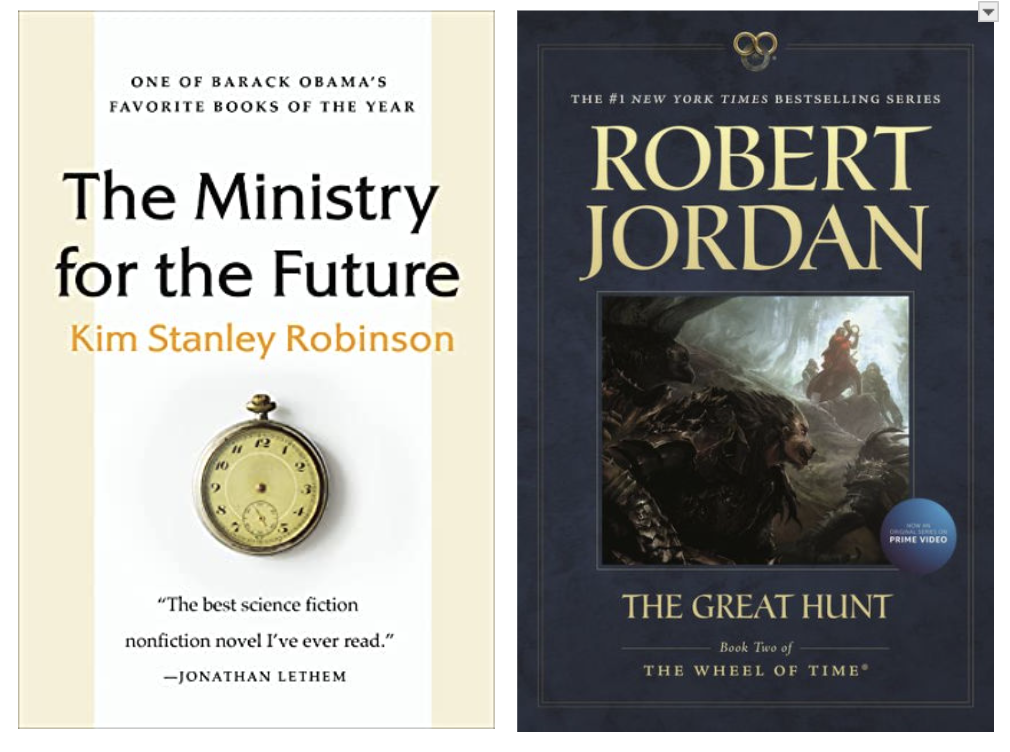
Yesterday, I gave up on Kim Stanley Robinson’s The Ministry for the Future. For those who are interested in science and climate change, I recommend the book. It is well written and is creatively organized, but I wasn’t digging it. Indeed, I only made it through page 88 on this one. I’ll keep it around because perhaps in a different season of life, the book might resonate more. However, since I always try to have one novel going, I immediately started the second book in The Wheel of Time series by Robert Jordan.
Simple Red Lines
A week ago I wrote about my love of college football. However, today I cancelled my YouTubeTV subscription, which means that starting next weekend, I’m shut out from watching anymore games unless I am at someone else’s house or I decide to go hang out at a pub. Everyone’s red line is somewhere and for me I can’t cotton to supporting Disney/ABC/ESPN, or CBS, or Fox at this point. So, no football for me this year. Luckily, I can access college radio stations online and still follow along with games I really want to experience. Looking on the bright side, it is going to save me some dough and open up some free time on Saturdays.
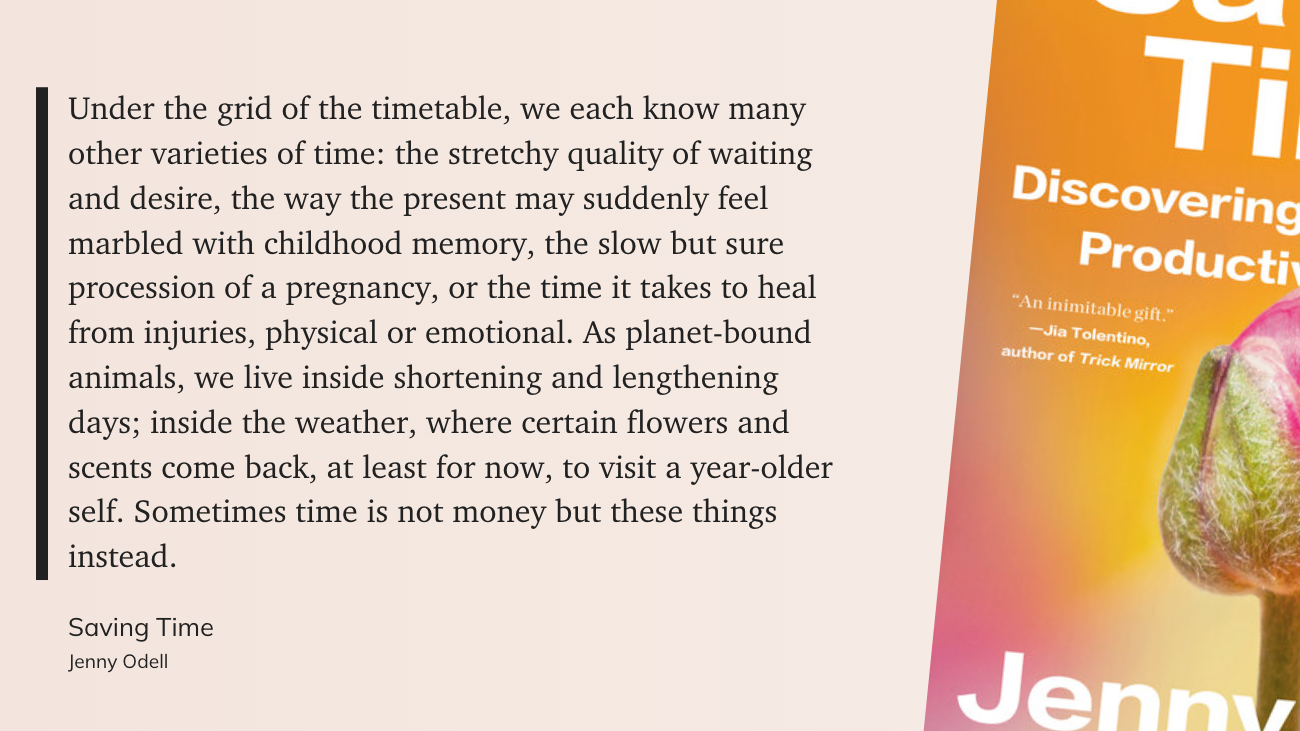
The Experience of Time
I didn’t finish this book by Jenny Odell, but I read enough to come across this arresting, beautifully conveyed idea about how we experience time. The first example that comes to my mind is how long the next three and half years are going to feel to many of us who are disgusted with the current political environment in this country. Other examples include:
- Scrolling online, when 10 minutes can quickly turn into a 45 minutes or more, in a blink;
- Parenting young children, when the days (and nights!) can sometimes stretch on for what feels like forever, but the years pass by at lightning speed;
- Waiting for test results or a scheduler to call for a needed appointment, leading to the sense that days have become weeks;
- Commuting, when the 30 minute drive feels ten times longer than the same 30 minutes at home engaged in your favorite activity;
- Vacations, when the the weeks and days leading up to it crawl by, but the vacation itself seems like it is passing by at double time;
More evidence that Buddhist teachings on Emptiness ring true.
Tyranny of the Majority—and the Minority: Federalist No. 10 and the Fate of Liberty
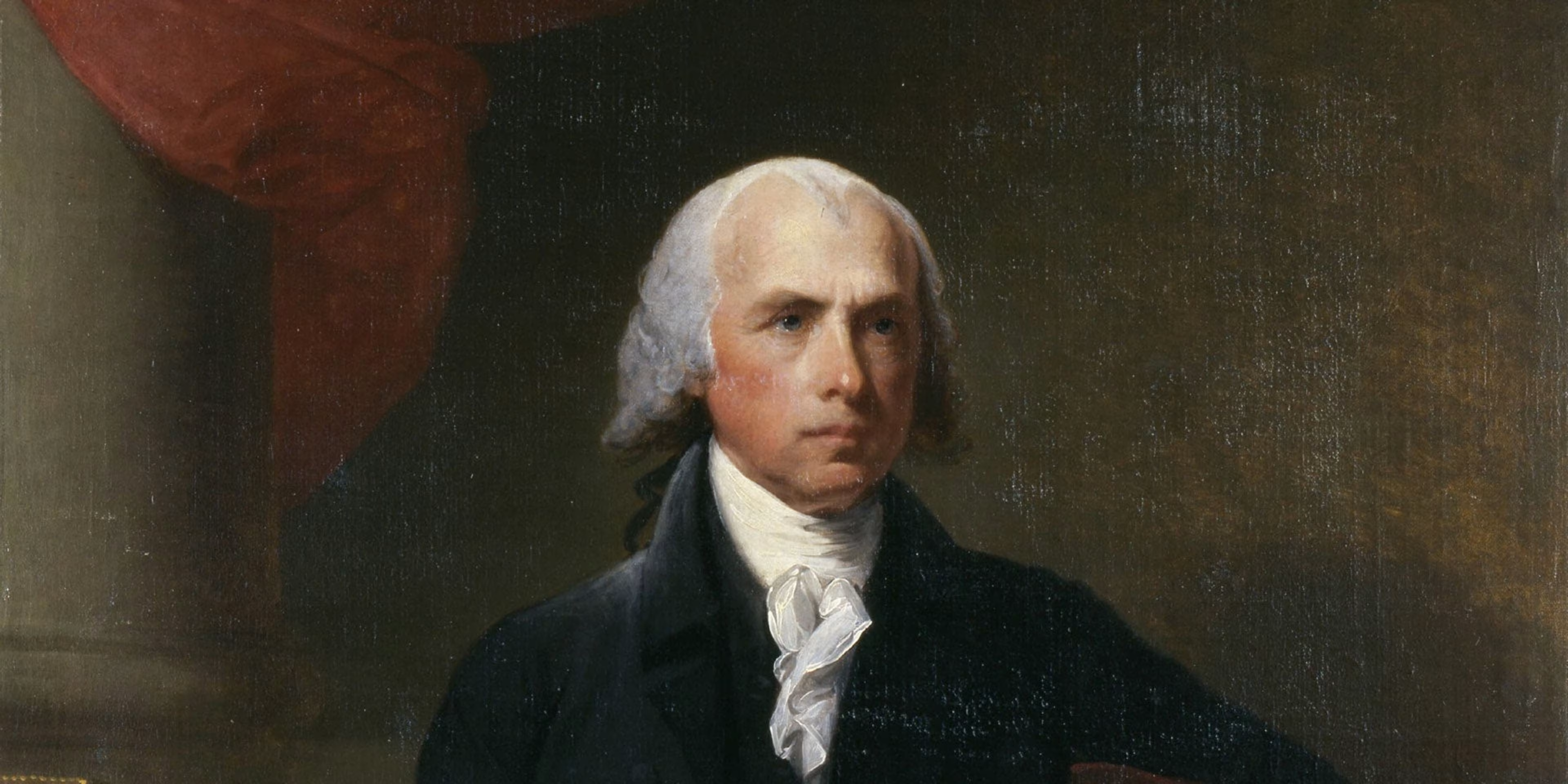
In my AP Government class we recently read Madison’s Federalist No. 10. Rereading it this year, I am reminded that it is something I wish more Americans were familiar with and the conversation in class connected to an idea in one of the books I just finished reading. In Federalist No. 10 Madison argues for a republican government; that is, a representative democracy. His fear of majority rule (‘direct democracy’) was based on the idea the majority might use that status to trample on the natural rights of the minority. He was mostly worried about the landless masses taking the property of men like himself through the power of the legislature. However, his point has been made throughout American history. The example I use in class is the stain of Jim Crow racism in our history. For close to 100 years a majority of whites in many states (and in all the southern states) voted to trample the rights of non-white citizens. They disenfranchised racial minorities as well, but even if everyone in those places could actually vote most southern states were still majority white so Madison’s point would have likely still been made, that in a pure democracy there is a danger of the minority having their rights abused. This is known as the ‘tyranny of the majority’ and it is an obvious danger of a direct democracy.
Of course, a minority faction (that is, an interest group or political party that does not represent the majority of society) can also trample on the natural rights of the people if they have power. Today, we certainly can see that those with enormous wealth, a minority for sure, have captured much of our government and take advantage of that capture to protect their wealth (I’m looking at you 119th Congress). While discussing the essay, students in class brought up campaign finance as an example of a faction’s threat to our democracy. Coincidentally, their comments touched on something I recently read.
The Narrow Corridor is an excellent, if wonky, book, subtitled ‘States, Societies, and the Fate of Liberty.’ At the end of the paradigm-shifting book, the authors (Daron Acemoglu and James A. Robinson) include a few suggestions for keeping America ‘in the corridor’ (between a ‘despotic leviathan’ and an ‘absent leviathan’), as it is clear to everyone paying attention that we are living in a time when liberty is being threatened by an increasingly unshackled state.
So what was the connection? Well, the first solution Acemoglu and Robinson mention was campaign finance reform. Specifically, they argue we should “curtail campaign contributions and limit the impact of lobbying. Specific measures to bring greater transparency to the relationship between firms, lobbyists, and politicians may be particularly important since accounts of how politicians became become faithful servants of certain industries or interests often involve meetings hidden from the public eye and poorly monitored revolving door arrangements in which regulators and politicians are later hired by the private sector at very attractive salaries.”
In other words, it would be beneficial to change our campaign finance laws in order to make it harder for minority factions (that is, special interest groups) or the uber-wealthy in general, to threaten the liberty of the majority of citizens.
I always love it when something happens in class that connects with something that has been brought to my attention by something I have recently read. I wonder what Madison would say about the fact that today such a small minority, due to their incredible wealth, can manipulate our government, at all levels, for their own benefit.
Links to Two of my Favorite Poems
I am not a huge poetry fan, but I do love Gary Snyder’s work. Snyder went to Reed College here in Portland and for many years taught at my alma mater in Northern California. His poetry blends nature mysticism, Zen Buddhism, and the vast landscapes of North America. As of this post, he is 95 years old and still kicking. Snyder’s poetry came to mind because the biography on Jerry Garcia that I am reading explains the influence of the Beats on San Francisco and Jerry. Snyder was one of the OG Beats. Indeed, he is the inspiration for the character Japhy Ryder in Jack Kerouac’s book Dharma Bums.
Below are links to two of my favorite Snyder poems. Enjoy!

New Read: Here Beside the Rising Tide
I recently started reading the new biography of Jerry Garcia by journalist and biographer Jim Newton. What first intrigued me about the book is that Newton, while a fan, is not an insider. Most of the many books about the Dead that have been published since Garcia’s death were written by insiders of one sort or another. Those sorts of books, especially memoirs by the band members themselves, are obviously great to read for big fans. However, I am now interested in reading a more distanced view.
I just started the book, but there are a few things I have already learned about Jerry.
- Jerry’s dad was a musician, but gave it up to run a bar in San Francisco.
- His father died when Jerry was only 5 years old. They left to go on a fishing trip and his dad drowned, so young Jerry had come home from that trip along with his mother, stunned by the sudden death of the family patriarch. I imagine that would have been an immensely difficult situation for such a young kid.
- Shortly after the passing of Jerry’s dad, he and his older brother moved in with their grandparents and Jerry’s grandfather sounds like a shitty grandparent. Jerry’s memory of his grandfather was apparently pretty negative. Considering the grandparents were taking the boys in after their father had died, it strikes me as particularly pathetic behavior.
- Jerry’s grandmother had other boyfriends while she stayed married to Jerry’s grandfather. Bill, Jerry’s grandfather, beat his wife once and after that she initiated what sounds like a Catholic divorce; essentially separated, but living in the same house.
I am less than ten pages in so I expect there is much more to learn about Garcia. If you are a Deadhead, check it out.