Teaching and Learning
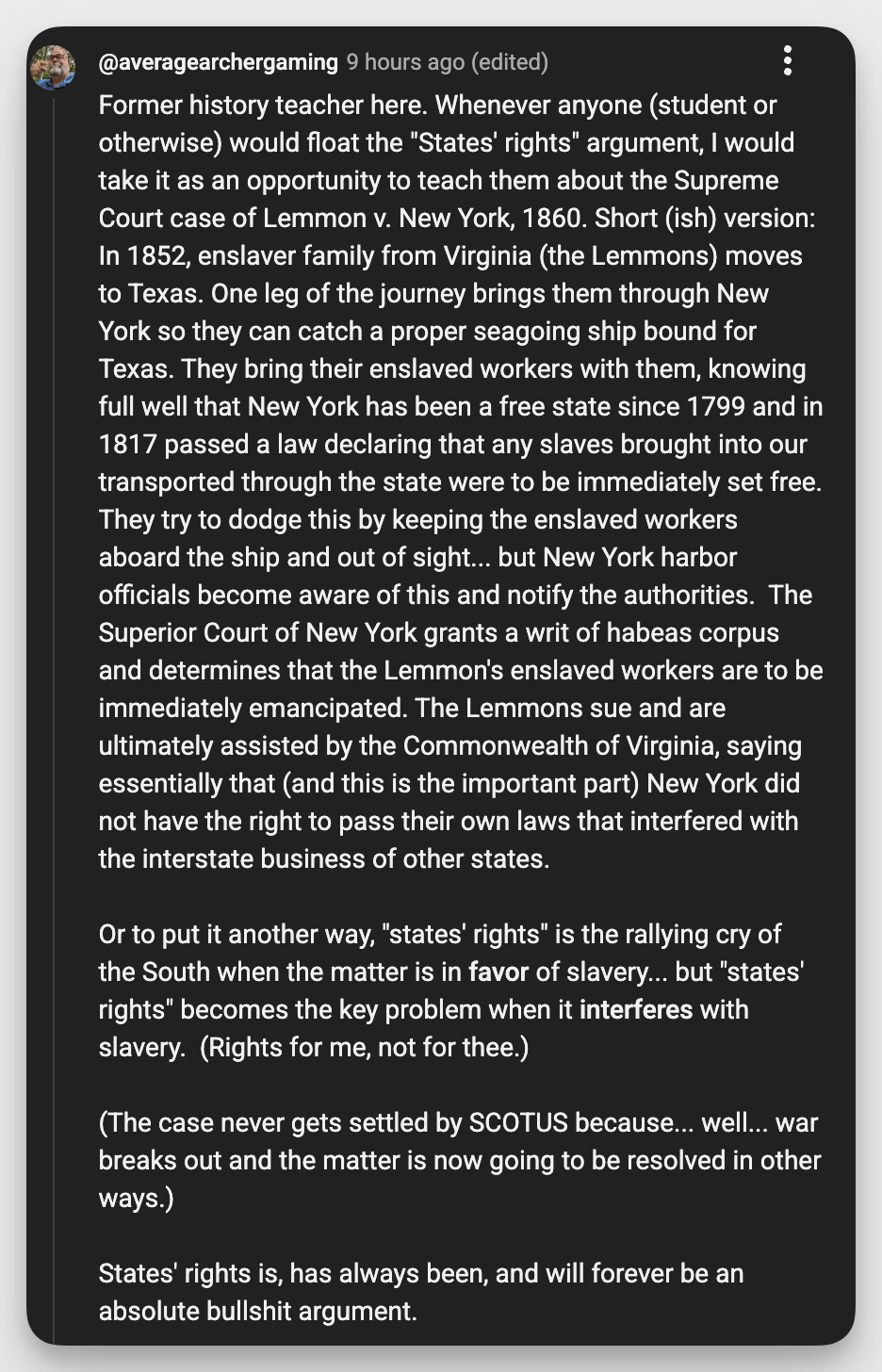
The 'Cornerstone' and Lemmon v. New York
Sometimes I know I couldn’t have said it better myself. In the case of this topic, it is something I teach every year. But @Amandas-Mild-Takes pretty much nails it, much more succinctly than I tend to put it in class. That there are still such ignorant people who try to deny the primacy of slavery to the Civil War is astounding.

3 Substack Blog Posts and Some Tunes
- WTED Goose Radio
As a massive Goose fan, I was very happy to recently discover this 24/7 streaming Goose radio station. They also have a great Goose 101 page for newbies.
- Substack blogger Rob Henderson on How I Read
As an avid reader I am always interested in other people’s take on reading and how they manage to read at volume. This is an interesting take.
- Substack blogger Joseph Heath on Becoming Less Full of Shit.
This is another Substack blog post I have come across recently that I enjoyed. At this particular juncture, we definitely need less bullshit.
- Substack blogger The Existential Contrarian on why modern young people’s liking for socialism suggests a failure of American schools
This one is relevant to social studies teachers, a group I belong to. Good stuff.
- New Stephen Wilson recording, Requiem for a Village
Stephen Wilson is the musical genius behind Porcupine Tree and tons of other great musical creations. He is a prog god and this new tune (it looks to have been released two days ago on Youtube, on September 11) is killer.

A Few Good Signs for the Upcoming School Year
Today was the second day of PD (professional development) that I attended at my school that was offered on a voluntary basis. My school does this every year and I appreciate it. Most years, they give us three days, but money is tight so we had two this year. I wanted to briefly acknowledge something that I saw that I have been wanting to see for years.
First, the concept of direct instruction was brought up as a necessary component of deep learning and critical thinking. In the past, the emphasis was always on the higher order thinking skills without any discussion of the critical importance of knowing to that process. This made me very happy to see.
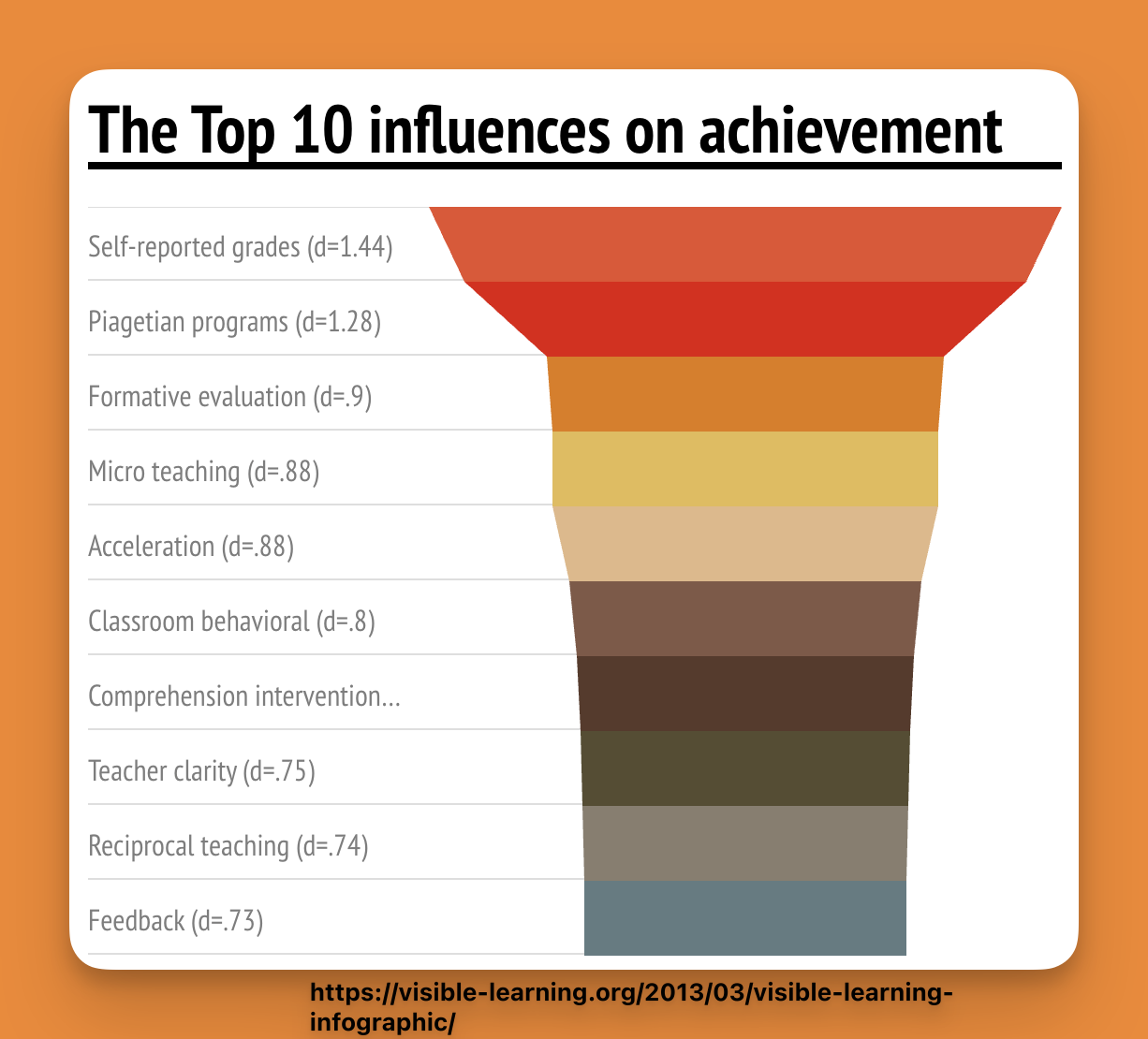
Related to that was the inclusion of research by Australian educator John Hattie, whose work is based on sharing meta-data on the efficacy of teaching strategies. Hattie’s research has been known in education circles for at least a decade, but today was the first real sharing of his ideas and research. This also made me very happy to see.
Nothing more to add excpept that I hope this positive element of my initial PD this year bodes well for my 29th year as a professional in the classroom.
5 Books Teacher Ed Programs Should Assign
I got a text an hour ago from my student teacher from last year. He was in a box at Madison Square Garden about to see his first Rush show. Lucky dog!
That got me thinking about teacher ed programs, which led me to recall the many chats I’ve had over the years with young teachers earning their M.A.T.s about what they are being assigned to read by their professors. I was often shocked that books I thought would be de rigueur were not on the syllabus.
Here are 5 books I think any future high school social studies teacher should read.
-
Jill Lepore’s beautiful American history book These Truths. Forget Howard Zinn, read this wonderful, comprehensive, narrative history instead.
-
John Hattie’s Visible Learning for Teachers. I first heard about Hattie from a friend and took a deep dive into his oeuvre, especially as it relates to social studies. What Hattie does so well is explain, based on all the research, what actually works to produce actual learning.
-
Developing Curriculum for Deep Thinking by a gaggle of experts, including John Hattie. This wonderful, short book about the importance of knowledge (aka, facts) should be mandatory reading for future and current educators. The argument isn’t trendy, but I agree with it completely: higher order thinking is not possible if people don’t have a strong foundational base of knowledge.
-
How Teaching Happens, by Paul A. Kirschner (one of the co-authors of the book mentioned above), Carl Hendrick, and Jim Heal. This book is a review of 30 seminal books and papers that teachers should know about. It is a follow up to their similarly styled book, How Learning Happens.
-
Make History: A Practical Guide for Middle and High School History Instruction by Art Worrell and Paul Bambrick-Santoyo. As the title emphasizes, this book is practical and contains a ton of easy to implement ideas for any high school social studies class.
Will My District Let Me Use This?
I’ll admit it: I get an unreasonable amount of excitement about AI tools built for teachers specifically, as opposed to the general-purpose chatbots most of us have added into our workflow over the past few years. So when Anthropic announced Claude for Teachers earlier this month, I read the whole press release like it was last night’s Rush set list.
Here’s their pitch, as best I can tell. Claude for Teachers is free for verified K-12 educators for at least a year, and it’s built around a partnership called Learning Commons, which maps academic standards across all fifty states down to the specific skills and sequences underneath them. In theory, that means when you ask it to draft a lesson plan, it’s pulling from an actual scaffold of what kids are supposed to know and when, as opposed to simply generating something plausible-sounding. Anthropic is also folding in Claude Code and Cowork, so teachers could theoretically use it for bigger tasks, like combing through student data or automating something that repeats every week.
I find I have my usual skepticism about any tech company claiming to close the gap between best practices and what a teacher’s week allows. We teachers have heard that line before. But the emphasis here is a little different than the last wave of ed-tech AI. Instead of being aimed at students, it is aimed at the person standing in front of the room trying to differentiate instruction for 28 kids on a Tuesday afternoon with emails to answer and work to grade. Task overwhelm is a real problem for educators, and if a tool can genuinely lighten the load, I’m interested.
Where things get murkier is whether I’ll actually get to use it. My district runs on Google, and like most public school systems, we’ve got an approved list of software that reflects understandable caution these days. Anthropic says they’ve built in FERPA-aligned data protections and that teacher conversations aren’t used to train the model, which is reassuring, but “reassuring” and “cleared by our tech department” are two different things. I have no idea whether Claude for Teachers will make it onto our list, or how long that might take.
Assuming I do get the green light eventually, I can already think of uses. In my elective Sports History, standards-aligned lesson planning would save real time on a daily basis. I’d also like to see what it does with differentiation, since I’ve got students reading four grade levels apart in the same room, and building truly different versions of an assignment by hand eats time I don’t have. And if the Cowork side can help me sort through exit tickets and assessment data with reduced stress, that alone might be worth the sign-up.
So consider this a placeholder post. I’m cautiously hopeful. If tools like this actually deliver on giving teachers back the hours we spend on the invisible half of the job, that’s a huge win, not just for me but for my students, who benefit every time I’m less exhausted. I’ll report back once I know whether I’m allowed to touch it.
My Resource Dashboard for Teaching
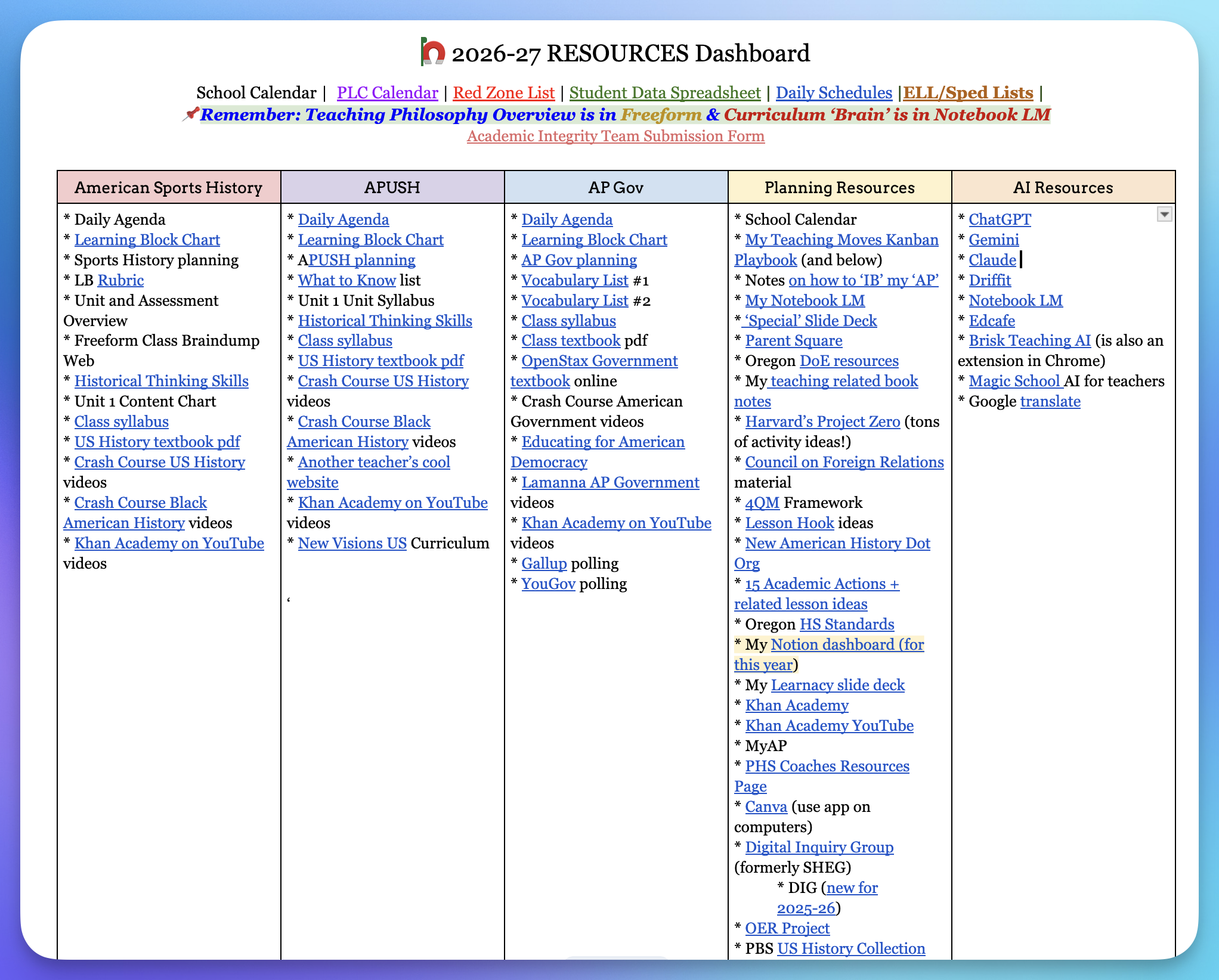
At this point in my teaching career it is abundantly clear that organization is critically important. When I have student teachers I emphasize organization, both digital and physical. Hight school teachers have no secretaries, interface with well over 100 teenagers a day (not to mention their coworkers and parents), and cope with quite a bit of paper that is both going out to the kids and coming in for grading.
Several years ago I came across a teacher’s website online and he had a Google Doc that was a hub for all the resources he’d need to do his job. I immediately saw the wisdom of such a thing and knew that it fit my personality. Below is a screenshot of what my current Resources Dashboard looks like. The links go staight the document in my Drive or to the website. I have this pinned on the top of my work and personal Chrome browsers to that it is only a click away if I am online anywhere.
Once it is built it is easily updated each year depending on changes to teaching assignments. I know every teacher organizes their digital lives differently, but if I were an administrator, I’d strongly recommend all my staff make something like this.
The Cradle of Citizenship
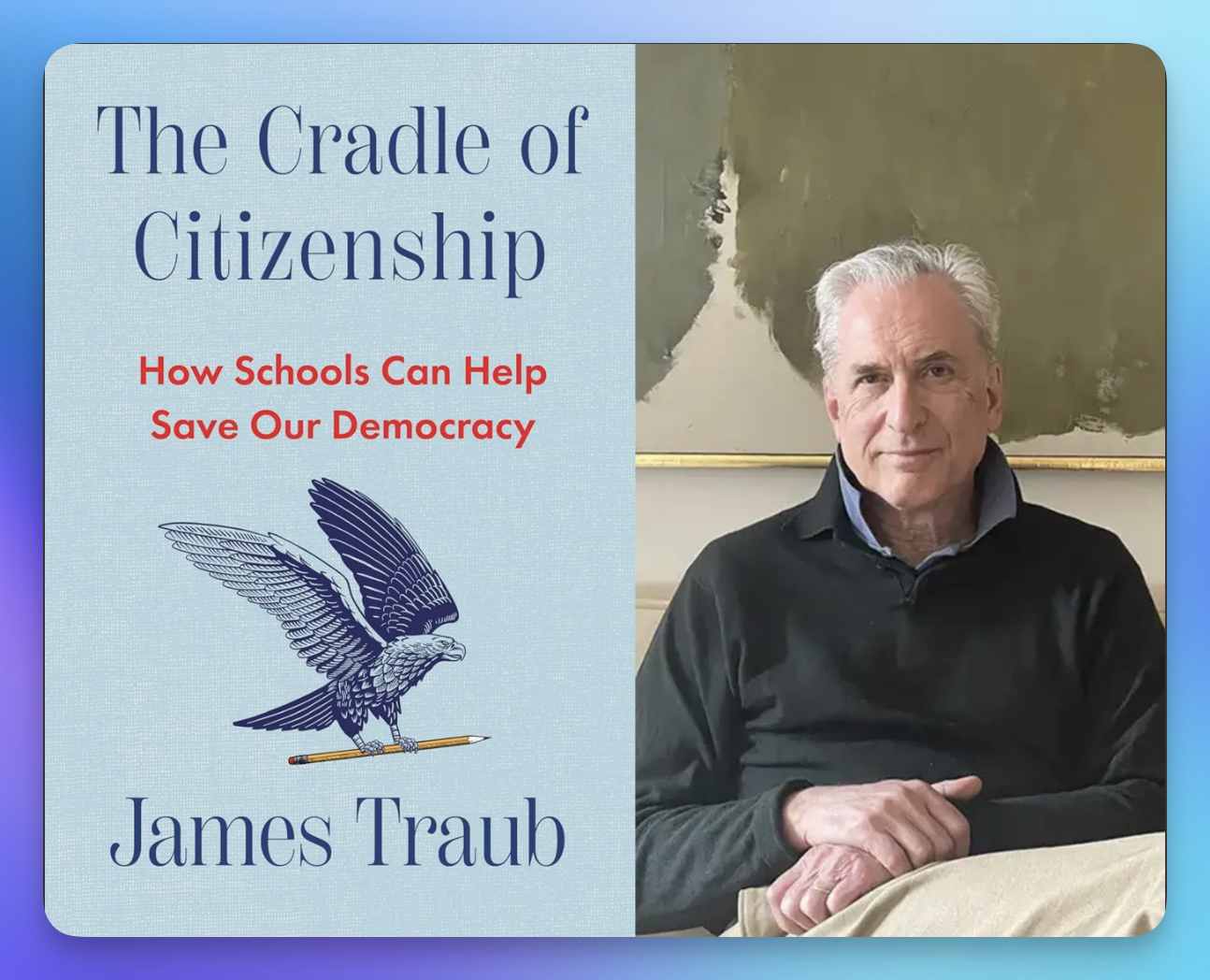
I recently finished James Traub’s excellent book The Cradle of Citizenship. Traub spends a year visiting classrooms throughout the United States, trying to understand how schools promote and teach our young people how to be citizens. As an AP US History and AP Government teacher in a majority minority public high school, with a large immigrant population, this topic is important to me. Along the way, Traub exposes the follies of both the right and the left, with Florida and Minnesota playing lead roles.Traub makes clear there are some stupid practices and ideas on both sides of the political spectrum when it comes to education. I certainly see this in my job here in Portland.
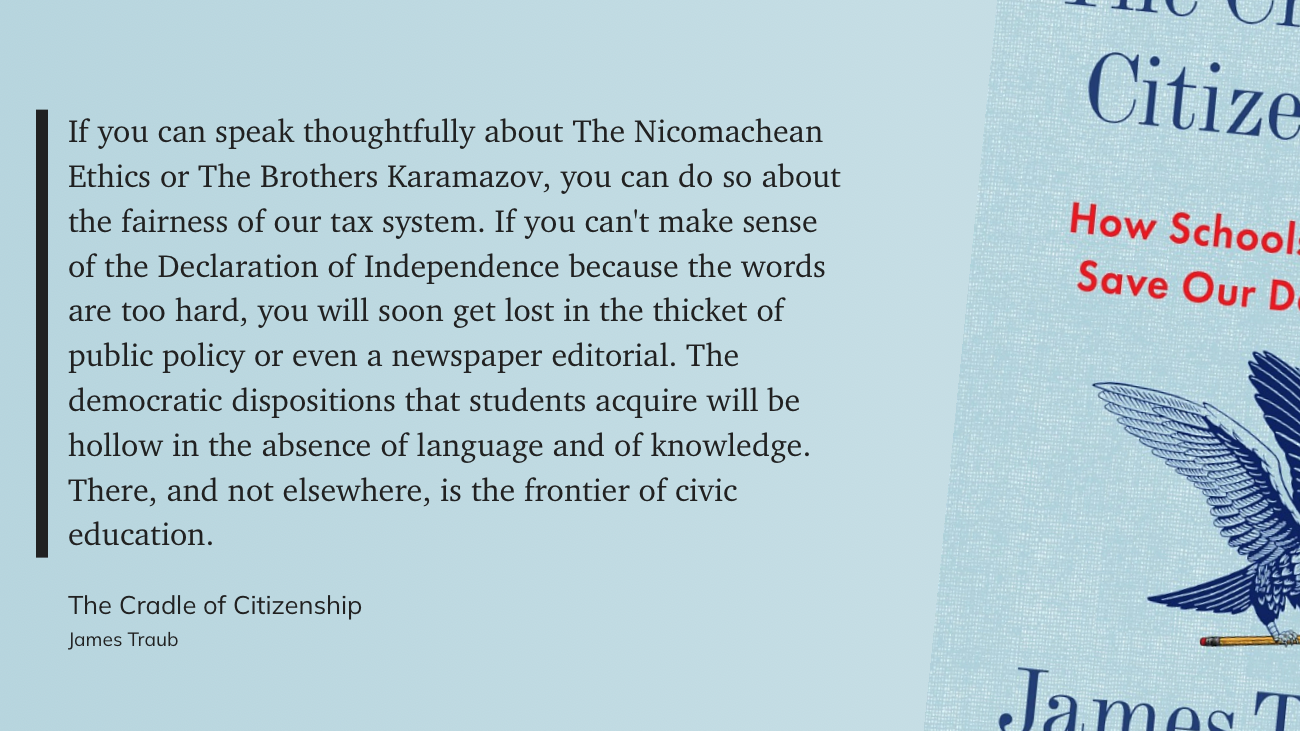
Traub defines himself as being center-left, which is how I see myself. Not surprisingly, I agree with many of his conclusions. With regards to one current debate in education, he makes the point that knowledge is the foundation of higher-order thinking and thereby citizenship. One can’t form an educated opinion on tariffs, for instance, if one doesn’t know what a tariff is. However, focusing on facts, and chronology (as opposed to thematic learning in history), and often, ‘dead white guys’, are practices associated with the conservative view of education. However, I agree whole-heartedly that Traub’s conclusion about this debate is correct; in this case, the conservatives are mostly right. For more on this topic, see this free pdf titled Developing Thinking for Deep Thinking.
I enjoyed the book as well because it gave me a peak inside other classrooms. One of the problems with teaching is that we work in a bit of a bubble. It is often difficult to see what is happening outside one’s own classroom walls, not to mention in other buildings, in other states.
Unfortunately, the book did not lessen my worries about the intellectual (and spiritual) rot of Christian Nationalism. There are some very ignorant people in this country that would turn our schools into madrasses. That is no bueno and is a reminder that there is a culture war being waged in our nation, one that is tied to the class war that continues to be waged by the Epstein class in this country. And schools are increasingly a battle ground in those wars.
If you’re at all interested in the relationship between schools and democracy, read this short gem of a book.
An Obit, Three Recommendations, and Some Interesting News
- New York Times obit of hIstorian of the American Revolution Gordon S. Wood
I haven’t read any of Wood’s books, but many are still in print and claim real estate in most American bookstores.
- New history podcast by author of 1491 and 1493, Everyday Abundance.
Charles C. Mann has teamed up with a partner to create a cool new history podcast. This just launched, but it looks promising. Mann is the author of the popular and respected books about indigenous America, 1491 and 1493.
- Cool blog at www.kottke.org
I recently discovered this blog, which is a curated stream of fascinating links, technology, art, and culture updated daily by OG blogger Jason Kottke.
- Netflix presidential biography documentaries
I was fishing around for a relevant documentary to show to the small AP Gov classes I have this week (most of my students were seniors and their last day was last Friday). I came across this collection of Netflix documentaries about our better, more note-worthy presidents. Each series consists of a handful of roughly 90 minute episodes. They are a mix of dramatic re-enactments (with solid, look-a-like actors), real footage (for the modern presidents), and interviews with a who’s who of renowned historians, including H.W. Brands, Jon Meacham, and Doris Kearns Goodwin. I’ve now seen episodes on the two Roosevelts and really enjoyed them. My students gave them high marks, as well.
What Real Leadership Looks Like
Yesterday was the 82nd anniversary of D-Day. I spent some time in class on Friday in all my AP classes reviewing its significance. I believe strongly it is one of the seminal events in American history that all Americans need to know about (my APUSH classes are just at WW II as the year is ending). I also briefly mentioned the fact that Supreme Allied Commander Dwight D. Eisenthower had prepared two letters to share with the press that day, depending on how the invasion went. The one he didn’t have to read was the one taking full responsibility for the failure of the operation. As my students heard about this it was clear they understood this sort of leadership is very different from what they see today.
Yesterday, Heather Cox Richardson, the great historian and documenter of our times, shared the video below, which touches on Eisenhower’s willingness to take responsibility had D-Day not been successful. It is short but worth watching.

Another Cool App: WisprFlow
In addition to Bevel, I have recently taken the plunge on another super cool app. This one is called WisprFlow and it seems to be taking over the Internet to a certain extent. The app is an AI voice to text app that I’ve been seeing in the productivity space online for more than a year. I finally decided to give it a try.
What’s cool about the app is that you can use it in any other app where a text box lives. That means I can use it to speed up my journaling, my assignment creation, my feedback on student work, my texting, my Second Brain note-taking, my recording of my food in Bevel (and in my other Google Doc food journal), my brainstorming, my blogging, and my interactions with Gemini and Claude. I’m still getting the hang of initiating it on my various devices, but I can already tell after less than a week that once I get the hang of using it–and train myself to think voice first instead of typing–I’m going to love what it does to my productivity.
Though it is still early days for me with Wispr Flow, I am very impressed with its ability to deal with the grammar of a stream of consciousness ramble. Indeed, this is one of their main selling points. It also does lists really well.
It is also worth noting that another of their selling points is that you can whisper and it will still accurately transcribe what you say (hence their name). So in a coffee shop, car, classroom, or living room (with someone else present) you can still use the app successfully. I have been very impressed with this feature so far.
For those worried about it training AI on your data, they give you the chance to opt out of that happening when you first set up your account.

Ragin' with Tom Joad
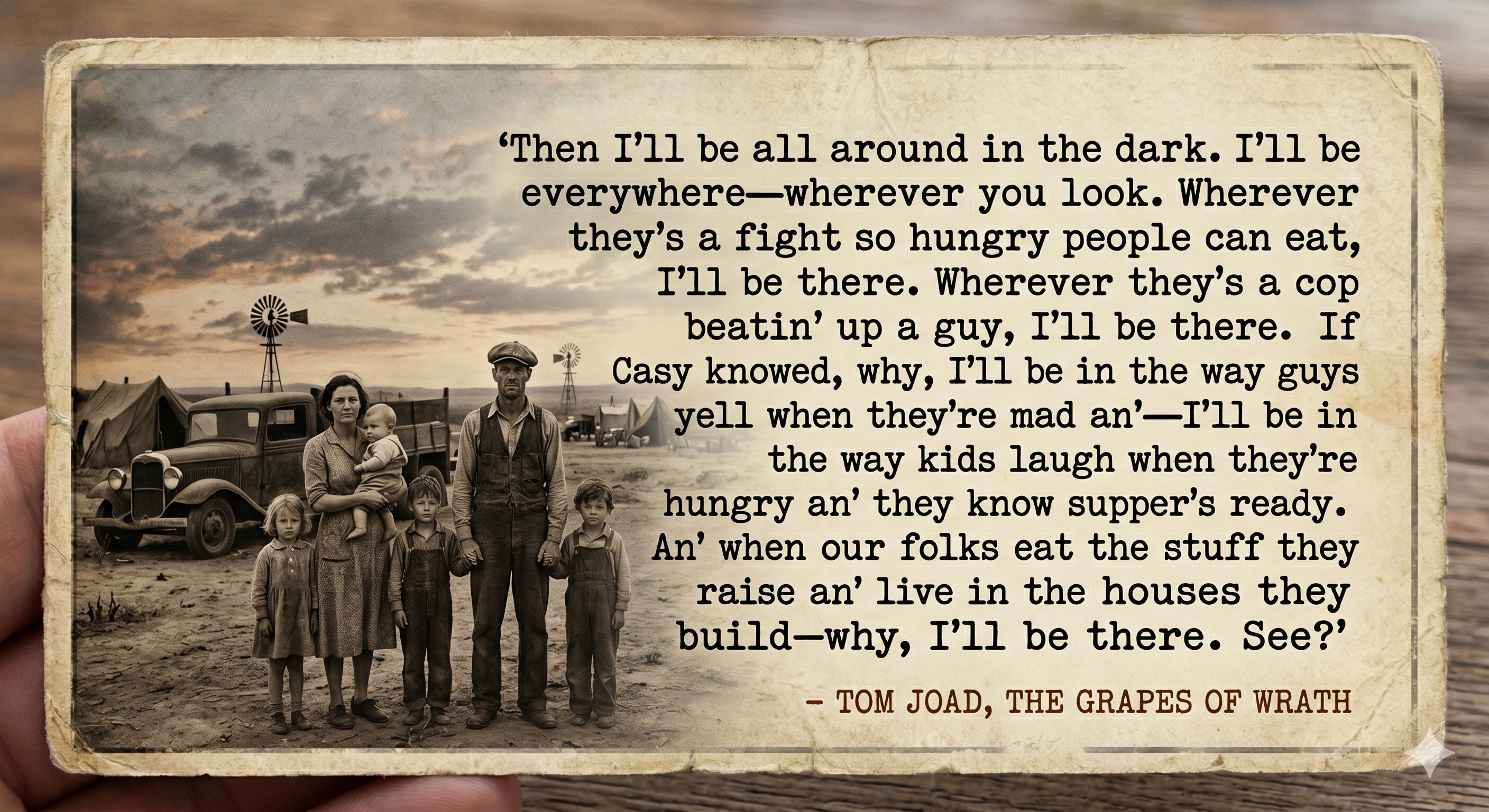
This past week we were learning about the Great Depression in my APUSH class. I usually have my students read an excerpt from The Grapes of Wrath while we are looking at the Dust Bowl and the experience of rural Americans during the early 1930s. I read the novel in high school (I think most California high schoolers my age were likely assigned the book at some point) and really didn’t like it. However, I read it again in my early 20s and enjoyed the novel immensly.
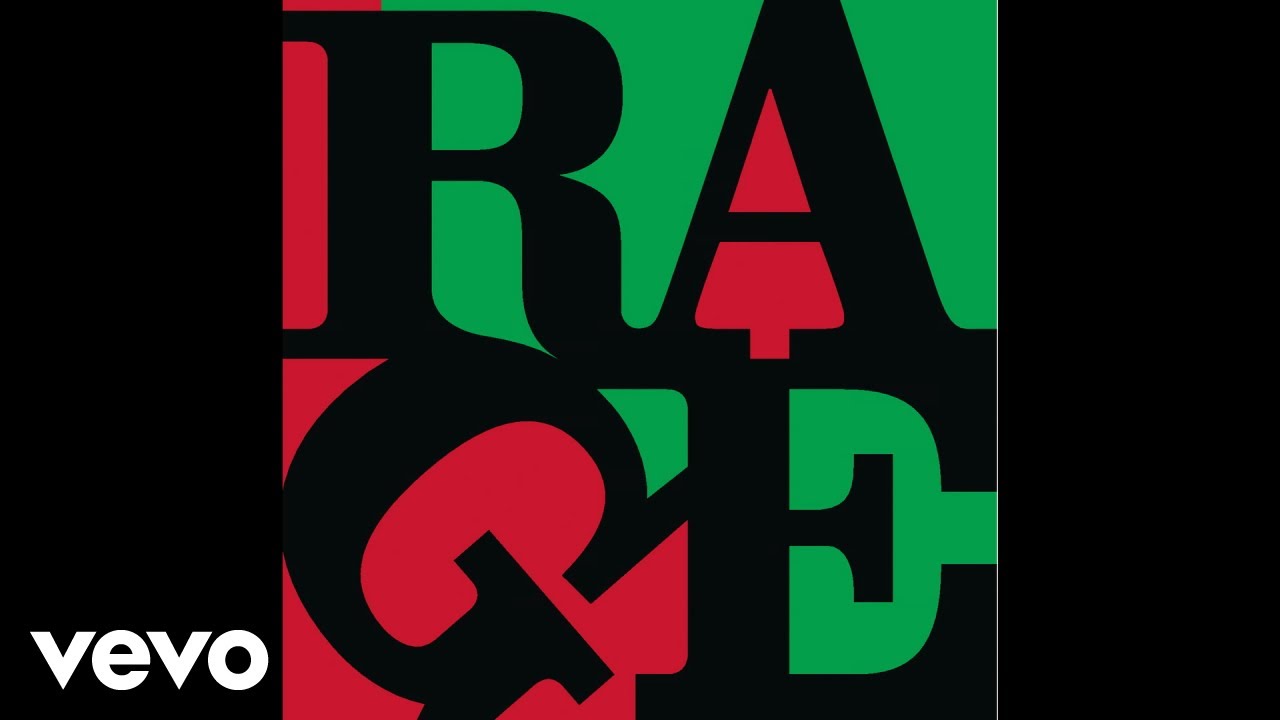
While discussing the book, Bruce Springsteen’s song “The Ghost of Tom Joad” came up. Knowing my kids, I also mentioned that Rage Against the Machine did a great, heavy cover of the tune. That led me to remember after class that Rage also did a fantastic cover of Dylan’s Maggie’s Farm, a song I was introduced to by the Dead.
Both of those songs are relevant now and the Rage versions, I think, convey the proper anger the lyrics convey more subtly. Enjoy!

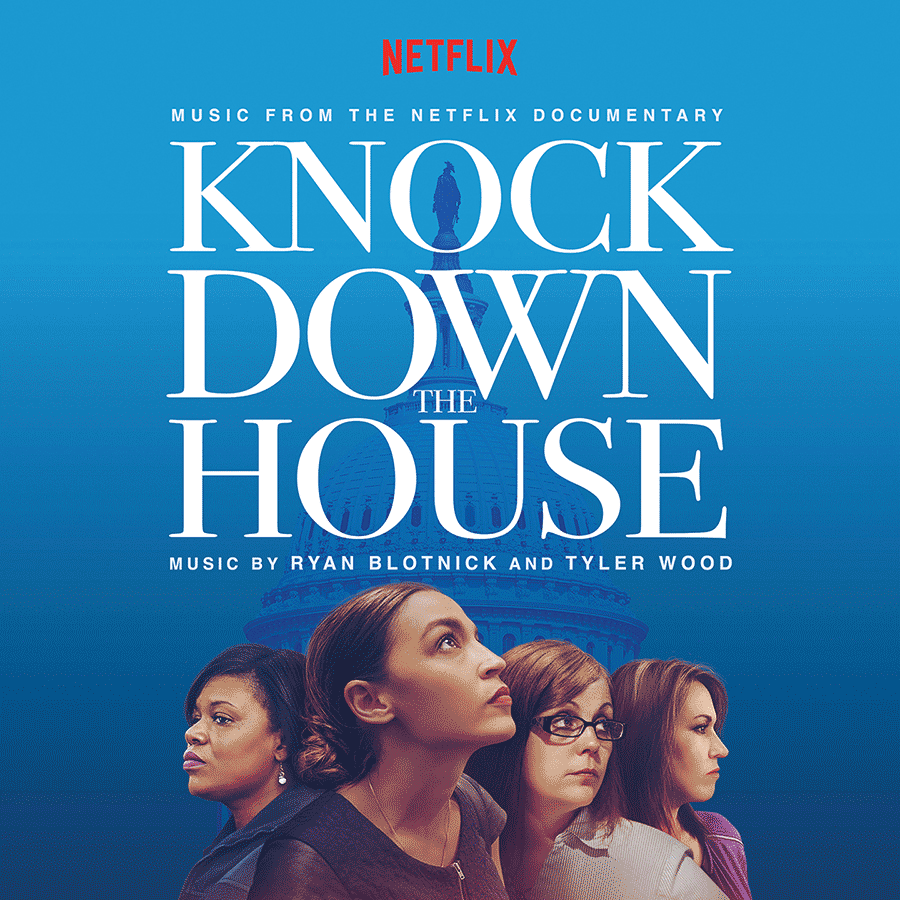
Knock Down the House
Today was the AP Gov exam, so I had many students out of class for the test. On such days, I often do something in class that I hardly ever do–show a film in it’s entirety. Today I screened the same documentary that I showed last year. Not only is it relevant to what we are learning about in class (elections and campaigning), but it features a politician most of my students have heard of…Alexandria Ocasio-Cortez.
If one is remotely interested in politics in general, or left-leaning politics in particular, this film is worth your time. In a nutshell, the film follows four women running in the 2018 congressional primaries. AOC gets the most screen time because she is the lone winner.
What struck me about the film was learning about the struggles that lead these four women to try and win a seat in the national legislature. Amy Viela’s story is the most heart wrenching. Her 22 year old daughter was denied tests after being admitted to the hospital because she didn’t have insurance. She died soon thereafter of a pulmonary embolism. So sad, and so very fucking American. AOC’s father, whom she was very close to, died while she was in college.
I was also struck by AOC’s confidence and tenacity. Watch the film, see if you see it to. I know she has become the boogyman of the right, and it is clear to see why–she’s smart, articulate, passionate, and has learned from the trevails she’s faced how to approach daunting challenges. Knowing more about her having seen the film, I am definitely rooting for her. She’e absolutely pissing off the right people.
Serendipity and Big Spending in DC
This is first and foremost a post about serendipity. First, I googled this very information yesterday while talking with my father. Then today I see the infographic below with today’s date (!), with the same exact information I googled yesterday and read about on a different website. Super weird!
But then, as fate would have it, my lesson today in AP Gov was about interest groups. And you’ll notice if you look at the graphic below, that Washington DC has the highest per capita GDP of any of the United States. New York is second, and has less than the half of DC’s number. Why? Well a big part of it is all the lobbying money flying around in DC (though there is tech and aerospace there, too). Indeed, the initial reason I googled the stat in the first place while talking with my father was because we were discussing the fountain of cash that is our federal government.
Mississippi has the lowest GDP per capita, and while Oregon isn’t close to that number, it is closer to Mississippi’s number than DC’s.
On a related note, according to Open Secrets, the interest groups that spend the most money lobbying at present are:
-
U.S. Chamber of Commerce: Typically the highest spender, representing business interests across various sectors.
-
The National Association of Realtors: Their primary goal is to “unleash” housing inventory through legislative and tax reforms
-
Pharmaceutical Research & Manufacturers of America (PhRMA): Represents major pharmaceutical companies, spending heavily to influence drug pricing policies.
-
Business Roundtable: An association of CEOs from major U.S. corporations, lobbying on tax, trade, and economic policy. National Association of Realtors (NAR): A consistent top spender focused on housing and real estate legislation.
-
American Hospital Association (AHA): Lobbies on behalf of hospitals and health systems.
-
Blue Cross/Blue Shield: A major player among health insurance lobbyists.
-
Meta: Their primary 2026 goal is to prevent a “patchwork” of restrictive state-level AI laws that could hinder development.

On Woodrow Wilson and His Wife Edith
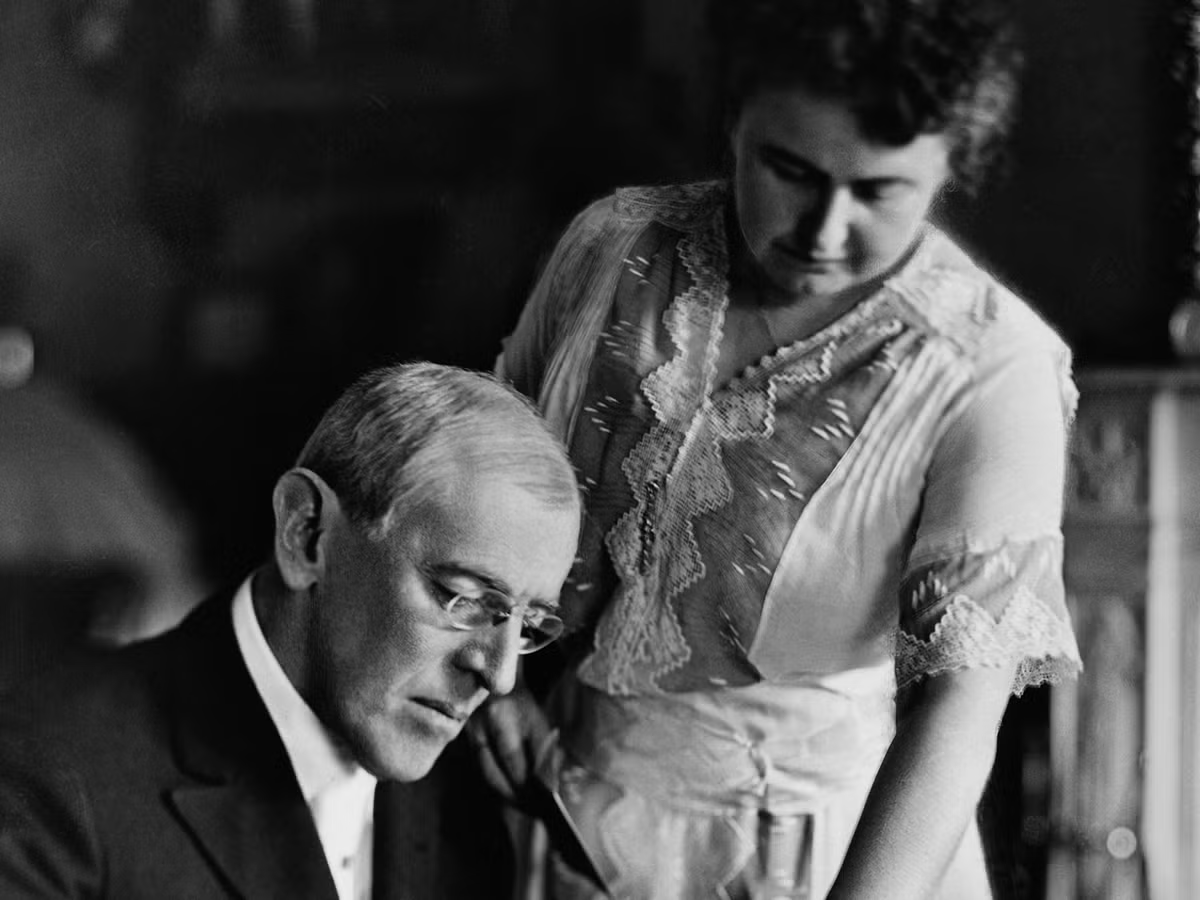
Few Americans know that in a sense, we’ve already had a female president. Back in 1919, after the fighting in World War I had ended, President Woodrow Wilson went to Paris to help negotiate what became the Treaty of Versailles. It was the first time a sitting American president had ever left the country. The negotiations were famously convoluted and difficult. One of the elements of the treaty was the idea of a League of Nations, which had been the 14th point of Wilson’s 14 Points. I’ve learned from reading Paul Johnson’s book Modern Times that the idea for such a league was not actually Wilson’s.
Nevertheless, he came to believe it was necessary and was willing to fight for it. However, treaties in America must be ratified by the Senate. In order to win support for the League, in 1919 Wilson barnstormed the country, speaking to massive rallies in the hopes of turning the focus of public opinion onto the Senate. Wilson apparently had a small stroke in Paris during the treaty negotiations early in 1919. Back in the states, he had a massive stroke in America in the fall at the end of his speaking tour. The stroke was so debillitaing that Wilson was essentially bed-bound and out of commission for the last year and half of his presidency.
During that time, his second wife, Edith Wilson, became a sort of shadow president. Indeed, he had only just married Edith in 1915, so she had only been the first lady for four years when this all went down. I was aware of this episode from my reading of A.Scott Berg’s biography of Wilson, but was reminded about it recently while reading Johnson’s book. Indeed, I make a point to teach this strange episode to my students.
The quote below is from Johnson and it is what sparked this post. Not only do I think it is a great sentence, but I just taught the Treaty of Versailles last week so Wilson was top of mind. The second quote below from Johnson’s book shines a light on another noteworthy event in Wilson’s administration–the jailing of Social Eugene Victor Debs for speaking out against the war. Debs ran for president from jail in 1920 and garnered slightly less than a million votes. His disgust with Wilson is understandable. Debs, luckily for him, was pardoned by the winner of the 1920 election, Warren Harding.
On the Uniqueness of Oregon's State Flag
I grew up in California, and always believed Cali had the coolest state flag. I still do. However, there is only one state flag that has images on both sides, and of course it is Oregon’s. Up until yesterday, I did not know this about our state flag.
What I did know was the following. First, Oregon became the 33rd state on Valentine’s Day, 1859, which is why there are 33 stars on the front. The front of the flag also has the year 1859 on it, as well as the words The Union. This checks out of course, because the Civil War was just two years away, and threats of disunion by traitorous southern fire-eaters were near peak levels. (John Brown’s raid at Harper’s Ferry and then Lincoln’s election in 1860 continued the insanity and lead to the terrible rupture that eventually killed close to 700,00 people.)
The back of the flag shows a beaver, the animal that brought the first Europeans and Americans to the region. Portland may be the alpha city of Oregon today, but Fort Vancouver, across the Columbia in what is now Washington, was the fur trading outpost of the Hudson’s Bay Company and was founded well before Portland, back in 1825.
This sort of thing is neither here nor there, but good to know if you’re an Oregonian.


Of Ballots and Bullets
As a social studies educator, perhaps I should have already known this; but it was news to me. I’m talking about the etymology of the word ‘ballot.’ While watching an episode from the Great Courses class on Turning Points in American History (#15 Expanding Universal Suffrage), the instructor mentioned that the word ‘ballot’ comes from the Italian word meaning small ball. In that time and place people voted with small colored balls, often white or black. I had never connected the word ‘ball’ with the word ‘ballot’, despite their obvious similarity.
In the United States, up until the early 20th century, people voted publicly, though usually with colored paper, not small balls. The wisdom of the Australian Ballot eventually became clear and states learned to make voting private. Good move. Thanks, Australia!
Thinking about all this, it occurred to me that perhaps the word ‘bullet’ also derived from the same root, since bullets used to essentially be small balls. The word ‘bullet’ apparently comes from the Middle French word boulette, also meaning “small ball” or “small pellet.” This was a diminutive of boule (ball). So, same original meaning, but different language. Digging further, it appears they do both have the same root, descending from the Vulgar Latin word balla, which means ‘ball’. Makes sense.
Did Boss Tweed know any of this? Not likely.
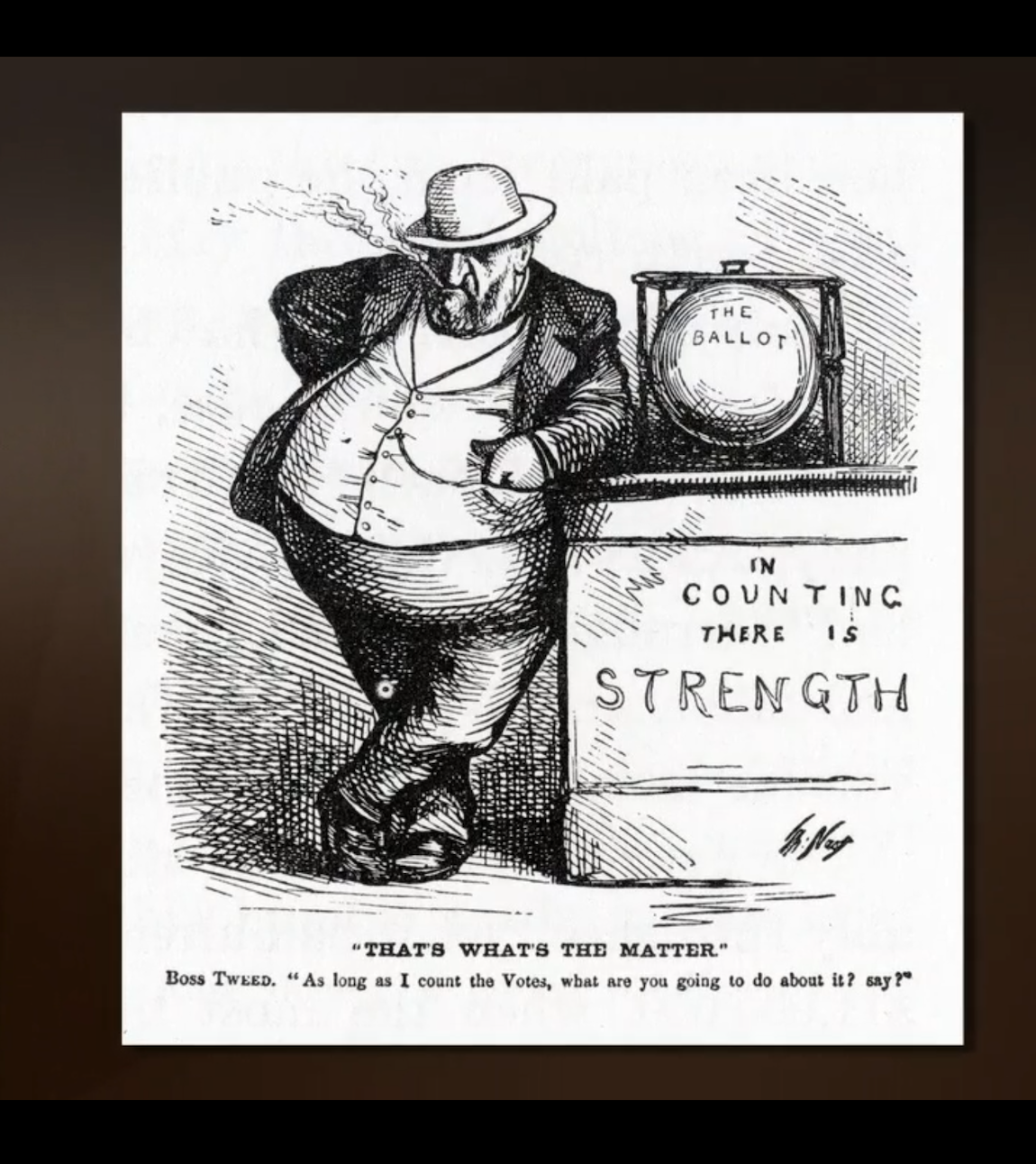
An Old Mystery Solved
There is a bit of very early American history that I always touch on very briefly in class that was in the news recently. It has to do with the mysterious disappearance of the English colonists who settled off the coast of North Carolina in the late 1500s. The settling of Jamestown gets more attention because it was the first permanent English settlement in what became the United States. However, the settlers at Roanoke settled first by nearly 20 years. However, when one of their leaders sailed back to England then returned in 1590, the settlement had been abandoned. Everyone was gone. Famously, the word Croatoan was carved onto a tree and offered one of the only obvious clues. But until recently, historians didn’t know for sure what happened to the settlers.
The term Croatoan was a reference to a Algonguian tribe of indigenous people who lived on nearby Hatteras Island. Could it have been that the 115 missing English settlers had gone to live with the Indians and ‘gone native?’ Nobody knew for sure.
However, it appears new evidence has led historians to conclude that some of the settlers moved their settlement inland while others did indeed assimilate with the Croatoan people. The sleuthing apparently involved an old map, some good old fashioned digging in the dirt, and a lot of DNA analysis by the Lost Colony DNA Project.
Next year, when I cover this in class, I’ll have a bit more to say. Is a good reminder that all history is revisionist.
Watch the video below for the full story.

The SCOTUS Cases Required for AP Government
Below is the current list of required AP Gov cases. Roe was taken off after it was overturned in 2022. I was familiar with several of these cases through my teaching of AP US History. However, several of the Warren court cases were new to me three years ago when I started teaching AP Gov. Most infuriating on this list? Definitely the last one, which continues to wreak havoc on our democracy.
Marbury v. Madison (1803) In a dispute over “midnight judge” commissions, the Court established the principle of judicial review, which empowers the Supreme Court to declare acts of Congress or the executive unconstitutional. This decision fundamentally established the judicial branch as a co-equal branch of government with the final authority on constitutional interpretation.
McCulloch v. Maryland (1819) The Court ruled that the Necessary and Proper Clause granted Congress the implied power to establish a national bank and that the Supremacy Clause prevented states from taxing federal institutions. This landmark case significantly expanded federal power and solidified the hierarchy of federal law over state law.
Schenck v. United States (1919) During World War I, the Court upheld the conviction of a man distributing anti-draft leaflets, ruling that speech creating a “clear and present danger” is not protected by the First Amendment. This established that First Amendment rights are not absolute and can be limited to maintain social order during times of war or crisis.
Brown v. Board of Education (1954) The Court held that race-based school segregation is inherently unequal and violates the Equal Protection Clause of the 14th Amendment, overturning the “separate but equal” doctrine. This decision served as the constitutional catalyst for the modern civil rights movement and the desegregation of all public facilities.
Baker v. Carr (1962) By ruling that challenges to legislative redistricting are justiciable (capable of being decided by a court), the Supreme Court opened the door for federal oversight of state voting maps. This led to the “one person, one vote” principle, requiring districts to be roughly equal in population to ensure fair representation.
Engel v. Vitale (1962) The Court ruled that state-sponsored, voluntary prayer in public schools violates the Establishment Clause of the First Amendment. This decision established a firm “wall of separation” between church and state, prohibiting the government from promoting religious activities in public institutions.
Gideon v. Wainwright (1963) The Court held that the Sixth Amendment’s right to counsel is a fundamental right that must be provided by states to felony defendants who cannot afford an attorney. Through the Due Process Clause of the 14th Amendment, this case incorporated the right to an attorney into state law, ensuring a more fair and balanced trial process.
Tinker v. Des Moines (1969) The Court protected students' right to wear black armbands to protest the Vietnam War, famously stating that students do not “shed their constitutional rights… at the schoolhouse gate”. This established that symbolic speech is protected in schools as long as it does not cause a “substantial disruption” to the educational environment.
New York Times Co. v. United States (1971) In the “Pentagon Papers” case, the Court bolstered freedom of the press by establishing a “heavy presumption against prior restraint,” even in cases involving national security. This ruling made it extremely difficult for the government to engage in censorship unless it could prove immediate, irreparable harm to the nation.
Wisconsin v. Yoder (1972) The Court ruled that compelling Amish students to attend school past the eighth grade violated the Free Exercise Clause because it interfered with their established religious lifestyle. This decision balanced the state’s interest in education against the individual’s right to practice religion without undue government interference.
Shaw v. Reno (1993) The Court ruled that while creating majority-minority districts is permitted, districts drawn solely based on race can be challenged under the Equal Protection Clause. This established that race-conscious redistricting must be held to a standard of “strict scrutiny” to ensure it does not violate the colorblind ideal of the Constitution.
United States v. Lopez (1995) The Court struck down the Gun-Free School Zones Act, ruling that carrying a gun in a school zone is not an economic activity that affects interstate commerce. This marked a significant turn toward devolution by placing a clear limit on Congress’s power under the Commerce Clause and reaffirming states' rights under the 10th Amendment.
McDonald v. Chicago (2010) This case ruled that the Second Amendment right to keep and bear arms for self-defense is a fundamental liberty applicable to the states. Using the doctrine of selective incorporation, the Court restricted state and local governments from implementing effective handgun bans.
Citizens United v. FEC (2010) The Court ruled that political spending by corporations and unions is a form of protected speech under the First Amendment and cannot be limited. This decision led to the rise of Super PACs, allowing for unlimited independent expenditures in political campaigns.
SCOTUS Case Resources
Supreme Court Justice Ketanji Brown Jackson is visiting my school in the coming days. I decided to read one of her dissent’s to help my students prepare for her visit. I decided to take a look at her dissent in Trump v. CASA (June 2025). I really enjoyed it and am going to do my best to work more SCOTUS opinions (both majority and dissents) into my regular reading.
I have discovered a few websites where one can access decisions and learn more about the Court. They are listed below. Now, more than ever, I believe active citizenship and defense of democracy requires ‘doing your homework’ on the issues that our judicial branch is wrestling with.
-
Oyez (The Best for Context & Audio) A key feature of this site is that It offers a “synchronized” audio player where you can listen to the oral arguments while the transcript scrolls, highlighting which Justice or lawyer is speaking.
-
Cornell Legal Information Institute (LII) This collection includes a curated section for Landmark Decisions organized by topic (e.g., “Powers of the Presidency” or “Civil Rights”)
-
Scotus Blog Another great resource!

Surviving Contact
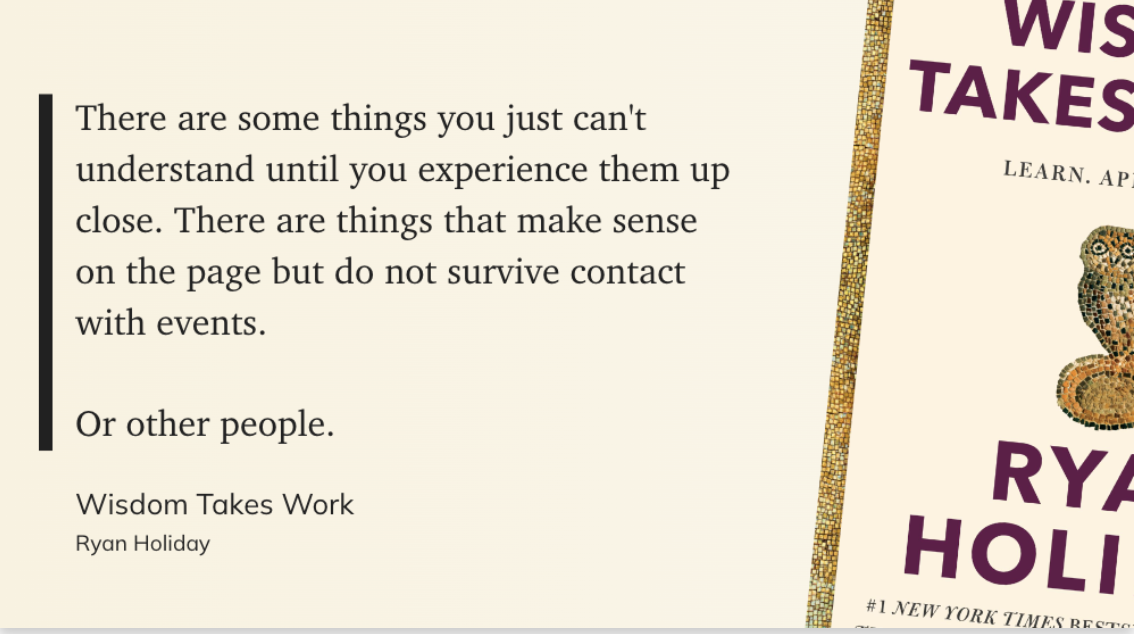
The second part of the quote below resonates strongly with me as a teacher due to the fact that I often come up with ideas for a lesson that I think are great, that don’t land when I am actually in the room with the kids. I think all teachers can relate to this planning problem. Thankfully it happens less as one improves, but often an idea triumphantly sketched out in the summer, is a dud when rolled out in October. Of course, military planning also seems like an example where this sort of thing is often true.
What ideas of yours need improvement before facing the reality of other minds?