My Reading & Thoughts
Peter Shamshiri's Blog Post FTW!
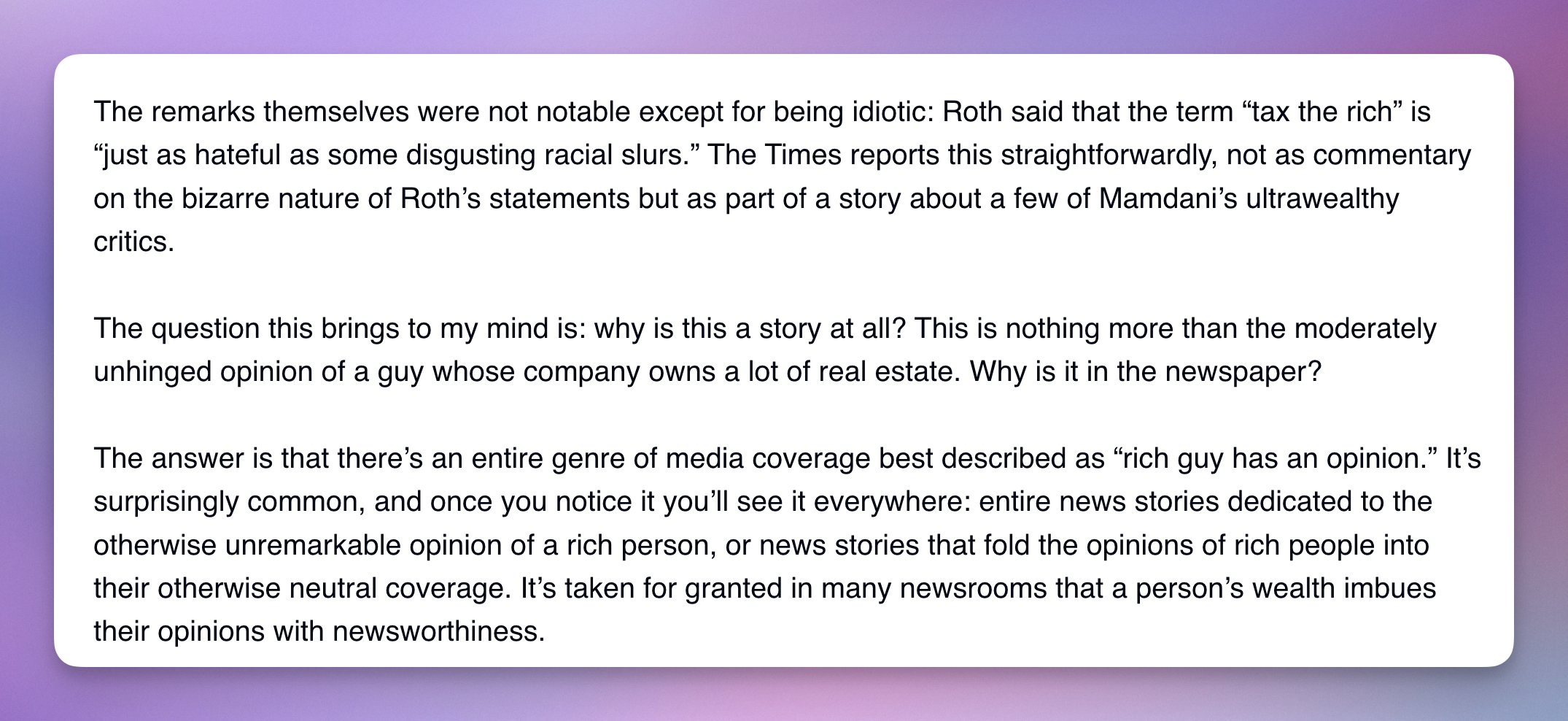
Once again, the weekly newsletter Dense Discovery delivers the goods. One of the links in today’s newsletter is to a blog post by Peter Shamshiri called Rich Guy Quote Journalism. The gist of the argument is that journalists often quote wealthy people and think it’s newsworthy, because the quote comes from someone with money. Of course, the thoughts of wealthy people are not more newsworthy than the thoughts of anyone else! Nevertheless, we live in a culture that worships wealth, so here we are.
Read the blog post.
The Cradle of Citizenship
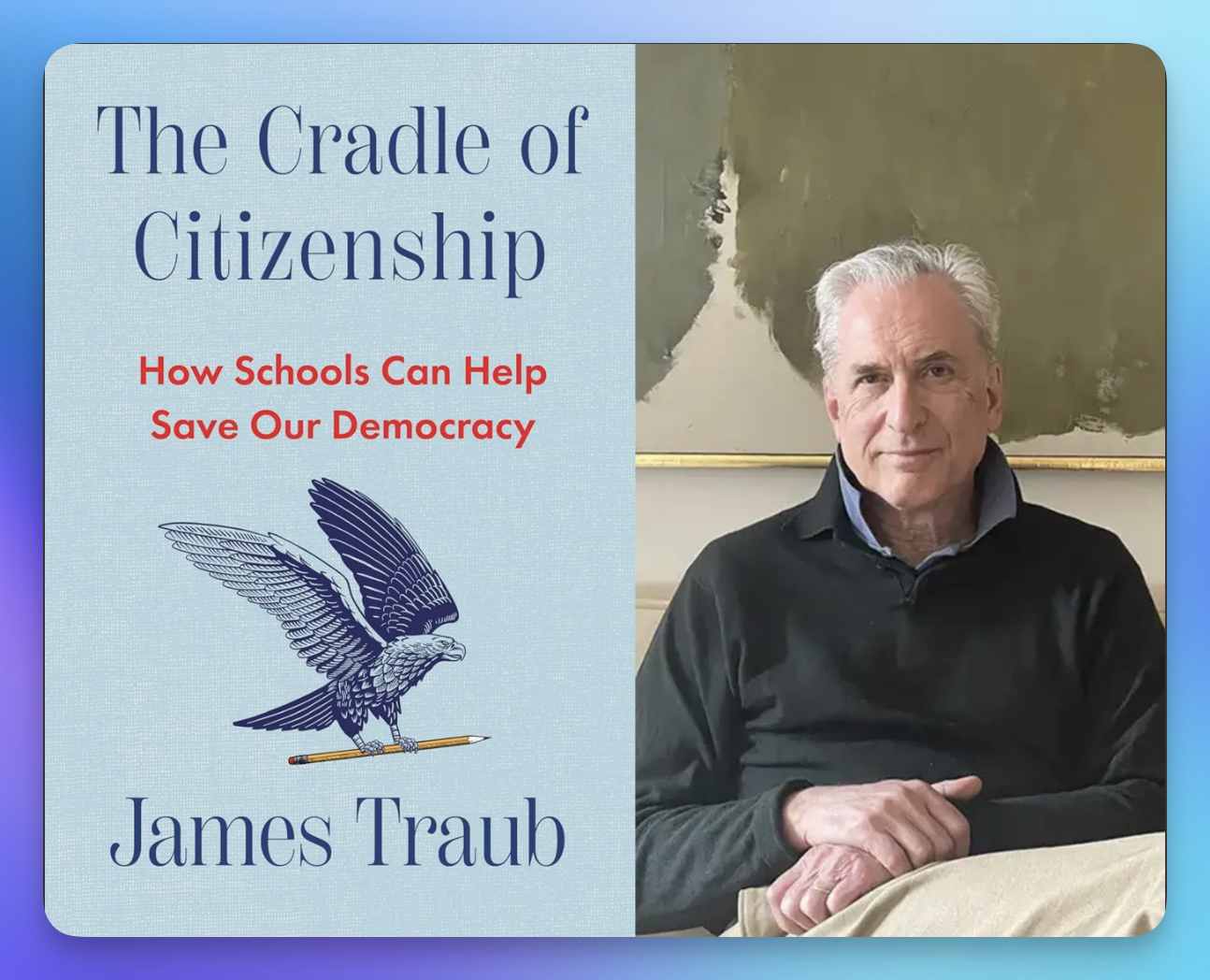
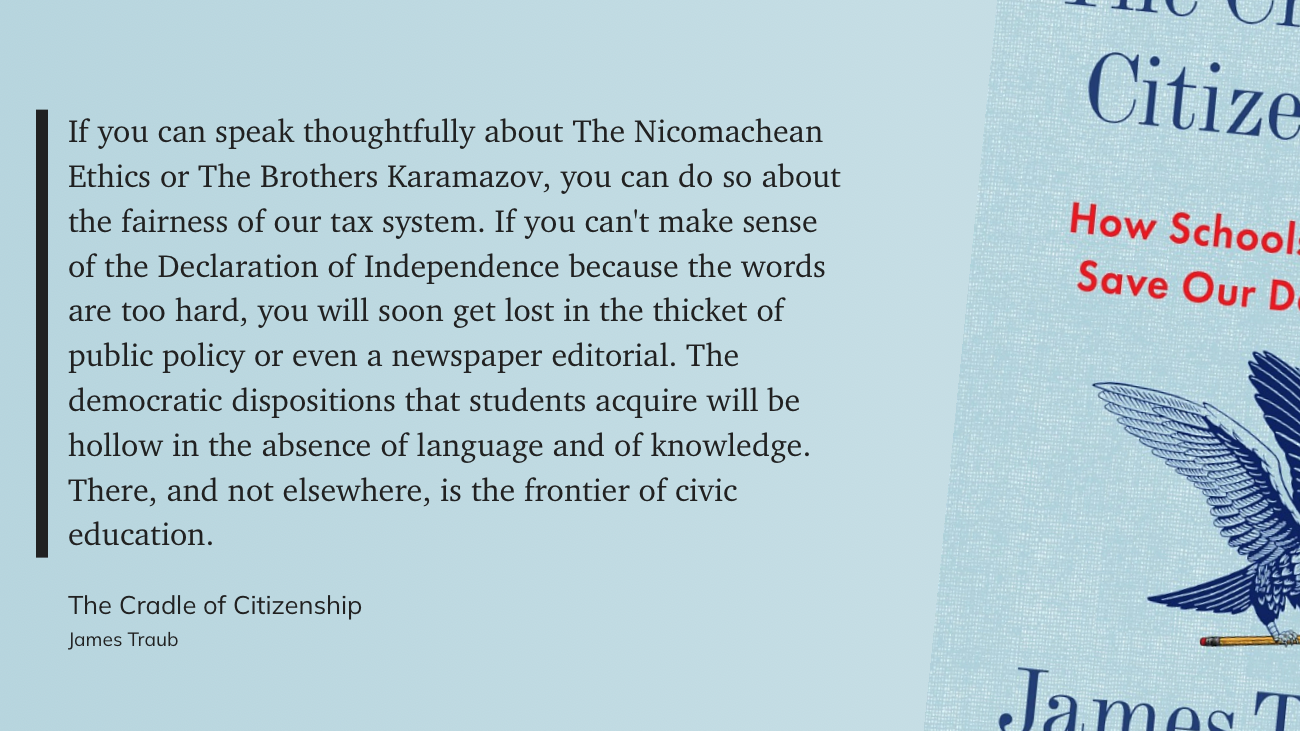
I recently finished James Traub’s excellent book The Cradle of Citizenship. Traub spends a year visiting classrooms throughout the United States, trying to understand how schools promote and teach our young people how to be citizens. As an AP US History and AP Government teacher in a majority minority public high school, with a large immigrant population, this topic is important to me. Along the way, Traub exposes the follies of both the right and the left, with Florida and Minnesota playing lead roles.Traub makes clear there are some stupid practices and ideas on both sides of the political spectrum when it comes to education. I certainly see this in my job here in Portland.
Traub defines himself as being center-left, which is how I see myself. Not surprisingly, I agree with many of his conclusions. With regards to one current debate in education, he makes the point that knowledge is the foundation of higher-order thinking and thereby citizenship. One can’t form an educated opinion on tariffs, for instance, if one doesn’t know what a tariff is. However, focusing on facts, and chronology (as opposed to thematic learning in history), and often, ‘dead white guys’, are practices associated with the conservative view of education. However, I agree whole-heartedly that Traub’s conclusion about this debate is correct; in this case, the conservatives are mostly right. For more on this topic, see this free pdf titled Developing Thinking for Deep Thinking.
I enjoyed the book as well because it gave me a peak inside other classrooms. One of the problems with teaching is that we work in a bit of a bubble. It is often difficult to see what is happening outside one’s own classroom walls, not to mention in other buildings, in other states.
Unfortunately, the book did not lessen my worries about the intellectual (and spiritual) rot of Christian Nationalism. There are some very ignorant people in this country that would turn our schools into madrasses. That is no bueno and is a reminder that there is a culture war being waged in our nation, one that is tied to the class war that continues to be waged by the Epstein class in this country. And schools are increasingly a battle ground in those wars.
If you’re at all interested in the relationship between schools and democracy, read this short gem of a book.
Some More Thoughts on AI
A topic that I continue to think a lot about is AI. As it becomes more ubiquitous, I am hearing more and more opinions about it. Hearing what others think is helpful because my reactions help guide my own reflections about the topic.
On one hand, I am coming to realize that the data center issue is an important one. The controversy in Utah has certainly got me thinking about the behind the scenes consequences of AI. Despite the benefits AI provides, would I want a giant, water and energy sucking data center located near me? The answer is hell no. I also respect the views of Sam Harris and he’s been an AI doomer since the beginning. The recent letter sent by all the giant AI companies to congress seems to indicate that Mr. Harris is right to be worried, not just about his electricity bill, but about our collective future. As a parent, these concerns cut deep. Finally, I worry about how AI seems poised to both displace millions of workers AND exacerbate the already depressing wealth disparities in our society. Will my kid graduate high school into an unimaginable job desert?
On the other hand, despite a keen awareness of my own bifurcated and evolving views about AI, the contrarian in me is irritated by other hypocrisies I detect around this issue. For instance, I use AI to help construct short, highly tailored text for use in class (usually as an introduction to a historical topic). However, I don’t hide this from my students (and of course I still assign reading from the required AP text on a daily basis, along with myriad relevant and challenging primary and secondary sources) nor do I preach to my students about how bad AI is. However, students tell me that other teachers bad mouth AI, while using it heavily (and obviously) themselves in class. That grates.
I also just listened to a podcast done by a doctor who shared her thoughts about AI. She said she’d ‘never write’ with AI, not even an email. She claimed to be irritated by reading emails from others that were AI generated. She also indicated, and I’ve heard many people say the same thing so I believe it is probably a dominate view, that she just couldn’t enjoy any writing if she knew it was AI.
I have a few responses to this. First, while she is of course entitled to her opinion, I believe it is an arrogance born of privilege to assume others want to spend their precious time writing emails. From my perspective, if someone wants, or needs, to use AI to help triage their email, that is no business of mine. Furthermore, for someone who probably hired a nanny to help raise her kids, it seems a bit rich to argue that writing that is partly done by AI is somehow ‘inauthentic.’ If you are not going to call out people for outsourcing their parenting, surely desk jockeys, newsletter writers, busy white collar workers, bloggers, and content creators can use the tools available to get their work done. Indeed, do celebrities and CEOs get shamed for hiring ghost writers to write their memoirs? Do photographers get shamed for touching up their pictures with Photoshop? If I read a newsletter that provides benefit to me somehow, I don’t give a shit who or how it was written. But alas, I realize my current view on this is probably in the minority.
I’ve heard from a few commentators that as AI continues to take over, human authenticity will be the new currency of the realm. Those that can provide a human touch in their work or their business will thrive, despite the increasing powers of AI. I think that is likely to be true. But we aren’t there yet. Instead, we are here now, in 2026, working our mostly 20th century jobs, raising our kids without robot nannys, watching idiots burn our institutions to the ground, and still driving our own cars around town. I can see why people are excited about using a technology that offers time saving, novelty, and in some important ways, hope. However, increasingly I am also aware of the huge potential downsides. One thing is certain, we are in for some major changes and I still don’t know exactly what I think about that.
Meanwhile…
Jackson Pollock's Demise
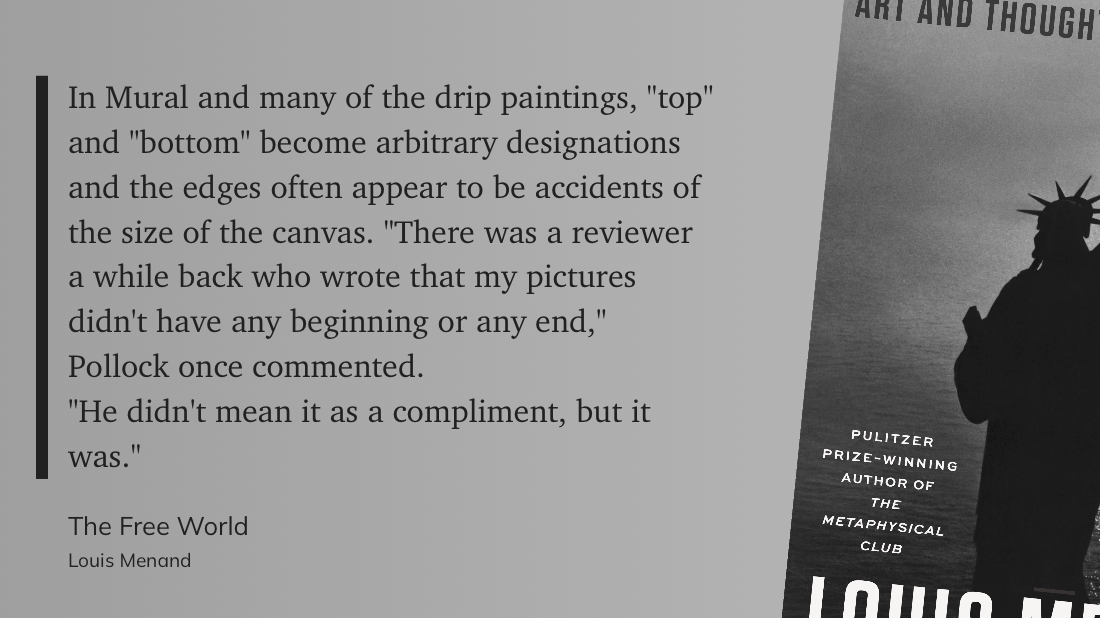
Reading Louis Menand’s The Free World I came across the section on artist Jackson Pollock. I had heard of Pollock and knew he was most famous for his unique ‘drip’ style paintings. What caught my attention about him was how his life ended. Like many, many incredibly talented artists, Pollock was an alcoholic. According to Menand, he had essentially stopped making art in 1954, but kept boozing. He also suffered from depression. On a summer night in 1956, after drinking, he crashed his car with two female passengers. One of the women, along with Polllock, died in the crash. He was just 44 years old.
What sticks in my mind is the connection between his drinking and his life being cut short. As I said, he had quit making art, but who knows if he had lived longer if he wouldn’t have cleaned up and got back down to the business of being creative and blowing people’s minds (the drip art definitely blew people away in the early 1950s!). He also killed another person, a recklessness that I pin on his drinking. What a fucking waste.
Some quick research reveals that he is one of many, many talented artists and thinkers that died in similar circumstances. For instance, others that died in car crashes include Albert Camus and James Dean. Alcohol and/or drugs doomed Jimi Hendrix, Janis Joplin, Jim Morrison, Jean-Michel Basquiat, John Bonham, and Welsh poet Dylan Thomas.

Big Red Spotted Court Side in the Times Today
Browsing through the New York Times today and who do I spot? Phish frontman Trey Anastasio, sitting courtside at a Knick’s game. The article was published today, spot-lighting the team’s owner James Dolan. Of course, Phish has played the Knick’s home arena, Madison Square Garden, more than any other musical act other than the great Billy Joel. Dolan also owns the Garden. And Sphere in Las Vegas, where Phish was the second band to play, behind U2.
Anyway, I love it when my world’s collide. In this case, the sports page and PHISH.

The Shelf of Abandonment
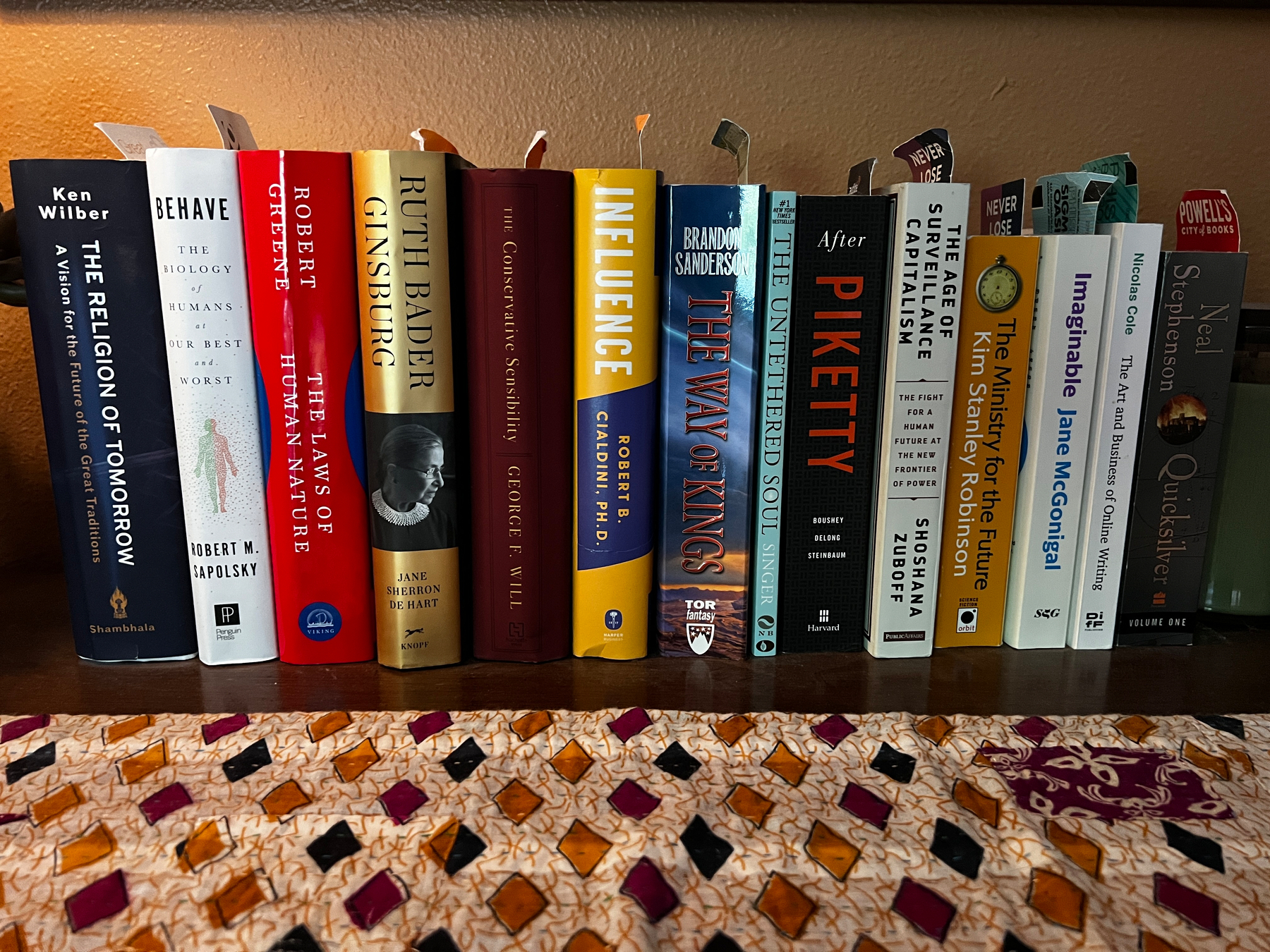
I mentioned last post that I gave up on a book, The Age of Surveillance Capitalism. It always pains me to abandon a book. It is inevitable though if you start a lot of books, which lovers of books do, of course. I have a spot in my bedroom where I put such books. I suppose the hope is that one day I’ll pick a book up from this forlorn collection and try again. That said, life’s too short to read books you aren’t interested in.
Here is a picture of those books today.
Current Stack
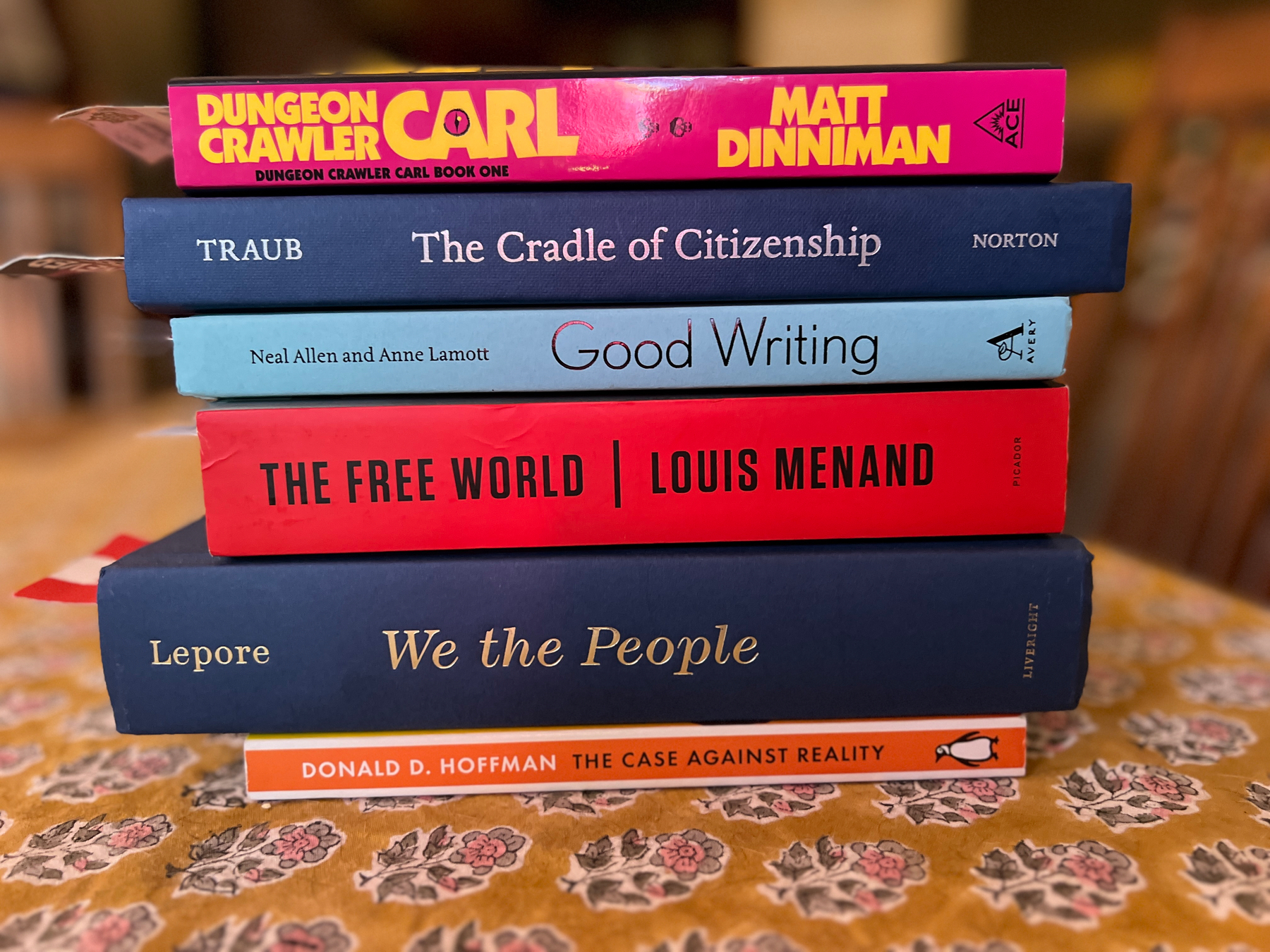
I finally gave up on The Age of Surveillance Capitalism. However, I did finish two books I’d been reading for a while, The Great Hunt and In Search of Deeper Learning. The Great Hunt got better at the end, but the book was a slog and I’ve decided I’m not going to read anymore of The Wheel of Time series. The teaching book was interesting because it gave descriptions of other schools. Teachers work in a bubble, so I liked reading about how other schools operate. That said, the authors have a few misguided ideas about what constitutes ‘deep learning’ and how important it is for 13 to 17 year olds.
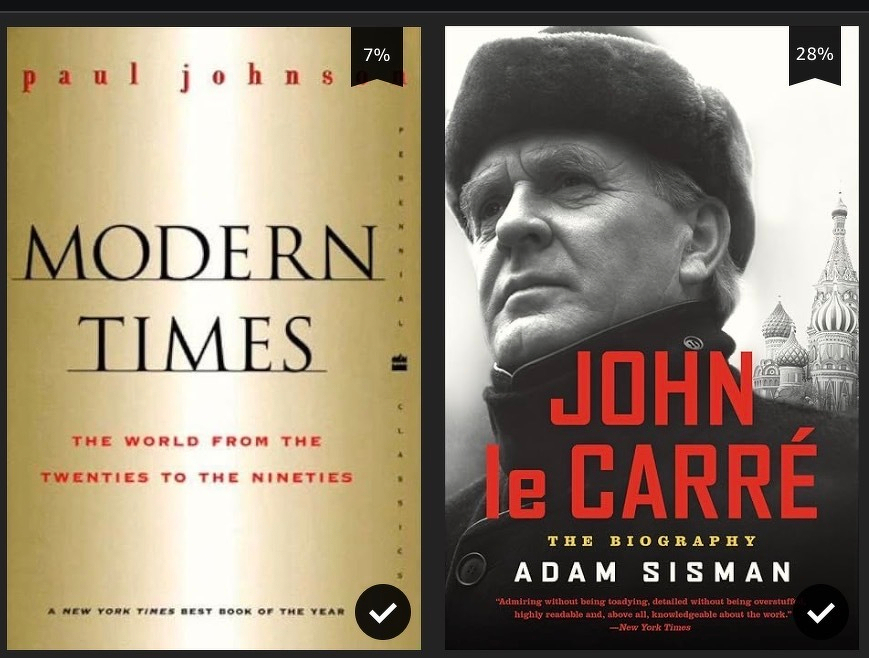
My current stack (see below) contains one novel (which I’m loving) and usual history, pedagogy, self-help, and biography. The two books I find myself wanting to pick up most frequently are The Cradle of Citizenship (civics pedagogy) and the biography of writer John le Carré.
Libby's Magazine Rack FTW!
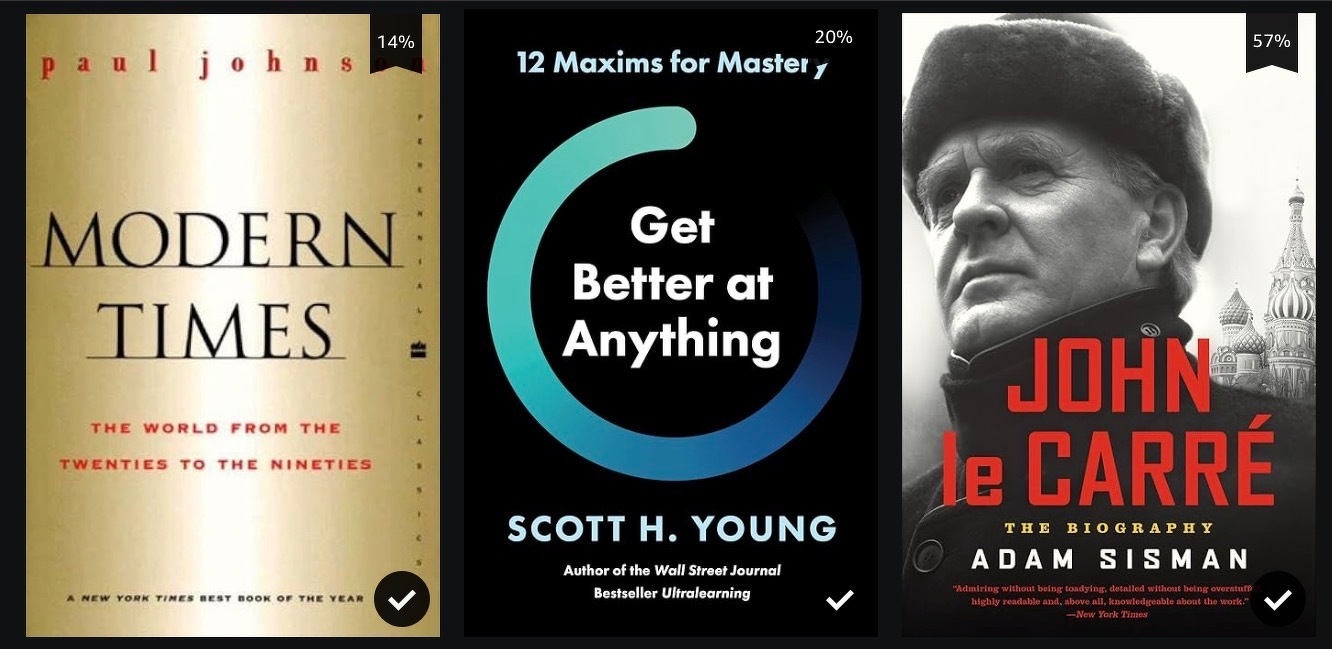
I realize I a late to the party on this app, but I’ve got to give Libby a shout out. I always knew the app was out there but I never really explored what was available. I haven’t tried renting or reading a book through the app yet, but the magazine options are phenomenal. And all for free!
Below is my ‘magazine rack.’ I’ve paid for some of these subscription in the past, but why spend the money when I can read ‘em for free on my iPad. I’m confident that annual subscriptions to all these periodicals would set me back at least a few hundred dollars. I also love that I can zoom in on the pages. Oh, and the automatically update on their own and you can browse older editions. And did I mention it’s free?
The only drawback I’ve encountered is not being able to do the crossword at the back The Week. There puzzle is my favorite because it contains current event clues and is just the right level of difficulty for me. You win some, you lose some, eh?

Friendships are True Gold
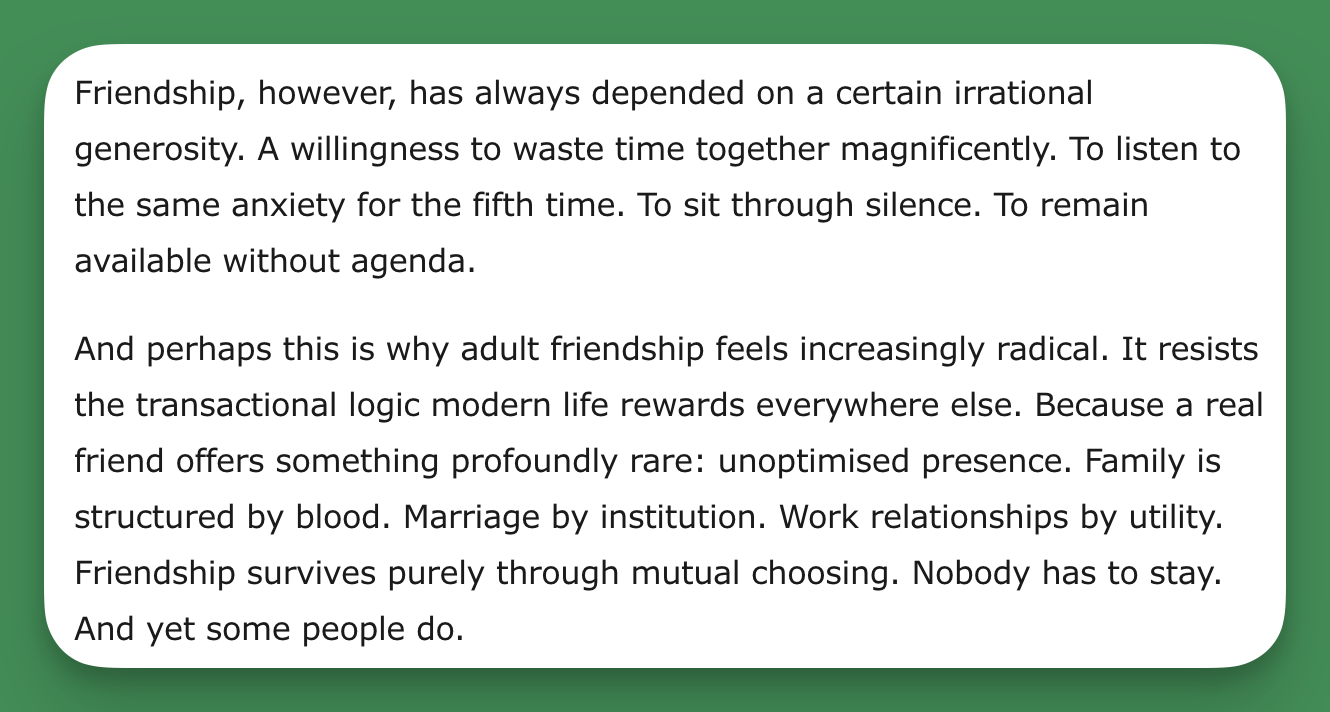
I came across this article twice in a matter of days and decided to give it a read. The article appeared originally in the Times of India and was authored by Pranav Jain. It is about adult friendships and if you give it a read you’ll see why it went a bit viral over here in North America. The dude makes some good points (including the one quoted below)!
My only commentary is that I agree with Jain’s take. Adult friendship cuts against the grain of so much in our culture, but it is true gold. The stats in America indicate many adults have fewer and fewer friendships. No doubt ‘social media’ is partly to blame. I am lucky to have friends from every period in my life and I try hard not to take them for granted (though I naturally do sometimes). Of course, the older I/we get, the longer the gaps sometimes are between connections. Gotta work on that!
On Being Brisk
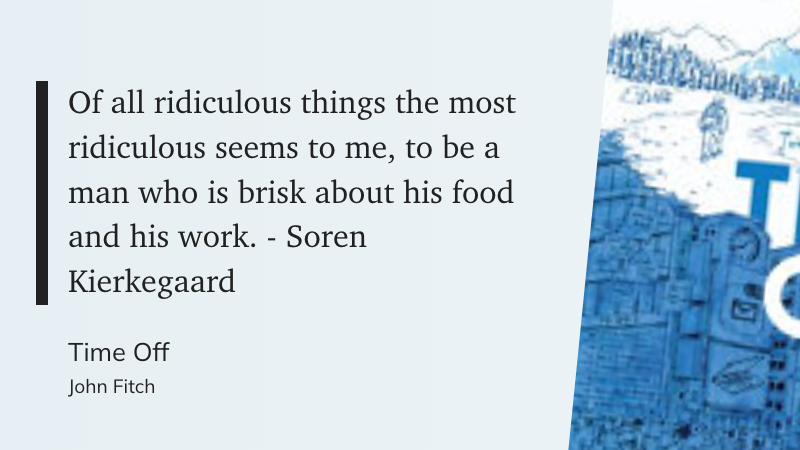
This quote originally caught my eye because it is strident and it is something I need to work on. Specifically, the eating part. I like food, but I tend to scarf. At work, I only have 30 minutes, so that doesn’t help. Nevertheless, I admittedly scarf at home, too! I know eating meditation is a thing, and I understand how strong of a mindfulness practice that is. That said, I suck at it.
I also appreciate what Kierkegaard was getting at with work. I don’t think he meant ‘our job’ necessarily. I think he meant ‘what we love to do.’ For lucky people, that’s their job. For many others, its their hobby and what they do for fun when they aren’t working. Those activities should be savored and indulged in–and done mindfully and with attention to detail.
Now whether these errors are ‘the most ridiculous’ is a bit of a stretch. Being a selfish asshole or a shitty parent is more ridiculous, but hey, I see what he was getting at.
On Judging AI Art
I came across this study this weekend in one the newsletters I peruse from time to time. The study was apparently published more than two years ago.
I saw the study in a post about someone who recently went viral tricking people on X with a Monet. He told people it was AI and asked why it was not better than a real Monet. Well, the catch was that the ‘fake AI’ Monet was an actual Monet.
The controversy interests me because I see both colleagues and students who are very distrustful of AI generally. I’ve been all in on AI since 2022, but I have come to realize there are many negative aspects of the technology, not the least of which is the energy demand and the potential for human extinction. No small things, for sure!
That said, as I’ve noted before, I use AI and I appreciate what it can do for me. The fact that I can relate to the enthusiasm for AI, despite the obvious issues it creates, set me up to enjoy alll the haters getting owned online for criticizing a real Monet just because they thought it was AI derived. Seeing this also made me smile because at this point in my journey I’m sick and tired of people being against issues in a way I find overly simplistic.
The study makes the point that people are specifically biased against AI-created art. To quote the abstract, “Participants were unable to consistently distinguish between human and AI-created images. Furthermore, despite generally preferring the AI-generated artworks over human-made ones, the participants displayed a negative bias against AI-generated artworks when subjective perception of source attribution was considered, thus rating as less preferable the artworks perceived more as AI-generated, independently on their true source."
For me, this is a reminder to think more slowly and deliberately. And to verify before jumping to conclusions. Often, we cannot believe our eyes (or our ears, or our media, or other people). AI’s rapid improvement makes this even more necessary.
Is the Fourth Turning Here?
Tonight I finished Neil Howe’s book The Fourth Turning is Here. It is one of those books that provides a powerful lens or frame through which to view both the past and the future. Being well versed in American history, I suspect I was able to follow along a bit more than many. Nevertheless, I am left feeling curious about whether the ideas really do explain where America is heading. The TL;DR is that we are entering the ‘Fourth Turning’ of a cycle, which is the crisis phase. Howe argues this will culminate by/around 2033. After that will be a new ‘First Turning’ and an era with less division and more unity (among other happy outcomes) will be upon us. I remain unconvinced, though I like the framework and I don’t doubt that he may be right. We sure seem to be headed for a crisis.
For those interested in history and the immediate future (that is, parents), this book is very interesting. Below are links to two reviews and two interviews with Mr. Howe.
 ~~~~~~~

The Revolutionary and the Existentialist
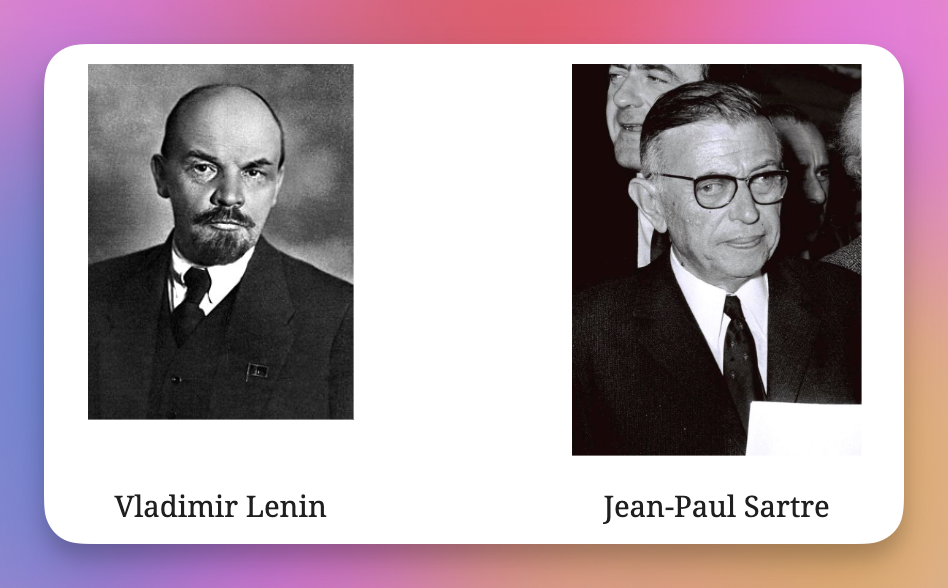
The beauty of reading a few books at the same time is that it provides an opportunity for a bit of “intellectual cross-pollination.” On one hand, I’m working through Paul Johnson’s Modern Times, which paints an extremely chilling portrait of Vladimir Lenin. I knew he was no angel, but I honestly didn’t know that much about him. On the other hand, I’m navigating the mid-century Parisian scenes of Louis Menand’s The Free World, focusing on writer and philosopher Jean-Paul Sartre. At first glance, they seem like an odd pair for a blog post, but for shits and giggles, and because I’ve done a few posts like this before, I figured I’d briefly compare these two 20th century giants with each other since they have both been renting space in my head of late.
Both men were intellectuals who felt a deep “moral rot” in the bourgeois systems they inhabited and were sort of ‘insider-outsiders.’ They shared a totalizing “bullet over ballot” mentality, believing that meaningful change required a violent break from the past rather than incremental reform. Whether it was Lenin’s Dialectical Materialism or Sartre’s later attempts to marry Marxism with Existentialism, they both sought a “synthesis of ideas” to explain the entire human experience.
However, when it comes to the “individual,” they were diametrically opposed. To Lenin, a person was a tool, a simple cog in the “Iron Discipline” of the party machine. He was, according to Johnson, ruthlessly quick to ‘put up against the wall’ those who were not willing to go along with his revolution. To Sartre, the individual is the ultimate source of meaning. Because he argued there is no pre-designed “human nature,” we are thus entirely responsible for creating our own truth through authentic, subjective choices. To him, hiding behind social roles or party lines (or dogmas) was a form of “bad faith”—an attempt to escape the terrifying reality that we, and we alone, are the masters of our own destiny. Indeed, for Sartre the ‘freedom’ we are born with is not a lighthearted gift, but a heavy burden, because there is no external moral authority or biological blueprint to blame for our failures, we alone are the masters of our destiny. Indeed, this existentialist idea is very Buddhist in my mind.
Ultimately, I find myself repulsed by Lenin the more I learn about him, especially his cruelty and his dogmatism. Sartre, despite being someone who apparently didn’t really take care of his body or personal hygiene (what kind of choice was that?), was accurate in his emphasis on authenticity and taking responsibility for our choices.
Current Stack
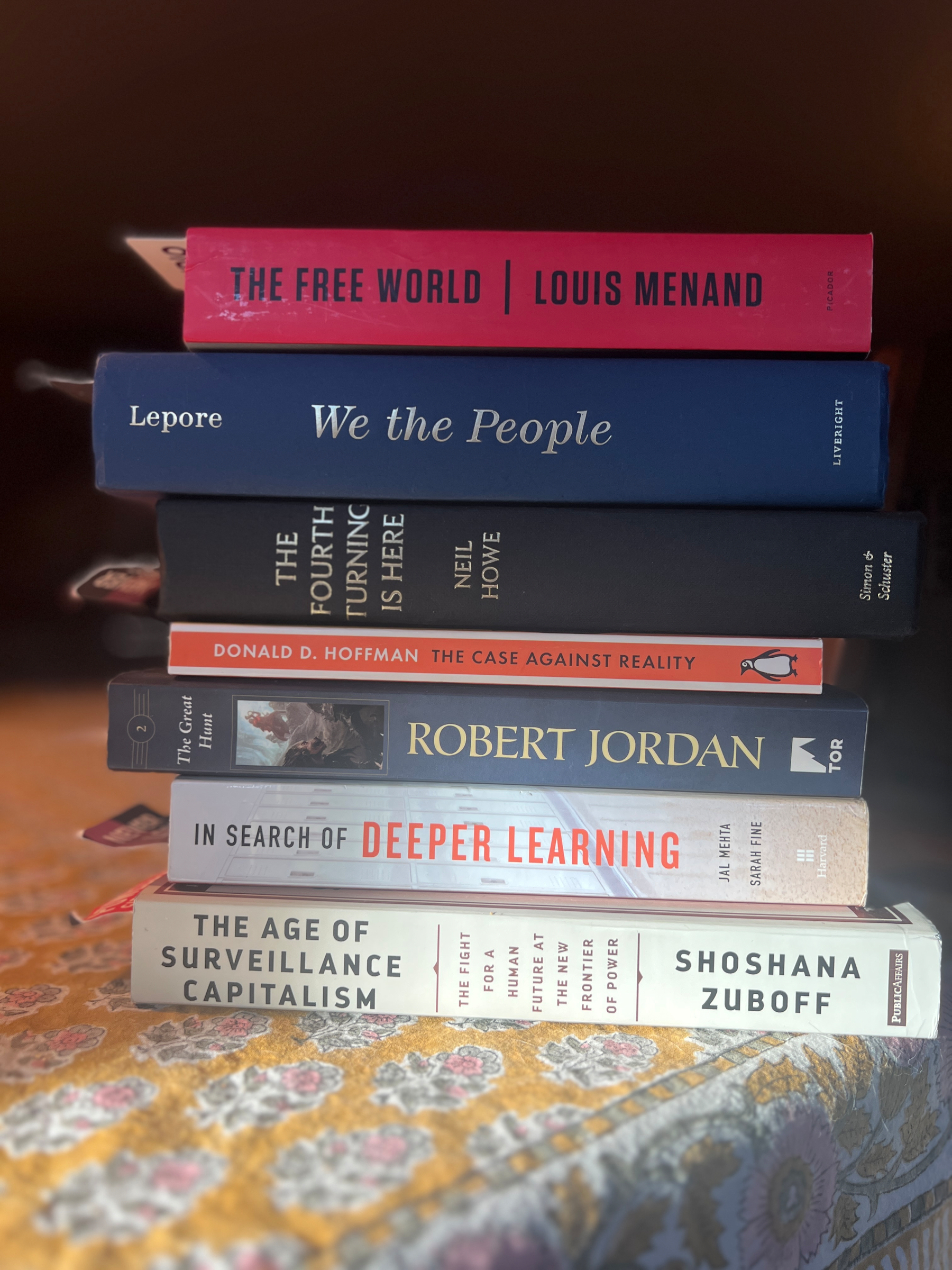
I managed to finish 6 books in April. The most enjoyable was Paul Johnson’s epic Birth of the Modern. Currently I am working on seven physical books and two ebooks. The only one I am really struggling with–still–is The Age of Surveillance Capitalism. Not sure if it is the writing style or the topic, but I am rarely reaching for it. I have been making steady progress on The Search for Deeper Learning after stalling out on it for a bit. While I appreciate the look into how different high schools operate, I am put off by the very typical, unrealistic academic perspectives of non-teachers expecting ‘learning’ that is actually impossible on the scale they expect to see it at.
Orwell & le Carré
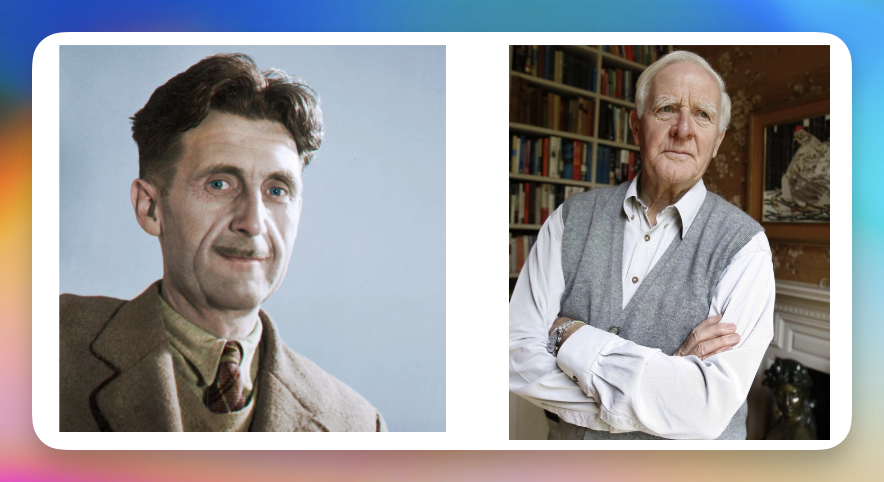
I love reading biographies. A sub-genre of biography that I like are those written about writers. One of the books I am reading now is a biography about the thriller writer John le Carré. Have I read any of le Carré’s books yet? No, not yet. Nevertheless, the life of a successful writer is endlessly fascinating to me.
Another book I just started (that I am really enjoying) is Louis Menand’s Free World: Art and Thought in the Cold War. In it, Menand has a long section about the writer George Orwell. Like most Gen Xers, I read Orwell’s 1984 and Animal Farm in middle school and/or high school. However, I didn’t know much about him. What struck me right away are some of the similarities between le Carré and Orwell.
Here are a few:
-
Both were British writers.
-
Both wrote with pen names. le Carré’s real name was David Cornwell. Orwell’s given name was Eric Blair.
-
Orwell attended Eton College (which isn’t actually a college) in his youth and le Carré taught there.
-
Both were anti-Stalinist. Orwell was famously a leftist, but was never a fan of Stalin, which helped him to stand against many of his fellow leftists in the early years of the Cold War. le Carré actually worked for a time for the British secret service in the Cold War (experiences which helped lead him to become a writer of spy novels).
-
Both writers were deeply skeptical of concentrated power. Whether it was Orwell’s critique of totalitarianism in 1984 or le Carré’s critique of the “Circus” and the cynicism of Western bureaucracy, both viewed big institutions as inherently dehumanizing.
-
Both lived lives characterized by a sense of not quite belonging. Orwell was an highly educated man who spent years living among the “down and out” ; le Carré was a spy who felt like an outsider within his own service due to his father’s criminal background.
-
Finally, both authors were fiercely independent thinkers who refused to follow a party line. Orwell was a socialist who critiqued the Left; le Carré was a patriot who remained one of the most vocal critics of British and American foreign policy (particularly the Iraq War).
The 6 Virtues of Positive Psychology
Often I come across in close succession two (or more) bits of knowledge that are connected in my mind. This afternoon, I came across the video below of Ryan Holiday critiquing Ivanka Trump’s public discussion of Marcus Aurelius. I love Ryan’s work and agree with his take in the video 100%. Of course, Ryan’s recent books constitute a four part series on the Stoic Cardinal Virtues, all of which I loved.
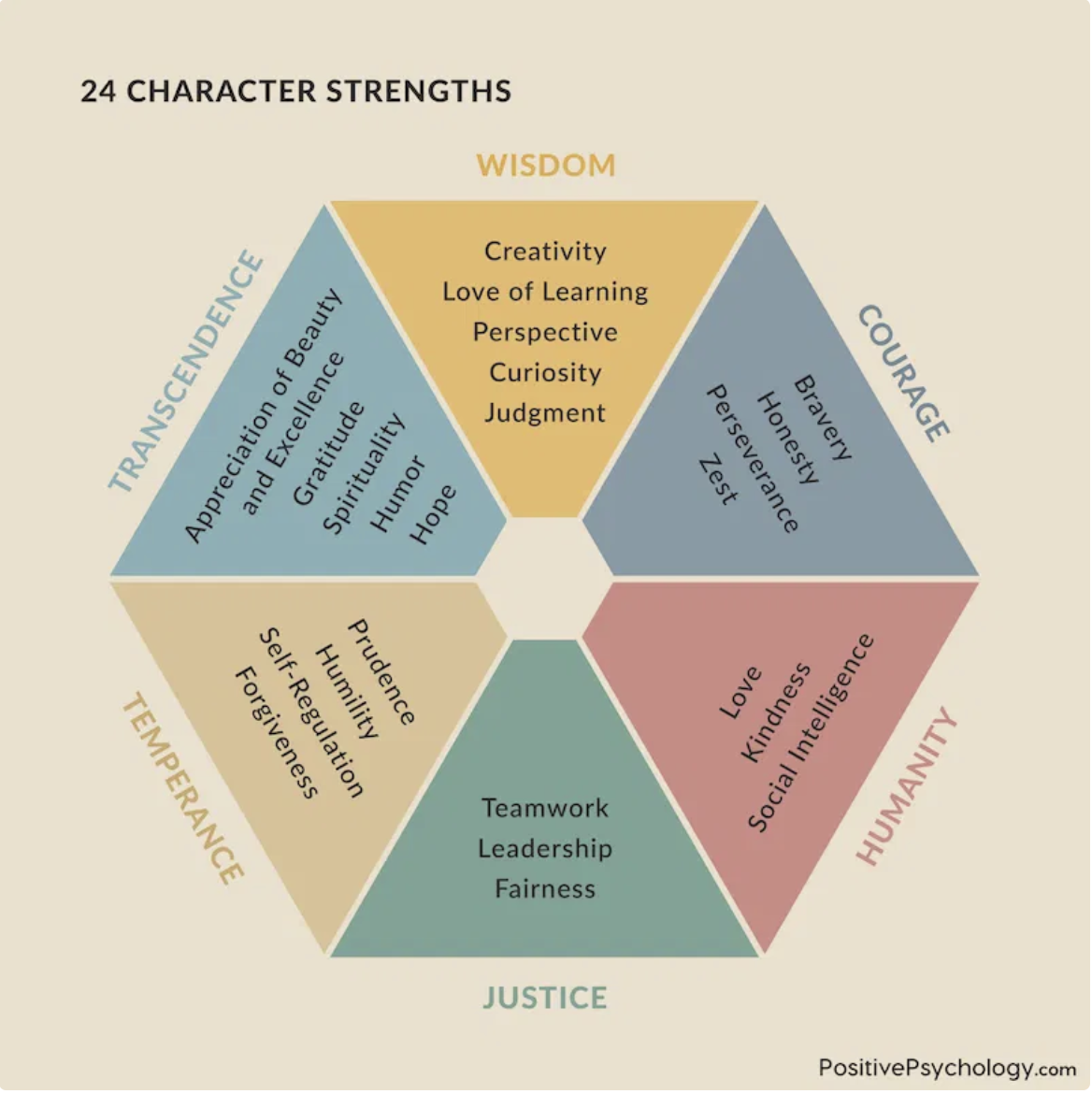
Later tonight while reading I came across, for the first time, the ‘6 Virtues of Positive Psychology.’ Reading about them, I noticed that there is quite a bit of overlap between the Cardinal Virtues and the 6, which were developed by psychologists Martin Seligman (the founder of positive psychology) and Christopher Peterson.
Needless to say, I’m glad I came across this more detailed list of charater traits and virtues. I wish more people, and especially more people in power, exemplified them.

On Woodrow Wilson and His Wife Edith
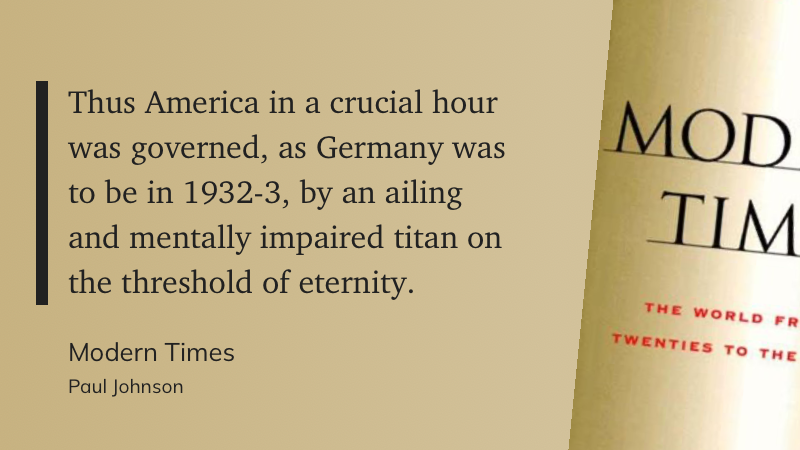
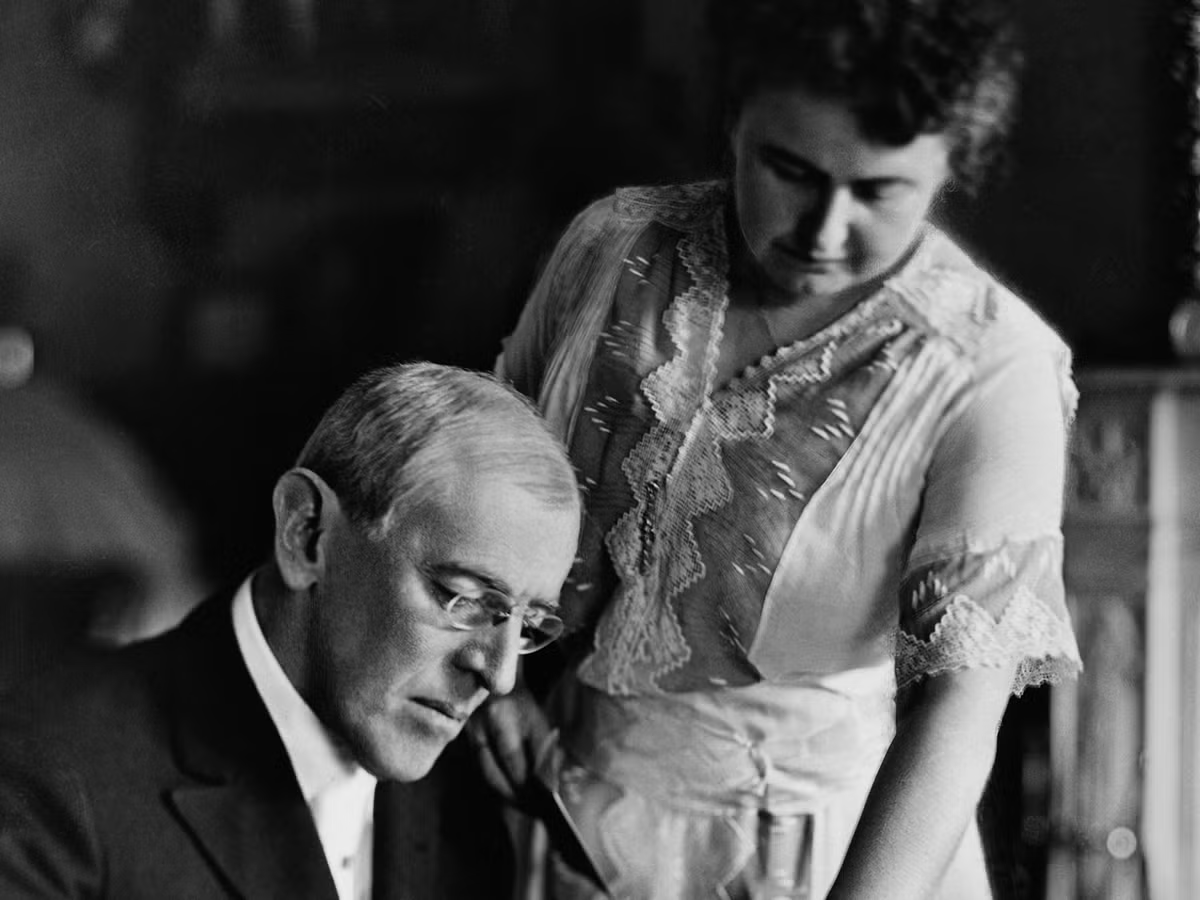
Few Americans know that in a sense, we’ve already had a female president. Back in 1919, after the fighting in World War I had ended, President Woodrow Wilson went to Paris to help negotiate what became the Treaty of Versailles. It was the first time a sitting American president had ever left the country. The negotiations were famously convoluted and difficult. One of the elements of the treaty was the idea of a League of Nations, which had been the 14th point of Wilson’s 14 Points. I’ve learned from reading Paul Johnson’s book Modern Times that the idea for such a league was not actually Wilson’s.
Nevertheless, he came to believe it was necessary and was willing to fight for it. However, treaties in America must be ratified by the Senate. In order to win support for the League, in 1919 Wilson barnstormed the country, speaking to massive rallies in the hopes of turning the focus of public opinion onto the Senate. Wilson apparently had a small stroke in Paris during the treaty negotiations early in 1919. Back in the states, he had a massive stroke in America in the fall at the end of his speaking tour. The stroke was so debillitaing that Wilson was essentially bed-bound and out of commission for the last year and half of his presidency.
During that time, his second wife, Edith Wilson, became a sort of shadow president. Indeed, he had only just married Edith in 1915, so she had only been the first lady for four years when this all went down. I was aware of this episode from my reading of A.Scott Berg’s biography of Wilson, but was reminded about it recently while reading Johnson’s book. Indeed, I make a point to teach this strange episode to my students.
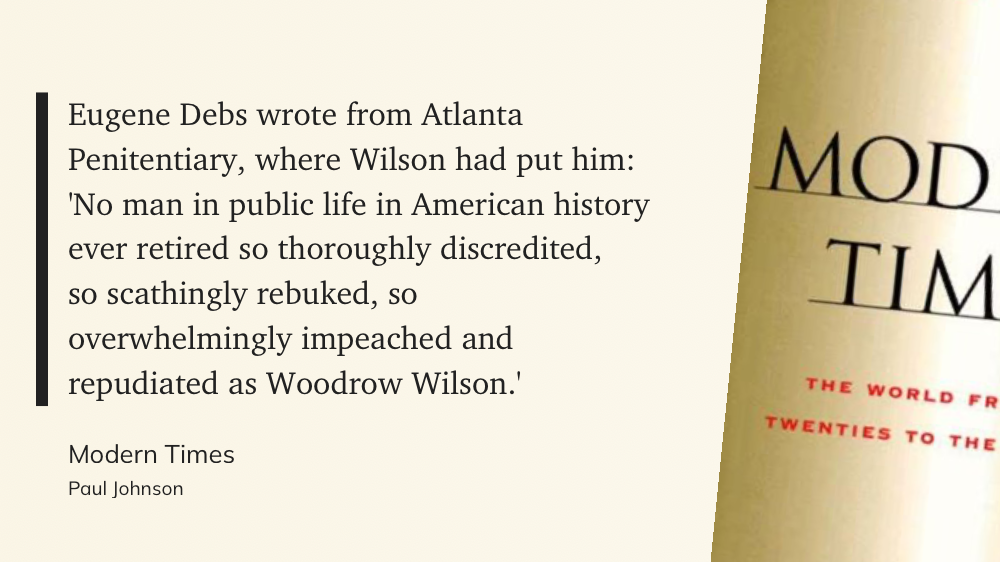
The quote below is from Johnson and it is what sparked this post. Not only do I think it is a great sentence, but I just taught the Treaty of Versailles last week so Wilson was top of mind. The second quote below from Johnson’s book shines a light on another noteworthy event in Wilson’s administration–the jailing of Social Eugene Victor Debs for speaking out against the war. Debs ran for president from jail in 1920 and garnered slightly less than a million votes. His disgust with Wilson is understandable. Debs, luckily for him, was pardoned by the winner of the 1920 election, Warren Harding.
On the Uniqueness of Oregon's State Flag
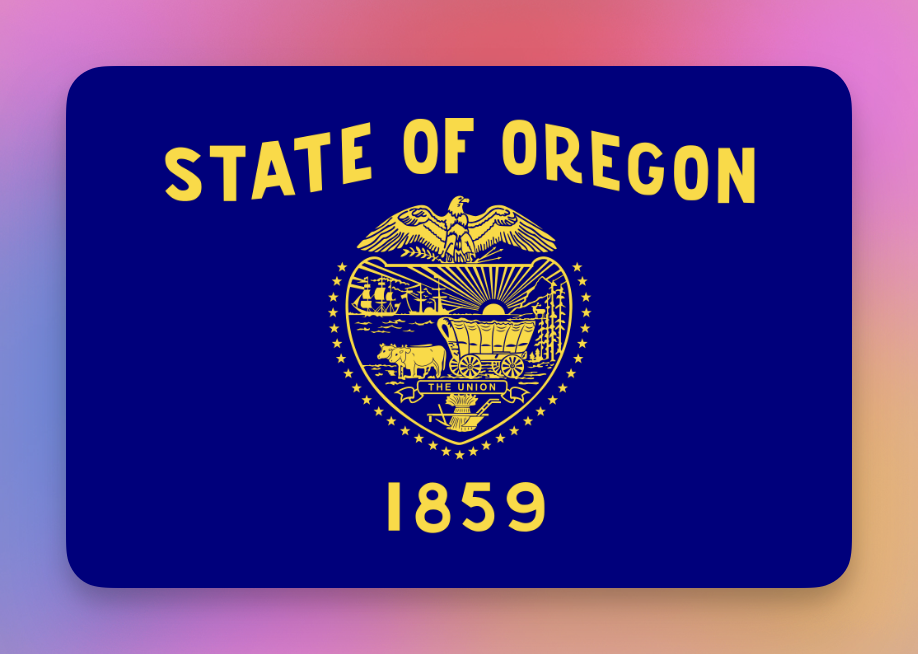
I grew up in California, and always believed Cali had the coolest state flag. I still do. However, there is only one state flag that has images on both sides, and of course it is Oregon’s. Up until yesterday, I did not know this about our state flag.
What I did know was the following. First, Oregon became the 33rd state on Valentine’s Day, 1859, which is why there are 33 stars on the front. The front of the flag also has the year 1859 on it, as well as the words The Union. This checks out of course, because the Civil War was just two years away, and threats of disunion by traitorous southern fire-eaters were near peak levels. (John Brown’s raid at Harper’s Ferry and then Lincoln’s election in 1860 continued the insanity and lead to the terrible rupture that eventually killed close to 700,00 people.)
The back of the flag shows a beaver, the animal that brought the first Europeans and Americans to the region. Portland may be the alpha city of Oregon today, but Fort Vancouver, across the Columbia in what is now Washington, was the fur trading outpost of the Hudson’s Bay Company and was founded well before Portland, back in 1825.
This sort of thing is neither here nor there, but good to know if you’re an Oregonian.

Of Ballots and Bullets
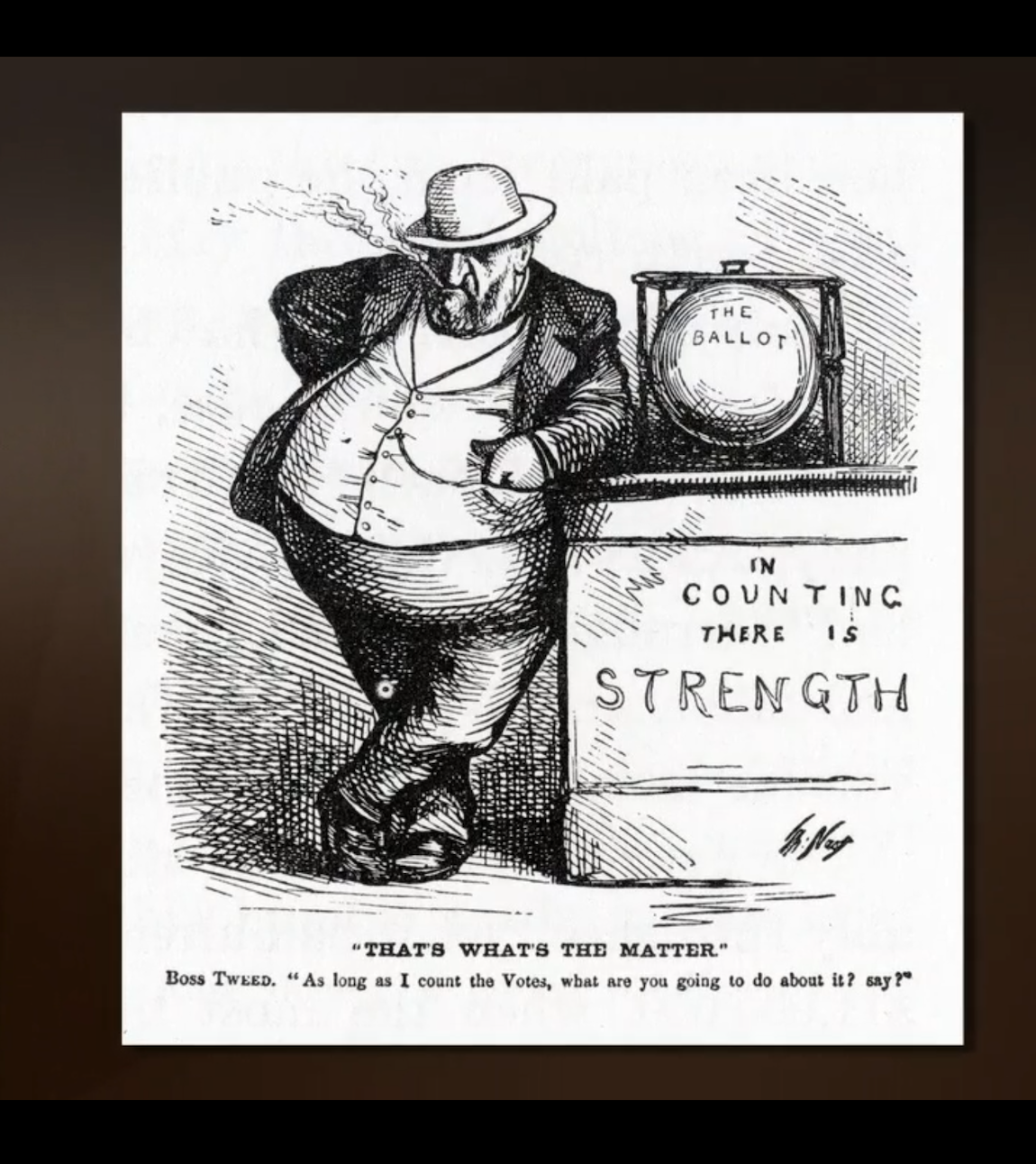
As a social studies educator, perhaps I should have already known this; but it was news to me. I’m talking about the etymology of the word ‘ballot.’ While watching an episode from the Great Courses class on Turning Points in American History (#15 Expanding Universal Suffrage), the instructor mentioned that the word ‘ballot’ comes from the Italian word meaning small ball. In that time and place people voted with small colored balls, often white or black. I had never connected the word ‘ball’ with the word ‘ballot’, despite their obvious similarity.
In the United States, up until the early 20th century, people voted publicly, though usually with colored paper, not small balls. The wisdom of the Australian Ballot eventually became clear and states learned to make voting private. Good move. Thanks, Australia!
Thinking about all this, it occurred to me that perhaps the word ‘bullet’ also derived from the same root, since bullets used to essentially be small balls. The word ‘bullet’ apparently comes from the Middle French word boulette, also meaning “small ball” or “small pellet.” This was a diminutive of boule (ball). So, same original meaning, but different language. Digging further, it appears they do both have the same root, descending from the Vulgar Latin word balla, which means ‘ball’. Makes sense.
Did Boss Tweed know any of this? Not likely.
Update to My Daily Wisdom Reminder Protocol
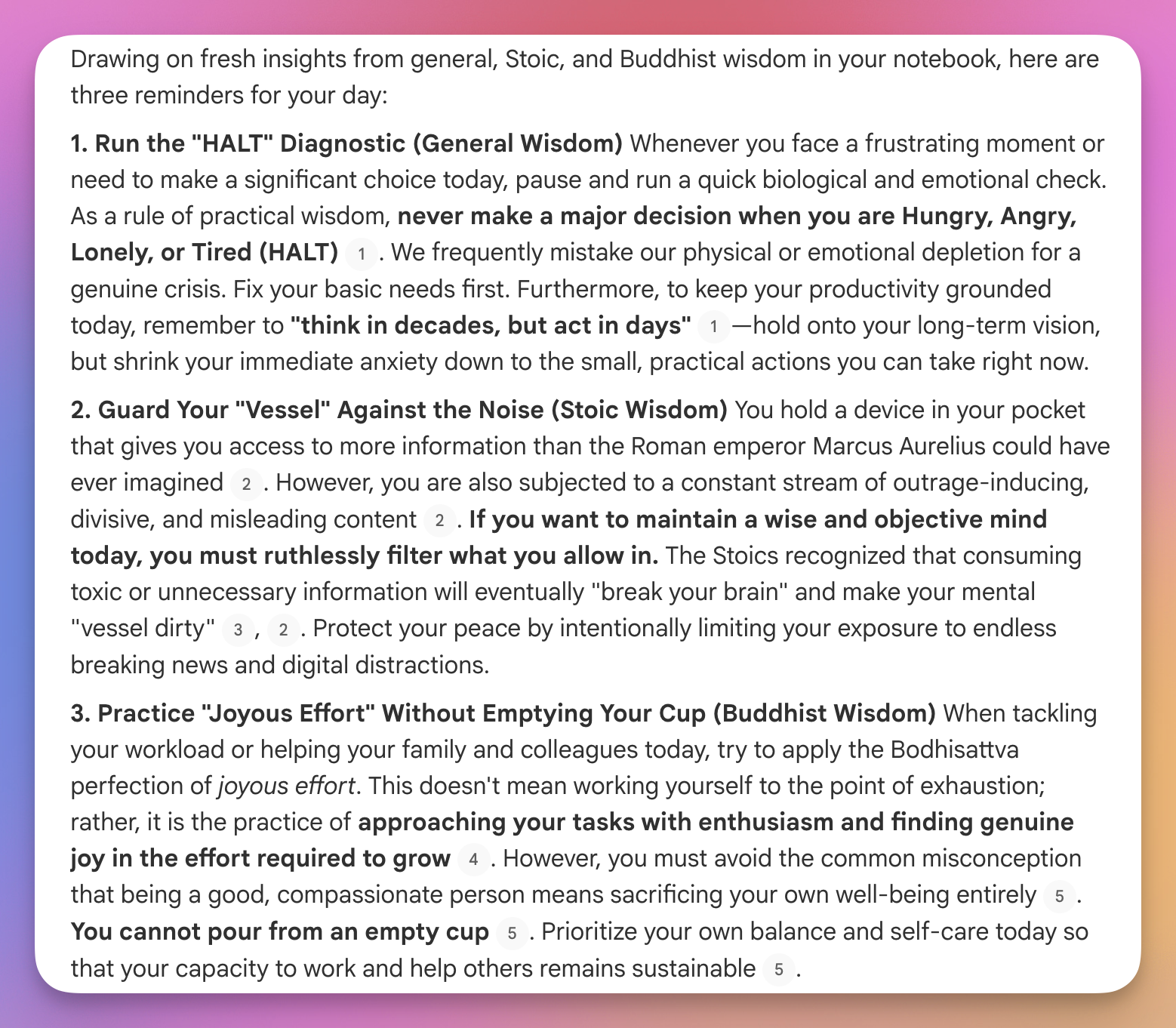
I shared before that I use Notebook LM (on most days) to provide myself with highly curated daily reminders. Yesterday I spent some time building a new Notebook LM that includes curated ‘reminders lists’ from smart people like Morgan Housel. I then used Notebook LM to distill the various lists into a ‘study guide.’ I then shared that study guide with my already created ‘Buddhist and Stoic Wisdom" notebook that I use for my daily reminders.
When asking for reminders today I asked that it included a newly added ‘general’ reminder, pulled from the study guide I created. Below is a screenshot of today’s reminder output. I’m pleased with the result and look forward now to getting 1) a general life reminder, 2) a Stoic wisdom reminder, and 3) a Buddhist wisdom reminder.
As I said before, a lot of people will likely find this practice useless and a waste of time. However, I need the constant drip-drip of wisdom or wisdom doesn’t sink into my mind. Current consensus about learning supports my practice, particularly around the benefits of spaced repetition.